

Meet Your All-Stars
And Play Bingo!

It’s NBA All-Star weekend! The festivities kick off tonight with the Shooting Stars, Three-Point, and Dunk contests, with the headline game confusing round-robin tournament pitting Team(s) USA against Team World tomorrow. Selection to the All-Star team was based on a combination of fan, player, and media voting, topped off with selections from coaches around the league and ultimately injury replacements tapped by Commissioner Adam Silver himself. Here’s where we landed for 2026.1
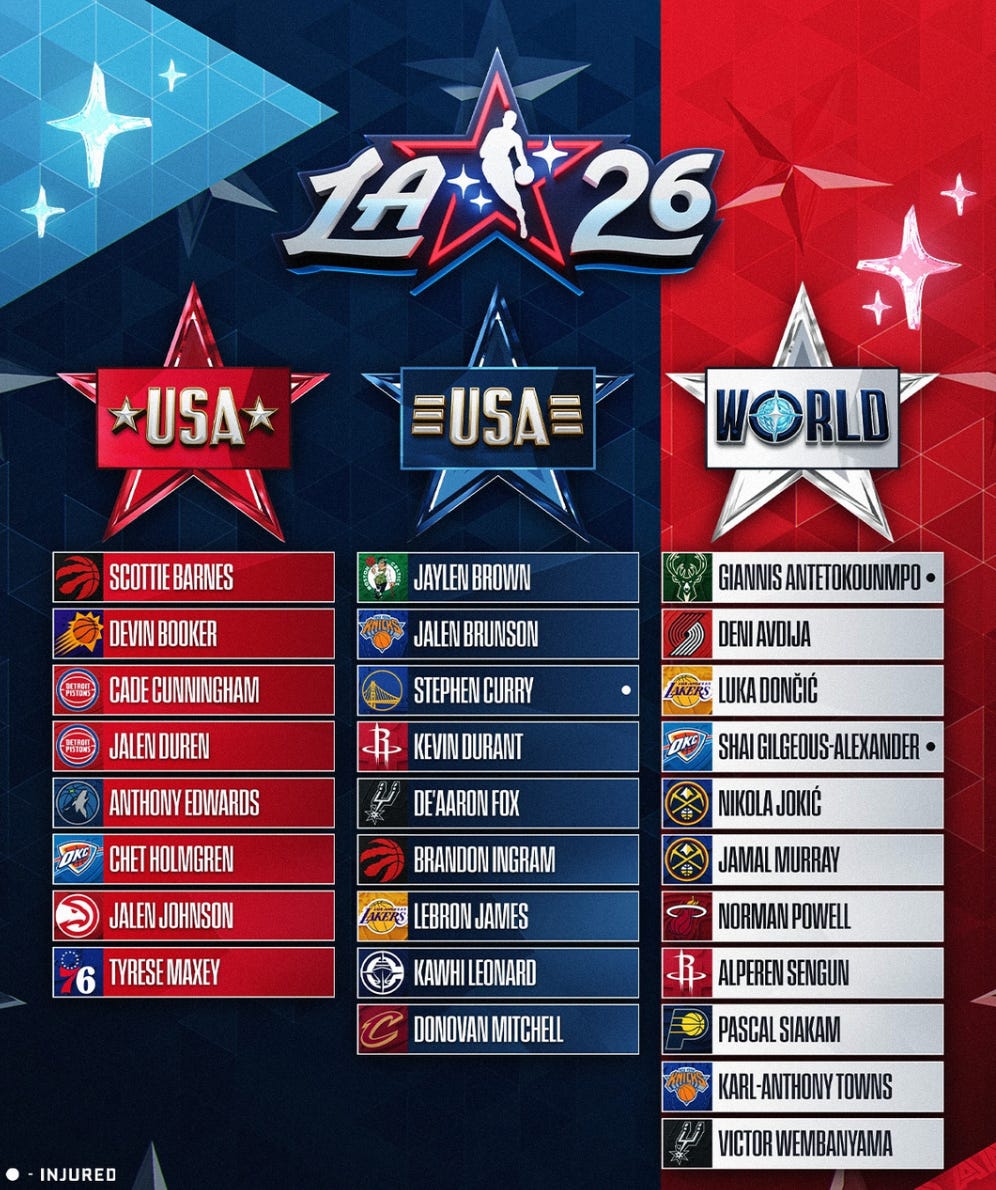
LeBron James makes his 22nd consecutive All-Star game, extending his NBA record, while Kevin Durant will now have the fourth most appearances at the midwinter classic all time.
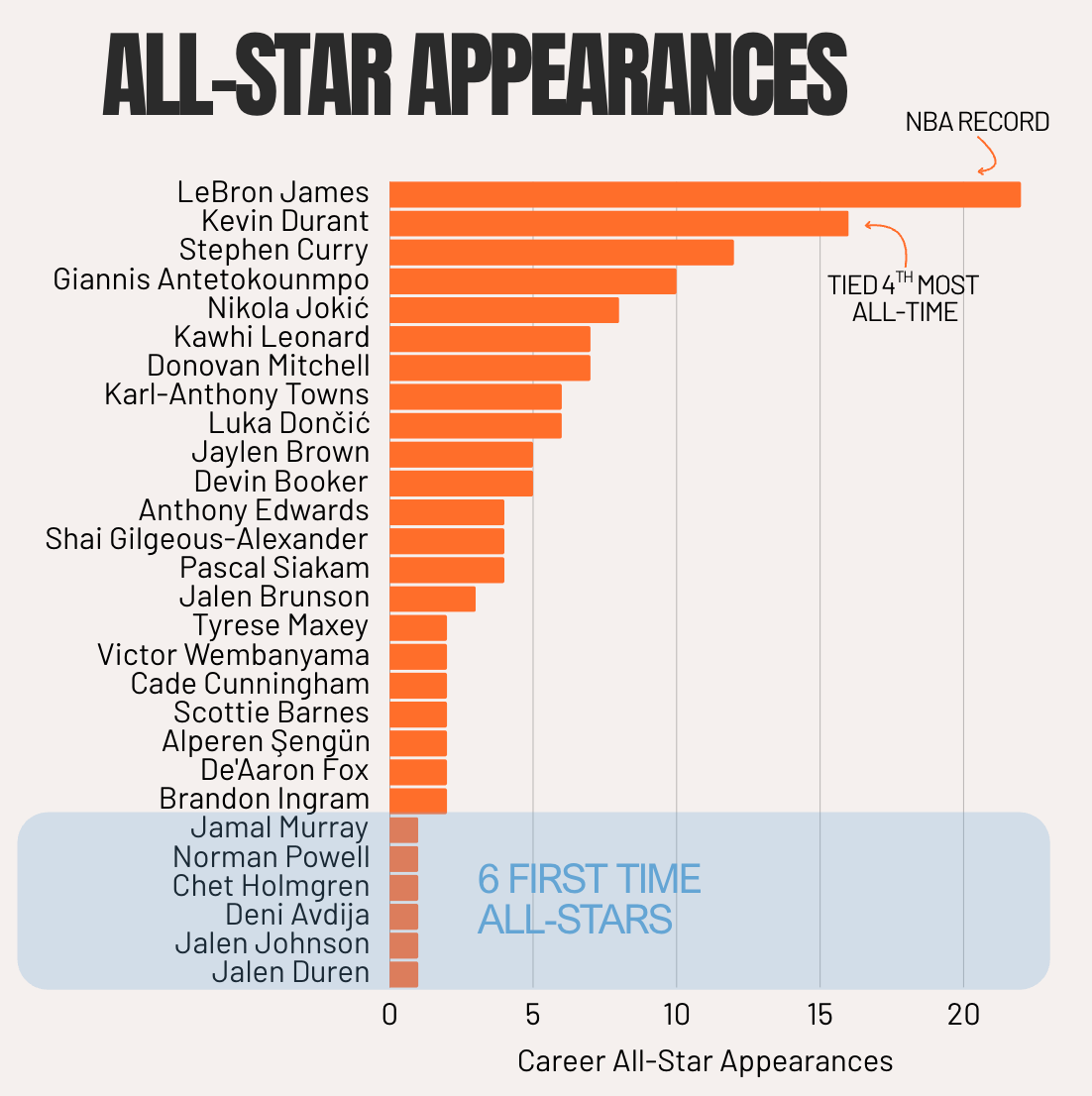
On the other end, we have six first-timers, including Norm Powell who made the team for the first time after 11 NBA seasons.
The Counting Stats
These are all very different players. Stephen Curry is a foot shorter and 15-years older than Victor Wembanyama. Deni Avdija drives everything for his team while Jalen Duren has (fellow All-Star) Cade Cunningham to do that for him. Jamal Murray and Chet Holmgren are both sidekicks, who complement their MVP teammates in very different ways.
Statistically though, all All-Stars have at least two things in common: they dominate the ball and score a lot.
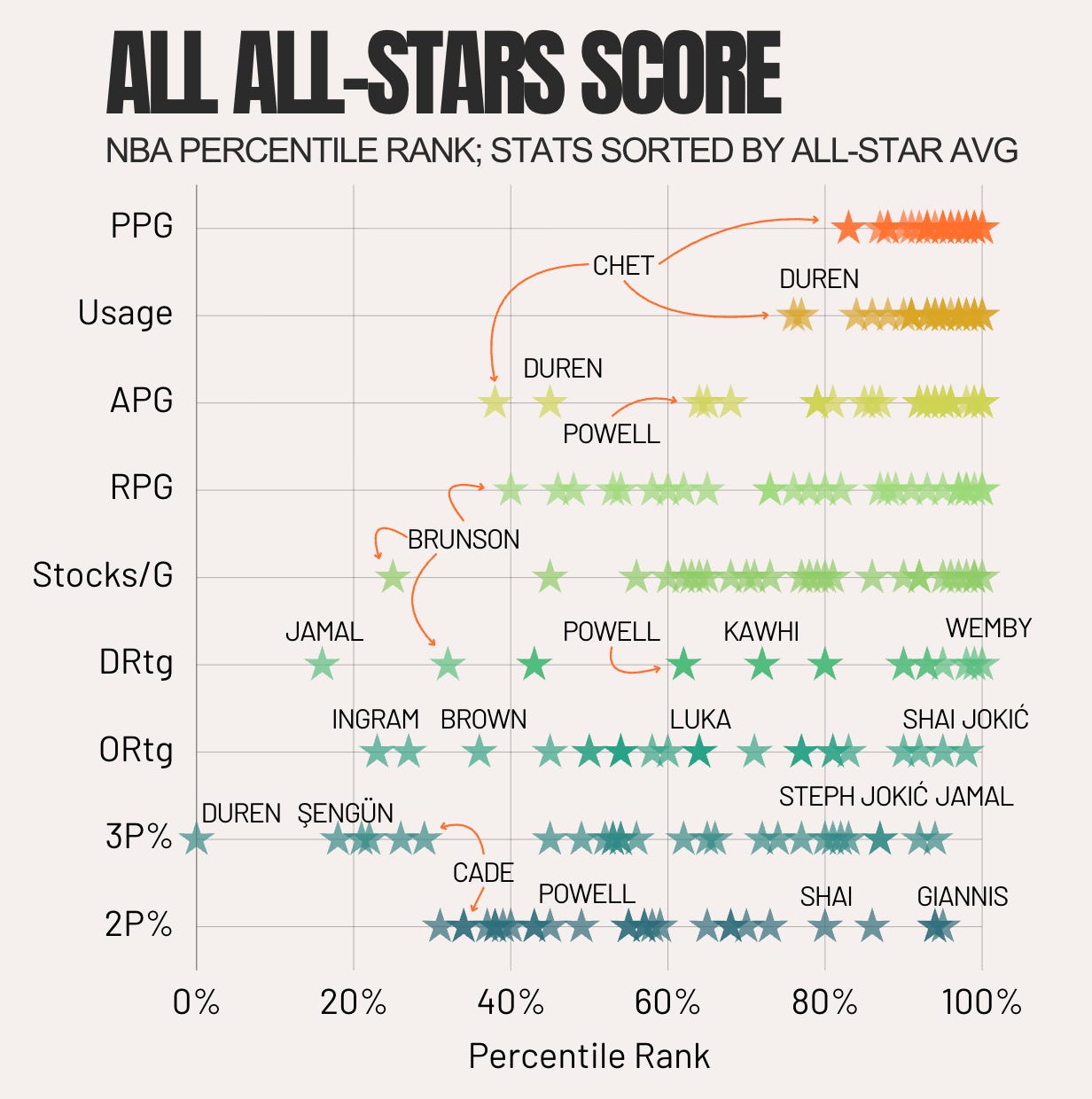
Of course, that makes sense. These guys are the best players on their respective teams (unless teammates both make it, in which case they are the second best), and it’s typically a good strategy to give the ball to your best players and tell them to score.
Except for Chet Holmgren and Jalen Duren (who’s teammates Shai Gilgeous-Alexander and Cade Cunningham are the two best Point Guards in the league), every All-Star is in the top 20th percentile in usage rate, and most are in the top 10%. The highest usage non-All-Stars are Joel Embiid, who quietly controls 34% of the Sixers’ possessions when he’s on the floor, and LaMelo Ball who loudly controls 32% of the Hornets’ possessions.
Every All-Star, even Chet, is in the NBA’s top quartile in scoring and all 10 of the league’s top scorers made it.2 Most All-Stars are also good passers (again, except Chet and Duren - more on them later), but beyond usage, scoring, and assists, the stats begin to spread out.
Cade is probably the worst shooter in the group, but he’s not alone. 11 All-Stars are below league average in two-point percentage including Devin Booker, Jamal Murray, Jalen Brunson, and Jaylen Brown. That’s a bit unfair however, as it doesn’t account for volume of shots, or the level of defensive attention they attract, being All-Stars and all.
The group is slightly better, relative to the rest of the league, at making threes vs twos, even with five players shooting under 33% (including three-point contest entrant Devin Booker) and Duren not even attempting a single three all season. The two best three-point shooters by percentage are on the same team, in Murray and Nikola Jokić.
The All-Star game isn’t known for featuring hard-nosed defense (unless you’re Kobe Bryant), which is reflected in the players’ defensive stats. A handful of the 26 selections are below average in rebounding, stocks (steals + blocks), and overall defensive rating. Jalen Brunson stands out here; it’s hard to be 6’2” in a land of giants.
That said, as a group the 2026 All-Stars actually have a better rating on defense than they do on offense. Returning to Chet and Duren, while they aren’t at the same offensive level as their fellow All-Stars, they are monsters on defense - both in the top 10 in the NBA in points allowed. Victor Wembanyama is, of course, first.
None of the All-Stars have to exert their anaerobic capacity much on defense though.
The Speeds
A couple of months ago, while pulling the data for my piece on Copycat Candidates, I noticed something surprising. Anthony Edwards, a 24-year old freak athlete, is one of the slowest defenders in the NBA. A guy who probably believes he could beat both Tyreek Hill and Noah Lyles in a footrace is moving at about the same speed as Jokić and Luka Dončić, two guys who are, let’s just say not the fastest guys in the league.
It’s not just Edwards, Jokić, and Dončić. The whole All-Star team is slow!
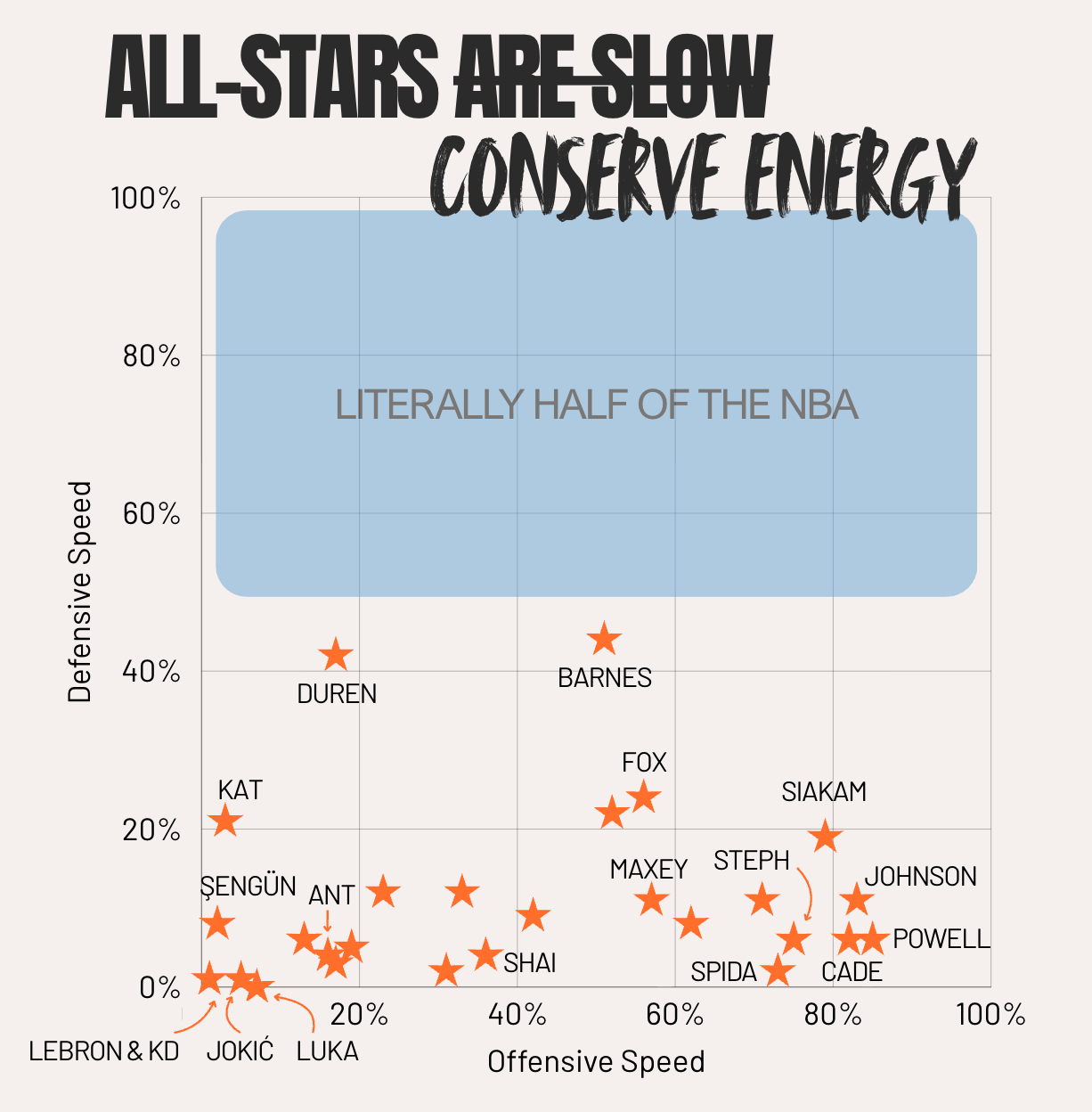
Scottie Barnes and Duren move around the most on defense, but even they are in the bottom half of the league. Now, I know this isn’t because All-Stars are actually slow, and I would like to watch Ant challenge an Olympic sprinter. Instead it highlights how much these stars rest on defense, in order to handle their offensive load (as seen in the usage stats from above).
A handful of the All-Stars do move much faster on offense, led by big, drive-first guys in Powell, Jalen Johnson, and Cade. Guards who rely on off-ball movement (Steph Curry, Donovan Mitchell, Jalen Brunson) also rank highly in offensive speed.
But even on offense, Ant still plays slow. He controls the action on his own terms, not letting the defense or his teammates speed him up. Luka and Jokić are even clearer examples of playing at their own pace, using their size to create advantages again and again.
Then you have LeBron and Kevin Durant who are simply too old for this.
The Advanced Stats
All-Stars fill up the box score - that’s what most fans consider when they make their votes. But not all have the actual impact that the box score numbers say they do.
The 2x2 below shows each player’s Game Score on the x-axis and DARKO rating on the y-axis, both as percentiles relative to the full NBA. The descriptions of these stats are in the footnotes,3 but all you really need to know is that the farther right a player is the more they pad the box score (points, rebounds, assists, blocks, steals, etc.) and the farther up a player is the more impact they have on winning. The dotted, 45 degree line is where the counting stats and advanced line up.
Players like Jokić, Shai, Kawhi Leonard, and Wemby are clustered in the upper right, all near the top of the league no matter what stats you look at. But other players are far away from that dotted line, reflecting a significant difference between box score and DARKO.
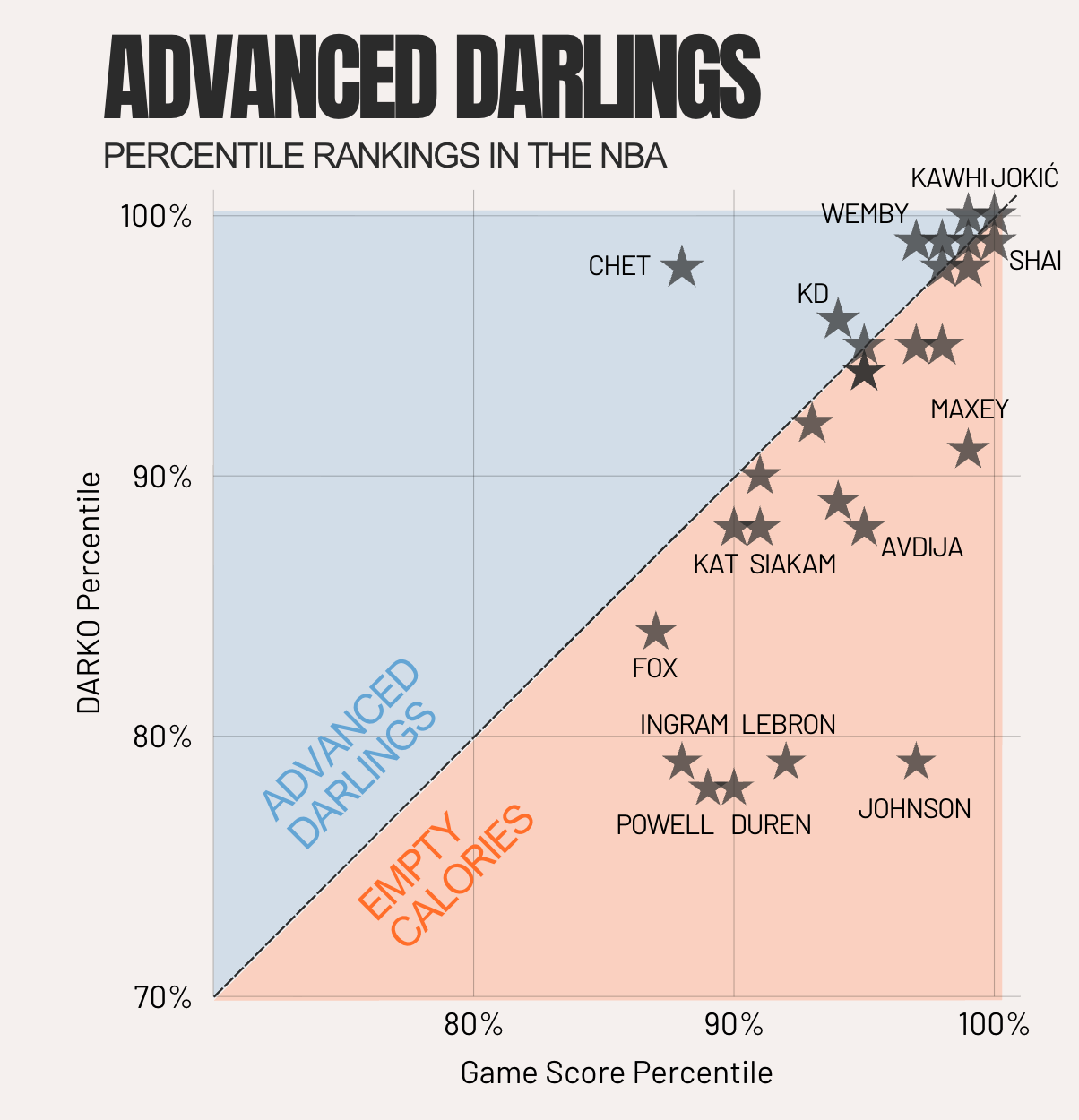
On the positive side, the advanced stats love Chet Holmgren. He has the single lowest game score among All-Stars (as we saw earlier, he is near the bottom in points and assists), and yet by DARKO is among the top 2% of players in the league.
Most of that comes from his defense. He’s contested the fifth most shots in the NBA, is second in blocks, and opponents shoot 7% worse when he’s the closest defender. He’s even better defending the paint; on shots within six feet of the basket, opponents shoot 14% worse against Chet than they otherwise would against an average defender. Plus, he protects the basket without fouling. It helps that he plays on the best defense in the league, but he is also a big part of what makes the Thunder so great.
On the other side, the advanced stats do not do Norm Powell or Jalen Duren any favors. Powell is a negative to neutral defender, and has been most of his career, but the advanced stats don’t even like his offensive production that much. He’s averaging a career high 23 points per game, but on reduced efficiency, and he doesn’t generate points for others, averaging just 2.6 assists per game, lowest amongst the All-Stars.
The advanced stats think Duren is just mediocre on offense and defense.4 It’s important to note however, that DARKO is a longer-term stat, while All-Star selections are based on a player’s performance through the first 40-odd games of a season.5 It’s possible, and likely, that DARKO will eventually catch up to the leaps Duren and Powell, both first-time All-Stars, made these last few months.
And none of this is to say any of these All-Stars are not deserving of the game. The stats and speeds are one thing, but narratives often do, and maybe should, count for more. After all, we want to see our favorite players in this exhibition, and favorite usually doesn’t mean best DARKO.
I’ll be expanding this “advanced darling” analysis to the rest of the league in next week’s post. Make sure to subscribe to get that and all the Charting Hoops content.
The Contests
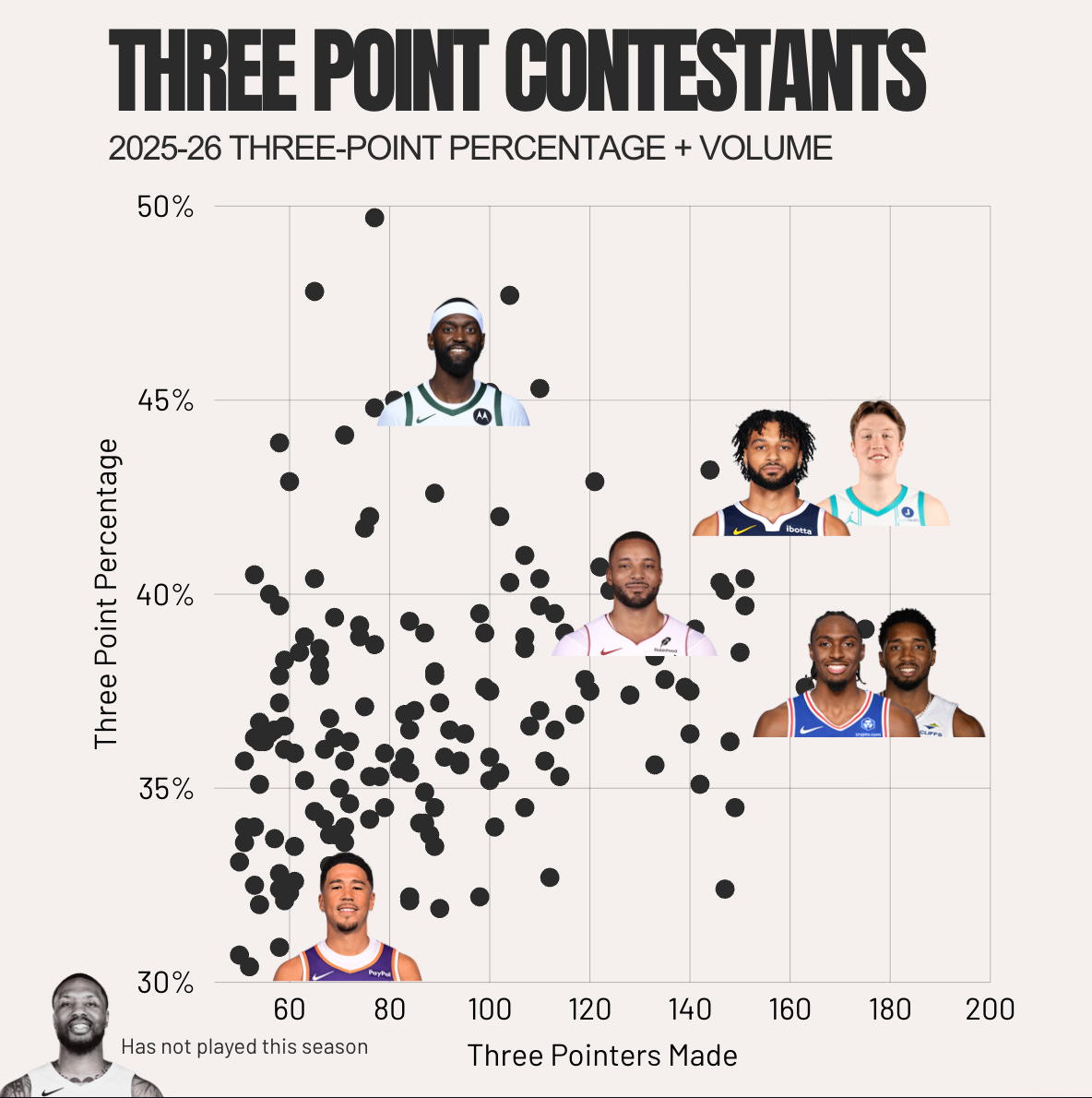
I did want to quickly mention the events tonight, namely the Three-Point and Dunk Contests.6 The Three-Point Contest should be a good one, as it features some of the best shooters in the league, as well as Devin Booker. Here’s every player in the NBA who’s made over 50 threes with at least a 30% success rate, with the contestants highlighted.
The Dunk Contest roster is a little more, uh, underwhelming. Jaxson Hayes is fine I guess. He pulled off a between the legs dunk in a live game and that wasn’t even his best dunk of the year by dunk score.
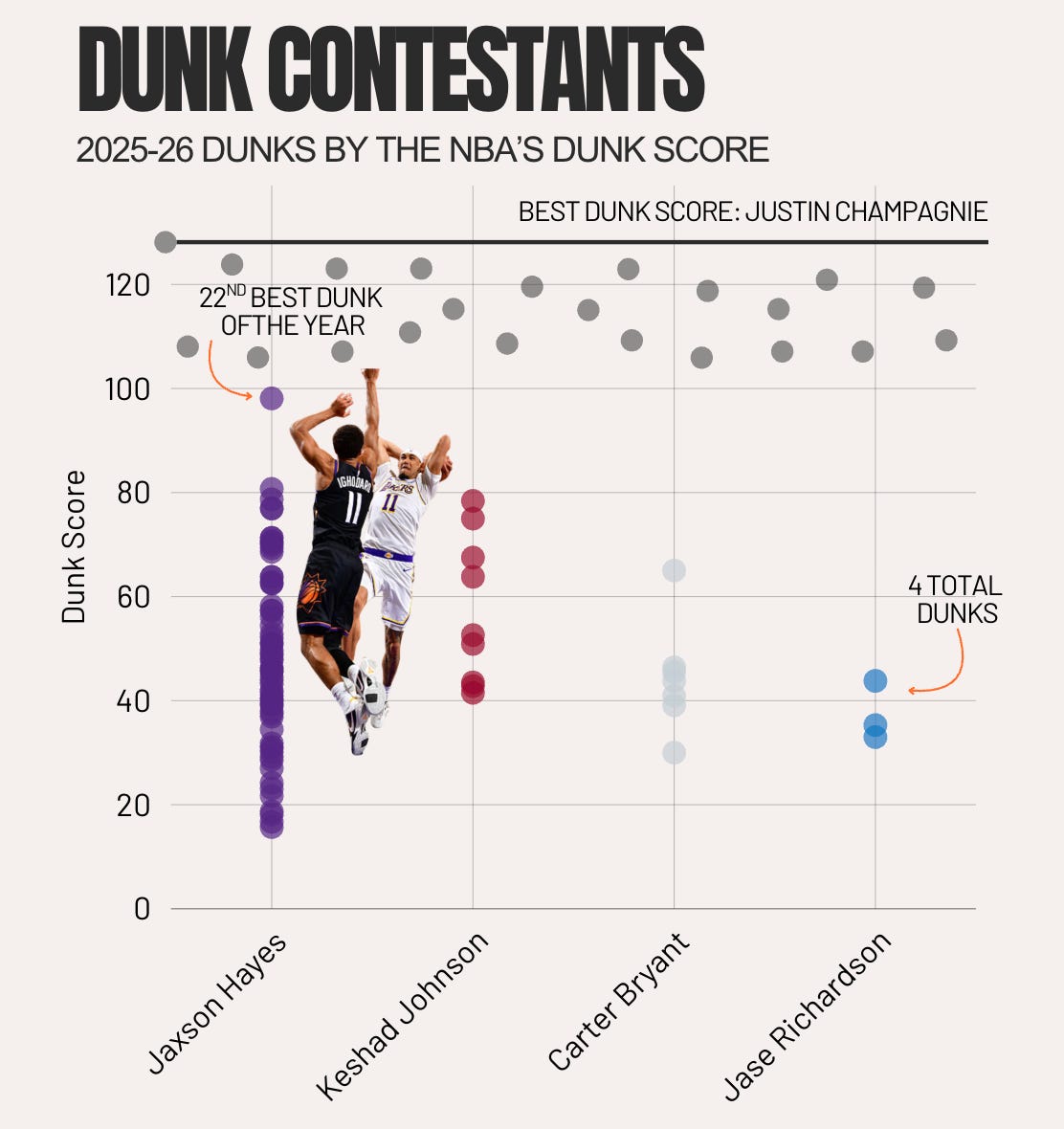
He’ll be competing against Keshad Johnson, Carter Bryant, and Jase Richardson who have dunked a combined 19 times this entire season, none of which were particularly impressive. Hopefully they’ll be able to do something we aren’t expecting in this format!
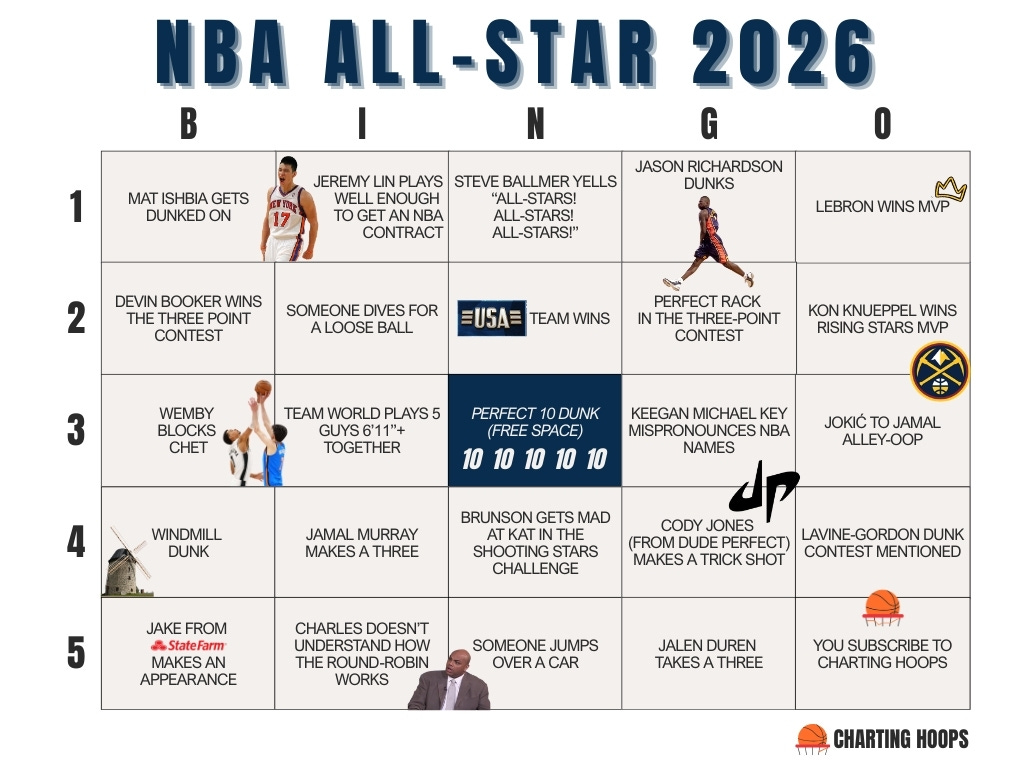
Bingo!
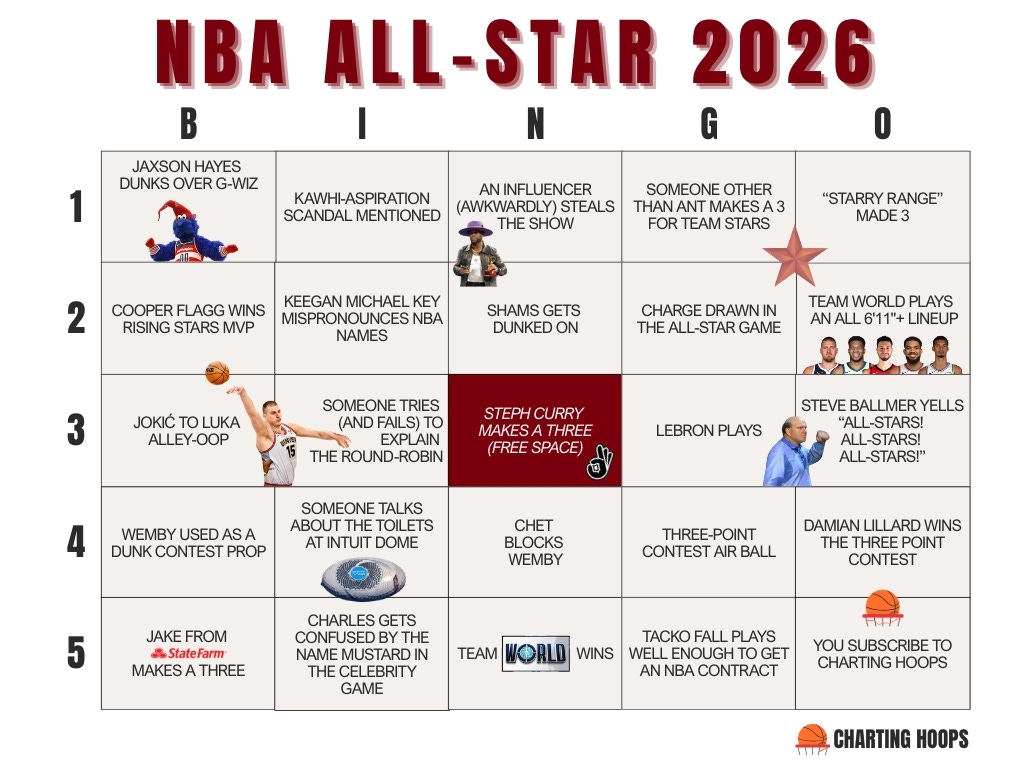
Finally, as you watch the weekend’s events, why not play Bingo!
Pending future injury replacements.
Lauri Markkanen of the tanking Jazz is the NBA’s top scorer not on the All-Star team.
The formula for Game Score is Points + 0.4 * Field Goals Made - 0.7 * Field Goals Attempted - 0.4*(Free Throws Attempted - Free Throws Made) + 0.7 * Offensive Rebounds + 0.3 * Defensive Rebounds + Steals + 0.7 * Assists + 0.7 * Blocks - 0.4 * Personal Fouls - Turnovers. The formula for Darko is way more complicated.
If we were going solely by the numbers, Rudy Gobert probably takes Duren’s place.
Unless you’re LeBron.
There’s also the Shooting Stars Challenge, but honestly I don’t remember what this is. When did they get rid of the Skills Challenge?
This is killer work, my friend.
Great analysis. Voters being biased towards offense makes sense due to the nature of the All-Star Game. This helps me understand why Derrick White was snubbed despite his top-tier marks in EPM and LEBRON.