

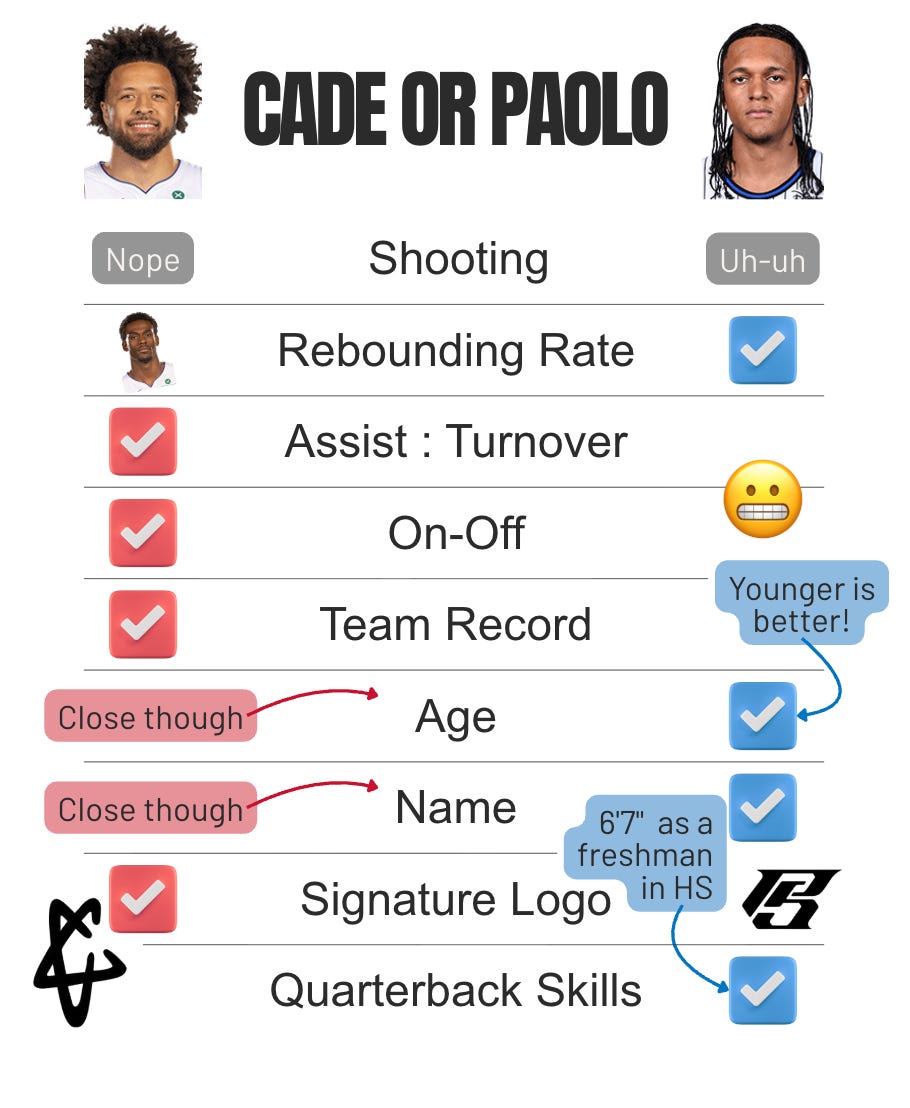
Cade or Paolo?
Two Roads Diverged in an NBA Woods

Cade Cunningham.
Paolo Banchero.
Two top draft picks. Two guys whose reputations were built on an amorphous sense of “potential”. Two guys now in the “prove it” phase of their careers. One is shining on the brightest stage. The other remains an unpolished diamond.
Cade Cunningham. Paolo Banchero. Who would you rather start a team around? This has become a self-evident question. Cade is a First Team All-NBA candidate; Paolo may not even be the best player on his team. But this was a serious question not long ago.
I had originally planned to research, write, and publish this piece in October, before the NBA season started. Then I got swept up in jersey deep dives and it fell off my calendar. I’m grateful it did, because I probably would have picked Paolo and proceeded to look very, very wrong.
There were very real arguments for Paolo, and I would have had plenty of company in my wrongness. Before getting into that debate, let’s take a step back. Why am I comparing these players at all?
Elite Prospects
Cade and Paolo would each go first in the NBA draft, back-to-back in 2021 and 2022. Every path to the NBA is different but before Commissioner Silver called their names on draft night, there were similarities between these two players.
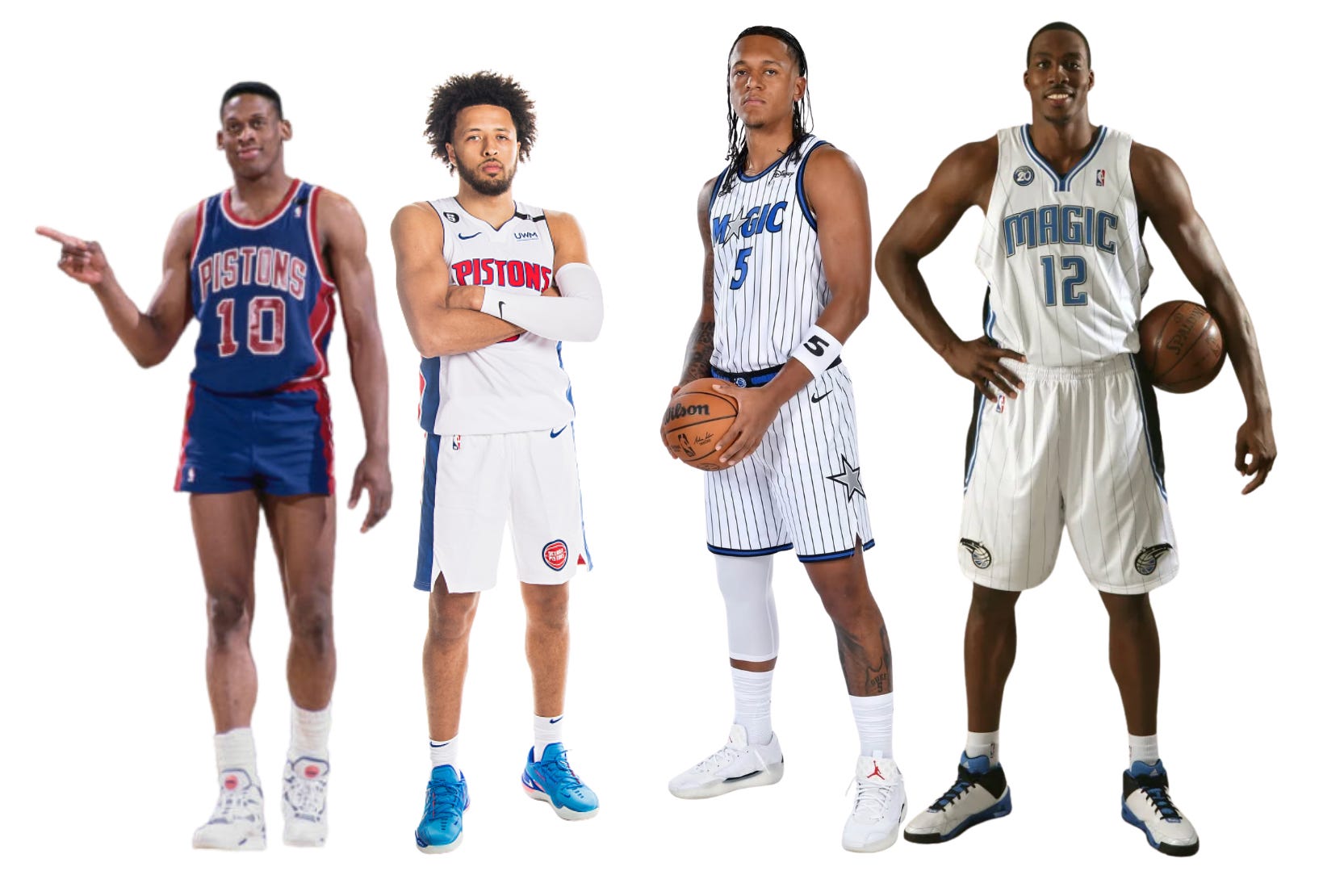
For starters, both were (and are) big players at their respective positions. Cade is a shifty Point Guard with great handles, who happens to be almost exactly the same size (6’6” 220 lbs) as Dennis Rodman. Paolo was already taller than both of them as a freshman in high school, and he’s topped out at 6’10”, 250 lbs. That roughly matches the profile of Dwight Howard, one of the most physically domineering players the league has ever seen.
Perhaps unsurprisingly then, both were elite prospects from an early age and had the opportunity to play at the best programs in the country. Paolo stayed local for high school - he played for O’Dea in his hometown Seattle and won Washington state’s Gatorade Player of the Year - but then chose Duke for college, the bluest of blue-blood programs. Four of his Blue Devil teammates would eventually play in the NBA.
Cade made his move away from home earlier, transferring from the local Texas high school he attended for freshman and sophomore years to Montverde, an NBA breeding ground.1 Since he’d already had the experience of sharing the court with NBA-level talent, when it came time to pick a destination for his obligatory college season, Cade opted for relatively unheralded Oklahoma State, as the highest recruit in school history.2
Despite playing alongside and against future NBA players in high school (Cade) and college (Paolo), they were always the guy; both Cade and Paolo were always the best player on every basketball team they ever played on. Actually, they were the guy on every basketball team they ever played on. Both were quarterbacks on their high school football teams.3
Both decided to put down the pads and focus solely on basketball, and both entered the NBA as number one overall picks, in back-to-back years. Paolo’s pre-draft comps included Blake Griffin, and he’s since been compared to a bigger Kobe and LeBron. Cade was compared to Luka Dončić.
Both were drafted to historically great franchises, who hadn’t been good in over a decade. The Pistons and Magic were together at the very bottom of the Eastern Conference in the years Paolo and Cade were finishing high school and playing in March Madness. In a weird coincidence, the Pistons won 27% of their games the season before drafting Cade (20-52 in the Covid-shortened 2020-21 season) and the Magic won 27% of their games the season before drafting Paolo (22-60).
As a result, Cade and Paolo continued to be the guy on their teams, even at the highest level of basketball in the world. Cade’s best teammate his rookie year was probably a 27-year old Jerami Grant, while Paolo’s was, I guess,4 second-season Franz Wagner. They were each heralded as their franchise’s savior, and handed the keys to the team.
The similarities pre-NBA are numerous - I didn’t even mention that both have all-time great mononymes5 - and would continue through their first few years finding their ways in the league.
Growing into their Potential
Cade had a one-year head start in the NBA (during which he averaged 17 points, 6 rebounds, and 6 assists and finished third in Rookie of the Year voting),6 but from there the pair had a very similar trajectory up the NBA pecking order.
Starting with the stats (this is Charting Hoops after all), the progression in points per game was almost identical, and a positive sign that they were figuring out how to score against NBA defenses.
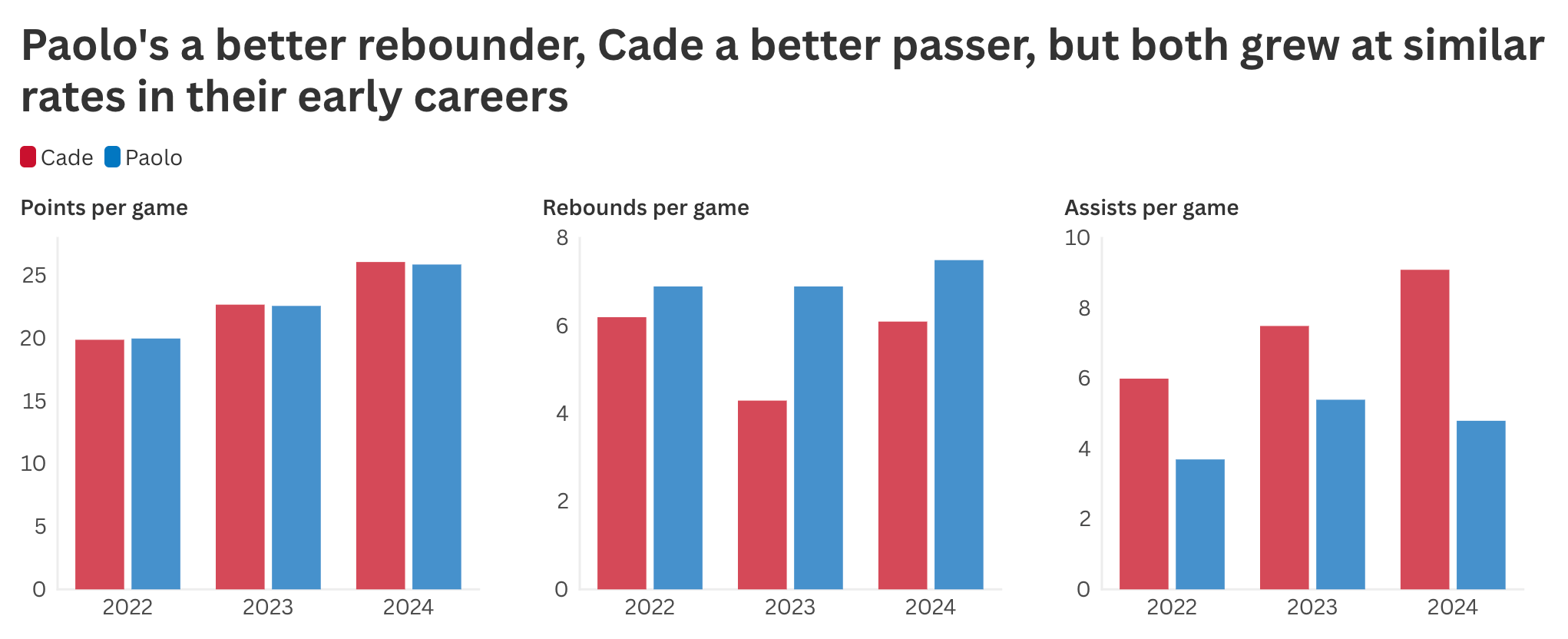
Paolo and Cade are both “do it all” players,7 but Paolo, with his Dwight Howard frame, has always been the better rebounder, and Cade the better passer. In addition to the step ups in scoring, we can see each player improving in their respective domains season after season in the middle and right charts above.
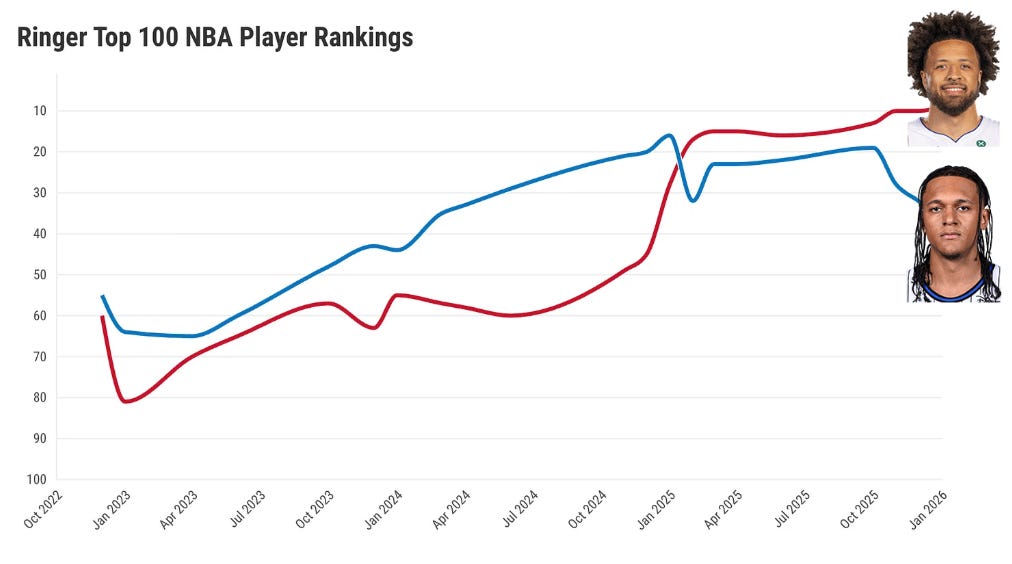
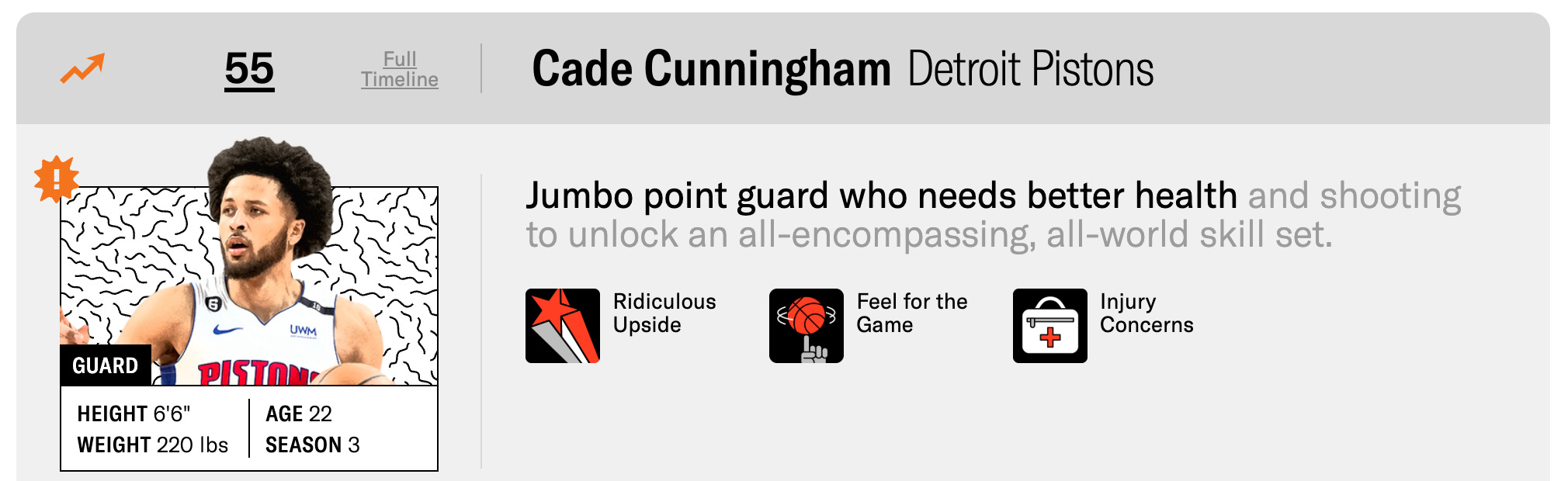
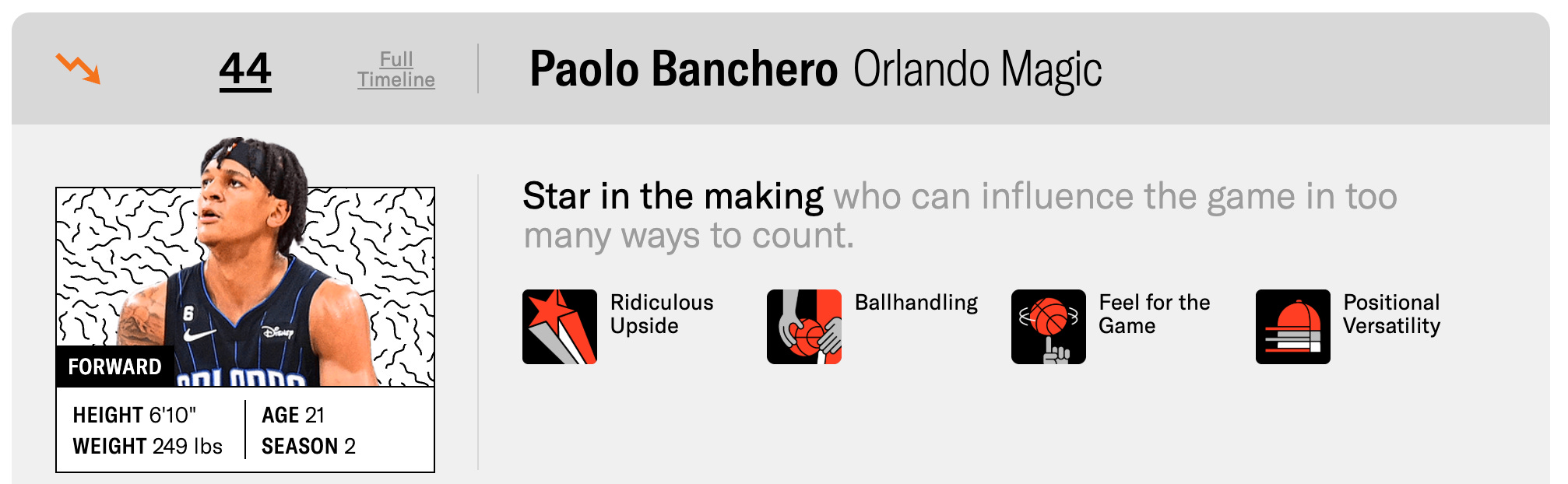
As a result, the more qualitative rankings had these guys higher and higher as the months went on. The chart at the top of this article shows the upward trajectory for Cade and Paolo in the Ringer Top 100 over this period. Here’s what the Ringer had to say about them in December 2022.
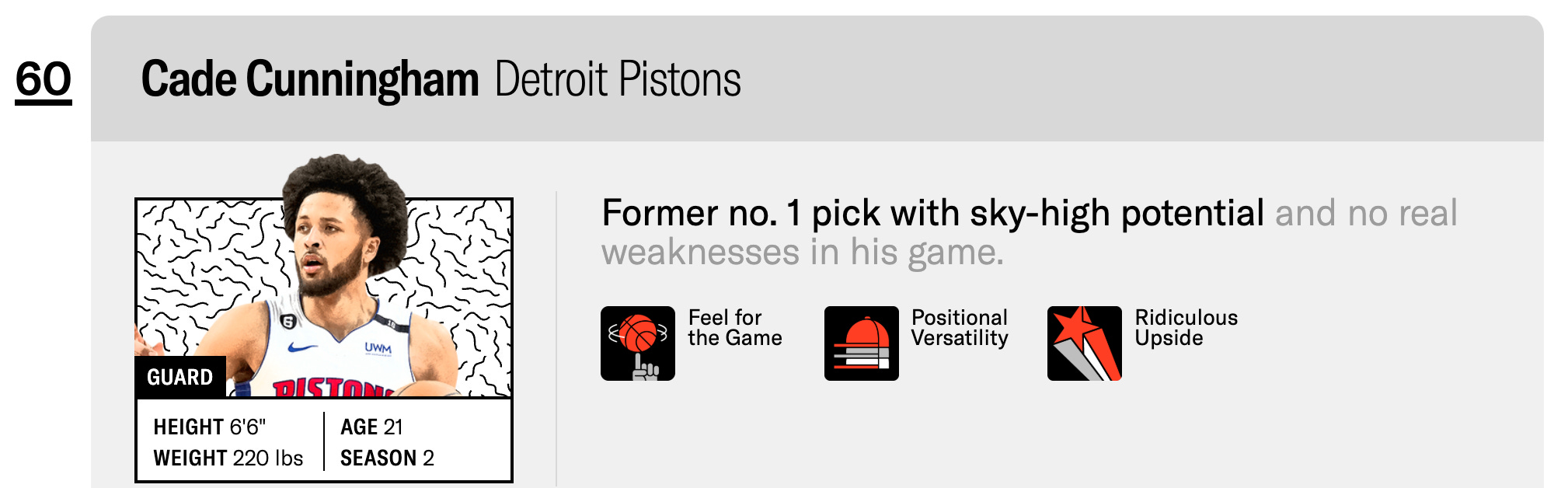
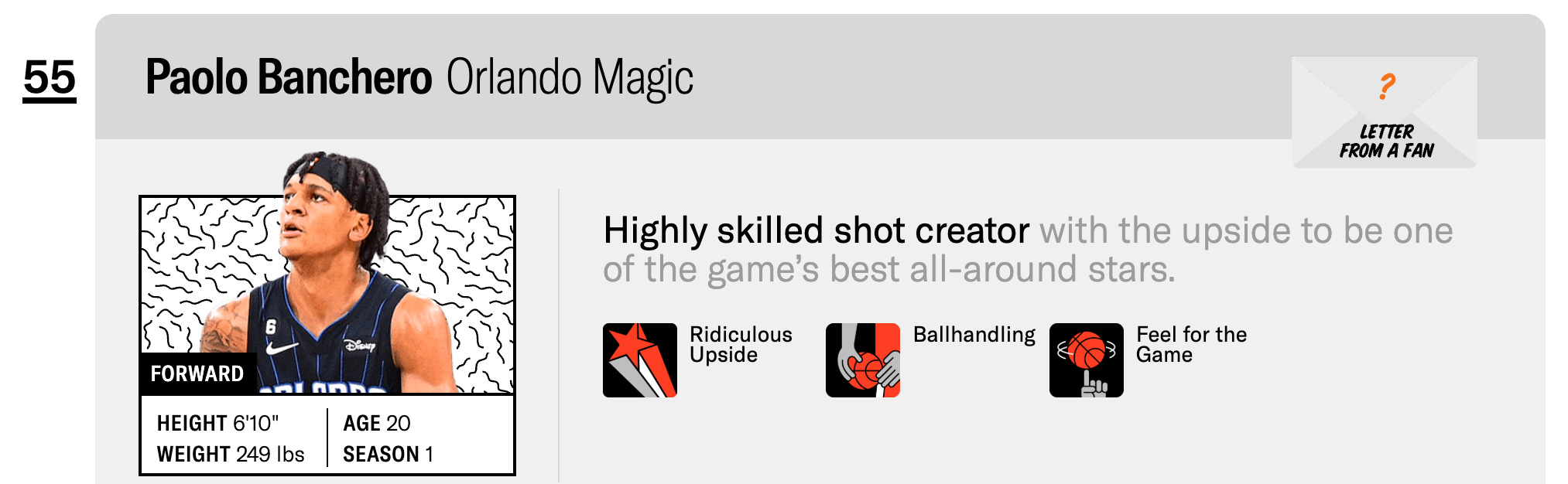
And in January 2024. Note the “Ridiculous Upside” stamp is still there for both.
Another, indirect, way to measure growth is by seeing which players their games resembled.
Using Neil Paine’s similarity index, we can see which former NBA players Cade and Paolo played most like, year by year. The comps clearly get better as time goes on, from some Sixers Rookies in their respective rookie seasons, to mid-2010s role players, to legit NBA starters.
It’s worth noting that despite Paolo’s higher Ringer ranking, Cade’s most similar players were significantly better than Paolo’s during these early years. The jury was still out.
Fatal Flaws
While both players were clearly improving, fans and the media were starting to get antsy. Several years into their careers, the discussion around these guys was still all about potential, with a growing dose of criticism. Tired of waiting for the potential to play out, some started looking for, and finding, the devil in the (analytical) details. Even the critiques were similar for Paolo and Cade, and mostly came in the following forms.
“The counting stats are propped up because they dominate the ball.”
Paolo and Cade were in fact fifth and sixth in the NBA in usage rate last season. Both were north of 33%, above guys like Anthony Edwards, Ja Morant, and Steph Curry.
“They’re inefficient.” (i.e., they can’t shoot)
Over this three season stretch from 2022-23 to 2024-25, Paolo Banchero has the single worst effective field goal percentage (49%) among the 55 players to average 15 or more field goal attempts per game. Cade isn’t much better, landing 47th, and he posted the second worst mark in a single season.
“They turn the ball over too much”
Cade turned the ball over four times per game over the last three seasons, second most of anyone in the NBA, and posted a lower assist ratio than all of the other high-turnover Point Guards. Paolo turns the ball over three times per game, against just five assists.
“They don’t win and [in Paolo’s case] their team is better without them”.
From the 2023-24 season (when the Pistons won just 14 games) through last year, Cade posted a -3 net rating. Of course, most of that was due to the very young and bad team around him, and he did have a +5 on-off figure. Paolo, on the other hand, has a -5 on-off, meaning his team gains five points per 100 possessions when he sits on the bench.
While both have made, and played well in, the Playoffs neither has made it out of the first round, even though they’re both in the “wide-open” (aka worse) Eastern Conference.
Despite the (often valid) criticism, Cade and Paolo continued to be viewed as elite talents and kept climbing up the NBA hierarchy. Cade made an All-NBA team last season and Paolo may have joined him if not for an oblique tear that kept him out half the season.
The narrative settled into something along the lines of “flawed when you dig into the numbers, but they have the potential/raw athleticism/flashes of brilliance. If they could just sharpen up on the margins, they’ll be top 10 players, maybe even MVP candidates. If not …”
2025-26: Divergence
Before the season started (and remembering that Paolo is a year younger with a year less NBA experience), I may have picked to start a team with Paolo over Cade. I wouldn’t have been the only one in that camp.
ESPN had Paolo third on their list of 25 players under 25, while Cade was 13th. That has exactly flipped in the most recent iteration.
Above the Break ranked Paolo the fifth best Power Forward8 in the league, only behind Giannis, Jayson Tatum, Evan Mobley, and Kevin Durant. He had Cade eighth amongst Point Guards.
Several Ringer folks picked the Magic to make the Finals, with Paolo as their leader.
Yet, at least for the season to date, we would have been wrong.
Early on, neither player looked like they were going to have a particularly promising year. The Pistons started with a 2-2 record, four games in which Cade turned the ball over 22 times and shot 36% from the field.9 It seemed like empty calories once again.
Meanwhile, Paolo’s Magic started the season with one win in their first five tries as Paolo shot 40% overall and just 15% from three. He picked it up a bit to help get the Magic back to 0.500, before a groin strain sidelined him for 10 games.
Thankfully for the Magic, but worryingly for Paolo, the team went 7-3 with their star on the bench. That inevitably brought back the “Paolo makes the Magic worse” talk. It’s becoming harder and harder to argue against that; the stats simply aren’t there.
Neil Paine has Paolo as the 105th best NBA player. Cade’s 8th.
ESPN has Paolo even lower at 116th. Cade’s tied for 6th.
By any of the numbers, Paolo is a slightly-above-average NBA player this season. Cade is knocking on the door of the top 5%.
While Paolo recovered from his injury, Cade leveled up his game and took his team to the top of the league. The Pistons rattled off 13-straight wins after their slow start, and now sit comfortably atop the East with a 36-12 record.
Returning to the similarity index, Cade is playing like late-Pelicans era Jrue Holiday, who averaged 20 points, 8 rebounds, and 5 assists per game and made Second-Team All Defense.
Paolo is still playing like a 30-year old Luis Scola. That’s the second straight year for Paolo-Scola comps, highlighting the glaring development plateau.10 In fact, if we allow self-comparisons Paolo’s actual most similar player this season, from everyone that has ever played in the NBA since the merger, is Paolo Banchero last season.
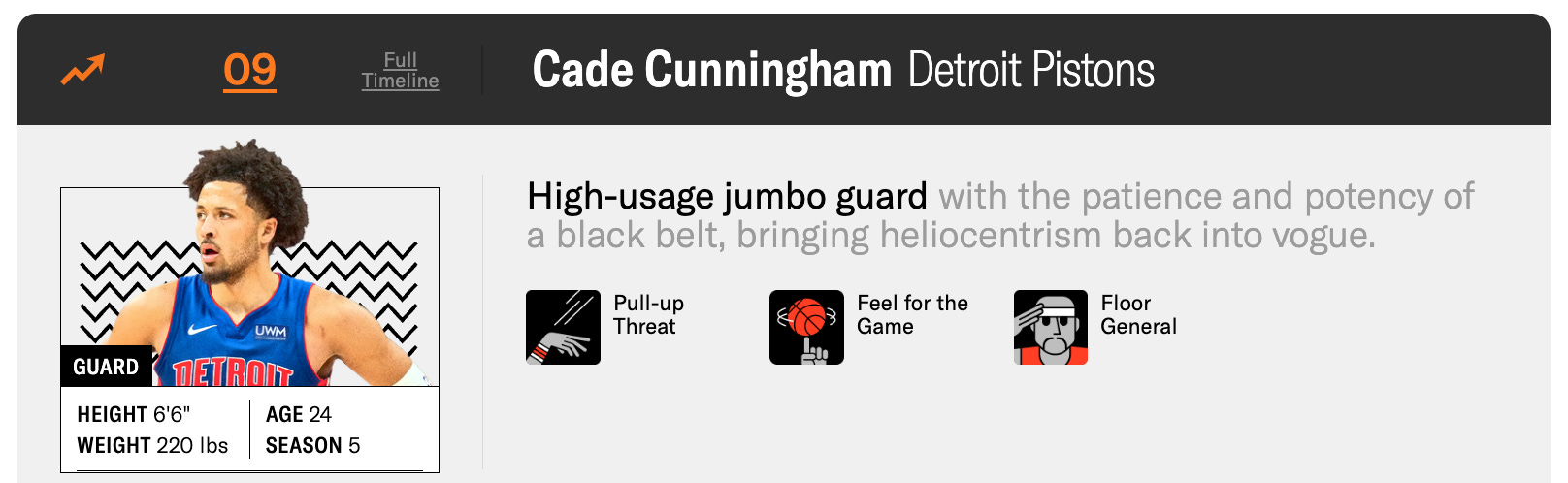
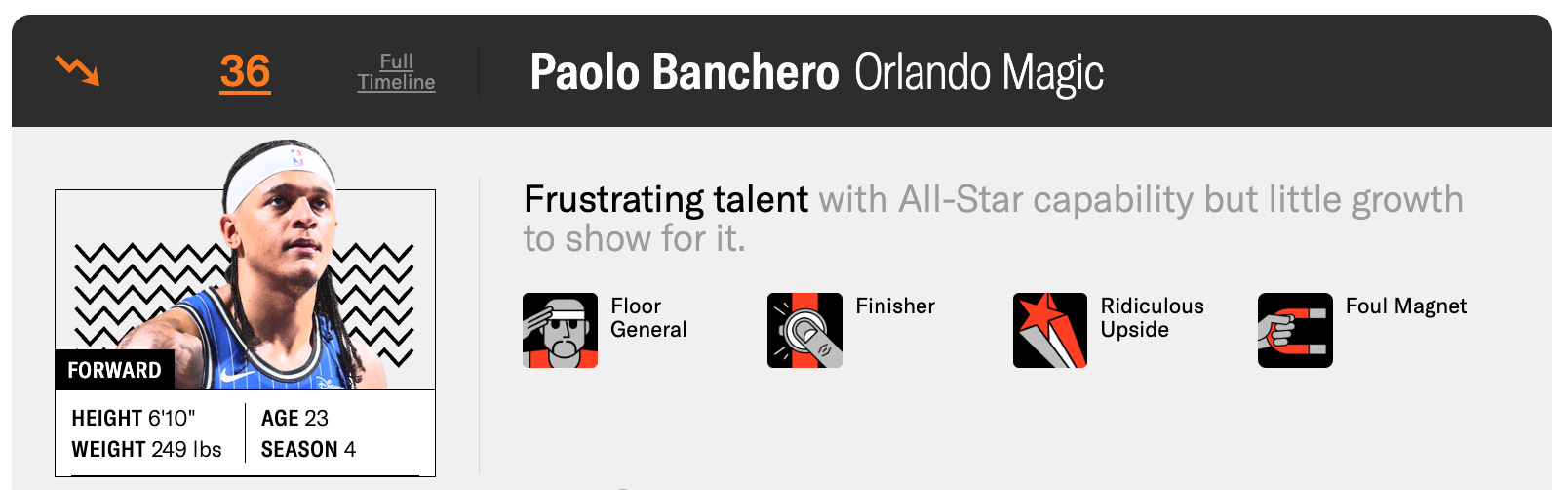
Cade is now in the Ringer’s top 10, while Paolo has fallen to 36th in the latest iteration, still with that “Ridiculous Upside” icon but now a “frustrating” label as well.
Why?
The continued development of these two players is obviously important to their two teams. The Pistons and Magic have sunk half a decade and a combined $600 million dollars - about the GDP of Tonga - into the idea that they will lead their once-storied franchises back to relevance, if not a championship. This season, Cade is proving good on that investment; Paolo is not.
So the question is why? Why has Cade been able to continue his meteoric rise from the 80th best player in the league just three years ago to top 10 today, while Paolo has plateaued and even started to regress. Everyone has their take on these two contrasting situations, which I’ve boiled down to five key explanations: injuries, shot selection, fixing weaknesses, schemes, and team-building. Let’s take them one by one.
1) Injuries
Ah injuries, the easiest excuse to lean on, but one that is often actually impactful11 for explaining team and player performance across sports. Cade has been healthy this season, Paolo has not. The Pistons have been healthy this season, the Magic have not.
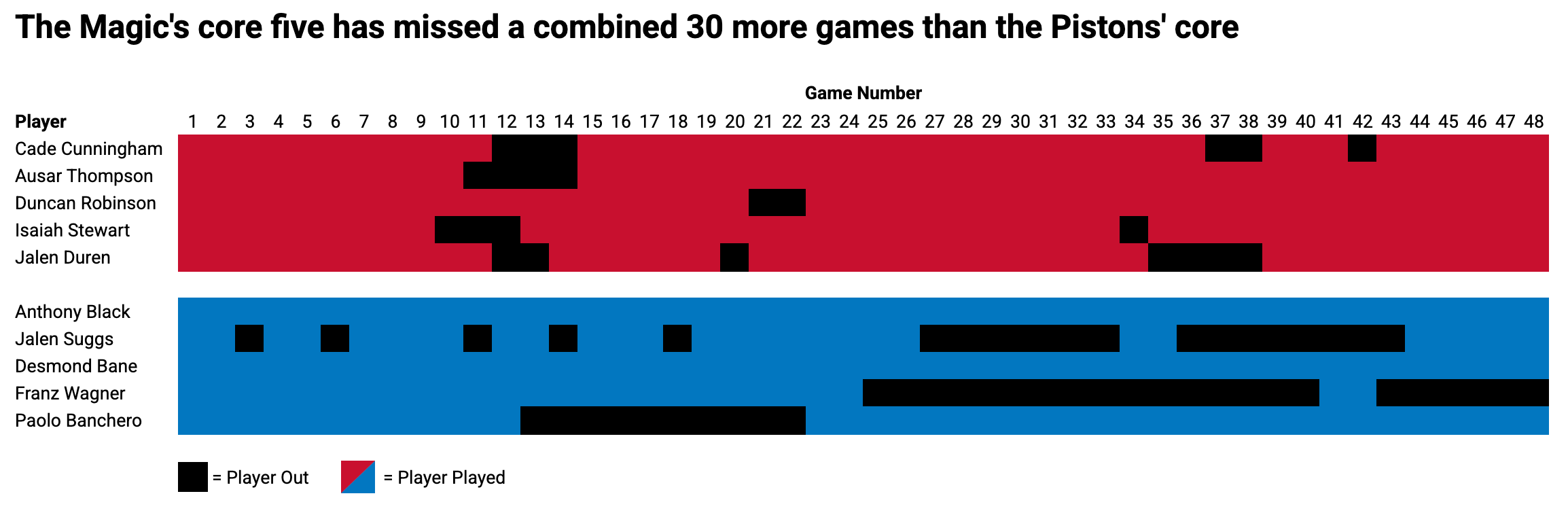
Last year, Paolo missed nearly half of his team’s games due to injury; this year he’s already missed a quarter. That makes it hard to find any sort of rhythm, which Cade Cunningham himself could tell you from experience. He played just 12 games total in the 2022-23 season, needing surgery early in the year to repair a stress fracture in his left leg. It took him a while, basically a full season of live action NBA basketball, to get back on track, as seen in the long plateau in his Ringer 100 position throughout the entirety of the 2023-24 season.
The same could be happening with Paolo. It could be a simple case of working his way back. Since returning to the starting lineup after his injury, Paolo has looked a bit lost, hesitant to disrupt the momentum his team built without him. Paolo has the added challenge that many of his teammates have been injured as well, making it impossible to establish any sort of chemistry.
As soon as Paolo came back for the Magic, his co-star Franz Wagner went out with an ankle injury and has played just two games since. Jalen Suggs, the Magic’s “skeleton key” per Zach Lowe, has missed most of the games since Paolo’s return as well. Going back to last season those three have played just 219 total minutes together, less than five regulation NBA games. They’re +11 points per 100 possessions in those games, which would be the second best net rating in the league. The Magic’s ideal five-man lineup (adding Desmond Bane and Wendall Carter Jr.) have played just 117 minutes together.
All that said, injuries are a part of the game and the best teams and players find a way to win anyway. When Paolo did play last year, he was a fringe All NBA candidate, despite the injury. The Cade comp may be unfair as well; an oblique tear and a groin strain aren’t the same as season-ending surgery to repair a broken bone. Paolo should be better this year, and I’m sure he wouldn’t use injuries as an excuse.
2) Shot Taking & Shot Making
Despite being incredibly high usage guys, neither Cade nor Paolo has ever been a good shooter. This season they’re both making 46% of their field goals, with just a 50% effective field goal percentage.12 That ranks about 125th in the league.
Players can obviously work on and get better at making shots, but they can’t always control if any given shot goes in. Players do have (nearly) full control over the shots they decide to take however, and a lot of the criticism aimed at Paolo and Cade their entire careers has focused not just on low percentages, but on poor shot selection. In his great breakdown of Paolo’s shooting, Above the Break astutely noted:
Shot charts have long been viewed as a map to locate shooting efficiency, and while that’s true, they can also tell us a lot about how an individual player is stressing a defense. For instance, we know that taking a lot of shots from beyond the arc helps space the floor, and conversely, taking shots closer to the rim compresses a defense. However, shots in the mid-range do neither.
So let’s look at some shot charts.
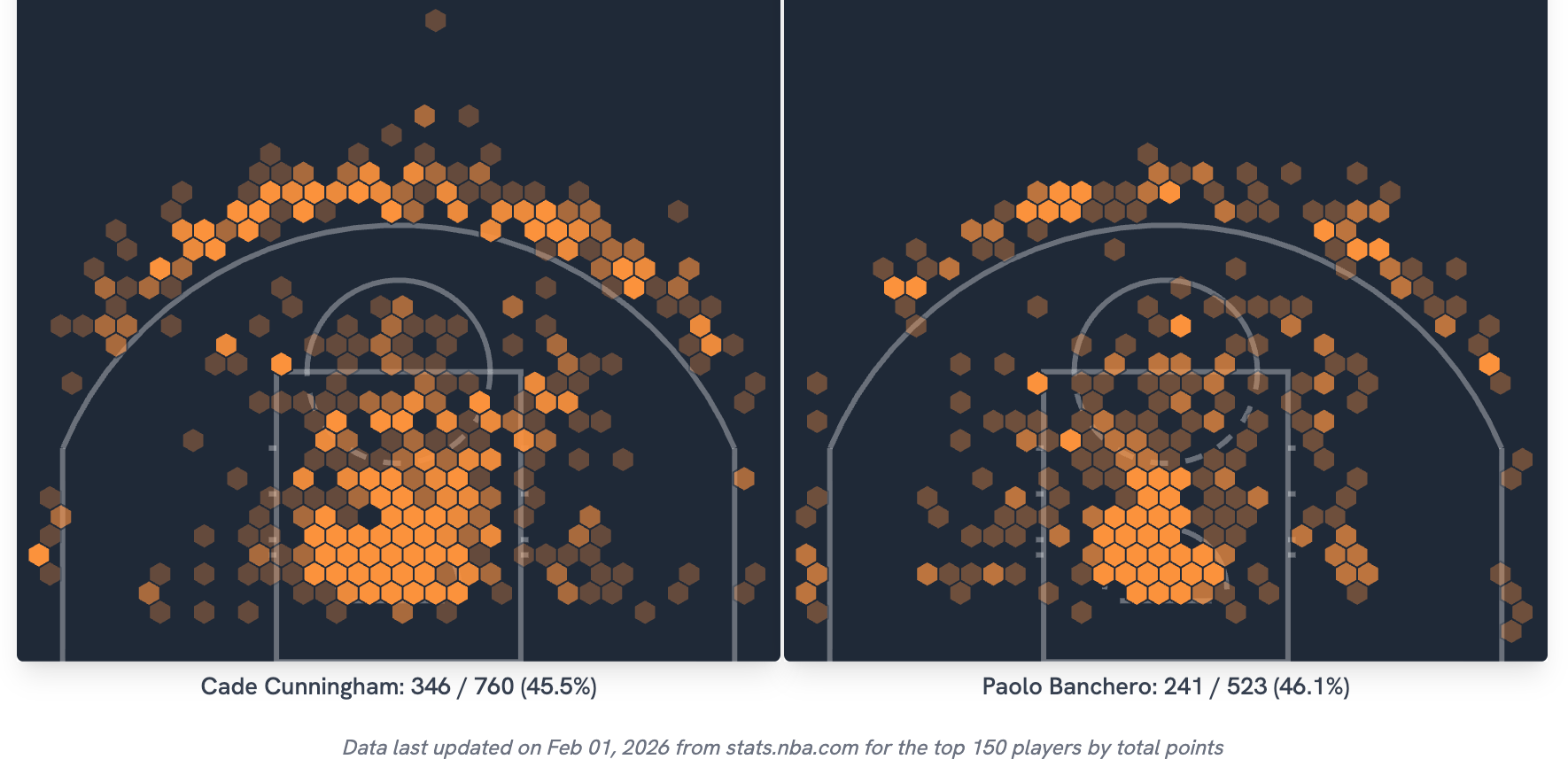
Welp. I suppose Cade may take a slightly higher share of shots in the paint and behind the three-point line than Paolo, but both still do a lot in the midrange. Paolo is 34th in the NBA, Cade 27th in midrange attempts. That’s a lot better than it used to be though.
Both have significantly lowered the percentage of shots they take in the midrange13 while increasing the share of close shots. Paolo’s now taking 55% of his attempts within 10 feet of the basket, up from 42% last season.
Sure that’s still less than Dwight Howard, who at Paolo’s build took over 90% of his shots from within 10 feet,14 but Dwight played in a different era (and was an even worse shooter). Among today’s best Power Forwards, Paolo gets to short shots at about average rates.
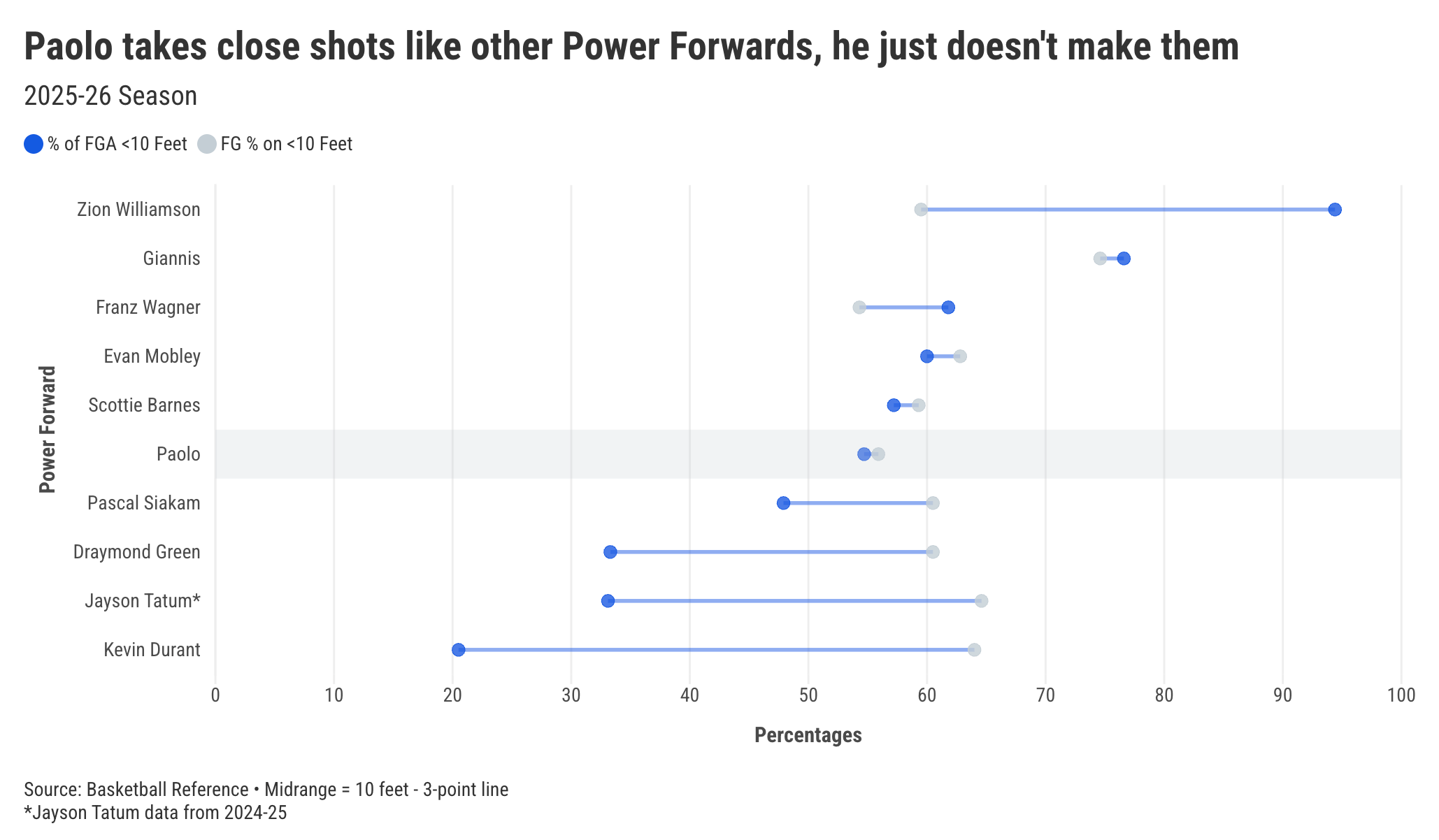
He’s just not making them. Whether that’s because they’re contested, rushed, or he just hasn’t mastered the art of throwing a 9 inch ball into an 18 inch hoop, the only top 10 Power Forward with a worse percentage on close shots is Paolo’s teammate Franz.
Still, Paolo and Cade are shooting about the same percentages. While both could be better, it doesn’t explain the divergence. What does explain the four-point difference in scoring this season, after they tracked so closely together previously, is simply volume: Paolo is taking four fewer field goal attempts per game than Cade (and than Paolo took last year). Even with an All-Star teammate for the first time, Cade is still the go-to option on the Pistons; Paolo may not be.
3) Turning Flaws into, well at least not Fatal Flaws
So Cade is still not a great shooter, but he has greatly improved the other aspects of his game, that final 10% that fans and critics alike have been hoping he would fix. Meanwhile, Paolo is largely the same player, even while taking a slight step back in usage. That is the difference in these two players’ trajectories this season.
The radar charts below show the percentile rankings for Cade (Red) and Paolo (Blue) relative to the league across a number of important stats that cover pretty much every aspect of the game. The darker colors represent this season, while the faded ones are from last season.
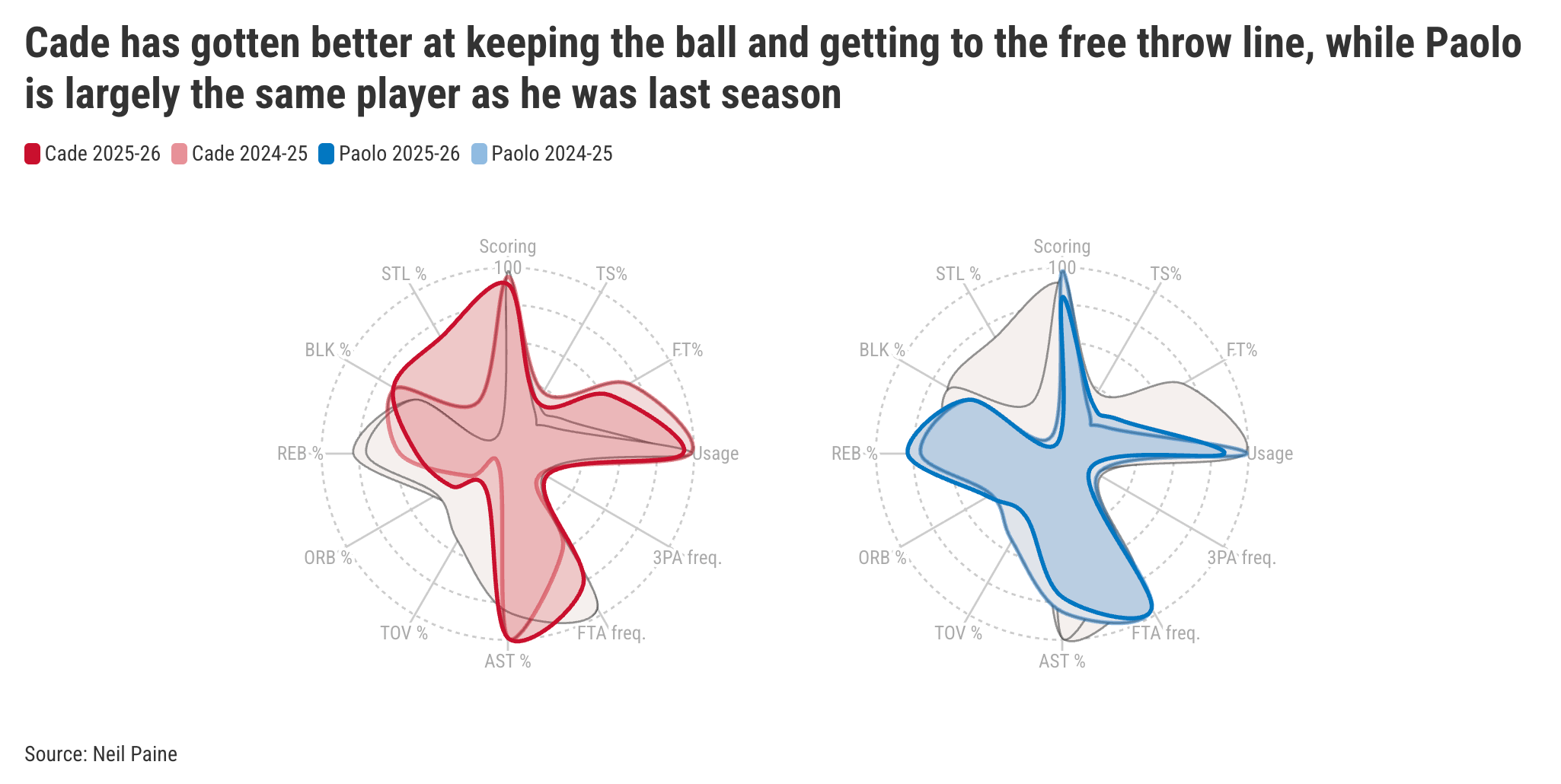
At first glance, Cade’s and Paolo’s blobs seem similarly shaped - sort of a deformed lower case t. They do have commonalities (elite scoring, high usage, etc.), but the slight differences between the two make all the difference,15 which you can see by comparing the colors to the light gray backgrounds on each radar. Paolo is a better rebounder and gets to the line more, while Cade is a better passer, free throw shooter, and defender.
Defense
Cade’s defensive improvement, measured by steal percentage here, stands out the most. He’s averaging 1.5 steals per game, 50% more than a season ago and top 10 in the NBA. His STOP rate, which includes all possession enders - steals, offensive fouls drawn, and recovered blocks - is up to the top 25th percentile and he’s a positive overall defender (by defensive box plus-minus) for the first time in his career.
Paolo’s defense remains a net neutral, by any | of | the | advanced | stats.
Free Throws
Cade has also improved his free throw rate, getting to the line nearly two more times per game. While his success rate once there has dipped from last year, he’s still above average and generates an extra 1.2 points per game from the line than he did a season ago.
Paolo gets to the line like he always has, but still can’t convert the trips into points.16
Turnovers
This one is more subtle, but perhaps the most important of all. Cade is still bottom quarter of the league in his propensity to give the ball to the other team, but at least he’s out of the bottom decile! He’s actually lowered his raw turnovers -0.6 per game, while increasing his assists +0.6 per game. As a result, his assist-to-turnover ratio ballooned from 2.1 to 2.7, now third in the league among guys averaging eight or more assists per game. He actually leads the league (yes, even above Jokić) in potential assists.
Paolo has regressed in both assist percentage and turnover percentage.
It’s not the highlight-making components that have made the difference for these two players this year. It’s the smaller, yet critically important aspects of the game that have created the divergence. More aggressive defense, getting to the line, fewer turnovers. That’s what has vaulted Cade to the highest echelon of the NBA, and left Paolo among the riff raff.
4) Schemes
If the shot charts were the where part of answering the why question, and the radars where the what, the schemes are the how.17 They help us understand how players are being used in the offense, as well as how efficient they are in different types of actions. The Pistons and Head Coach J.B. Bickerstaff are setting up Cade to be his best self, while the Magic and Jamahl Mosley aren’t doing Paolo any favors.
About half of Cade’s possessions have him acting as the ball handler in a pick-and-roll or going one-on-one in isolation. He is undoubtedly the guy the Pistons want with the ball. Un-coincidentally, those roles are where he shines brightest. Cade averages about one point per possession on those two play types, about the same as fellow All-Stars Jalen Brunson and Jamal Murray. The only more effective action for Cade is a post-up, but that sample is smaller because it requires the right mis-match to take advantage of.
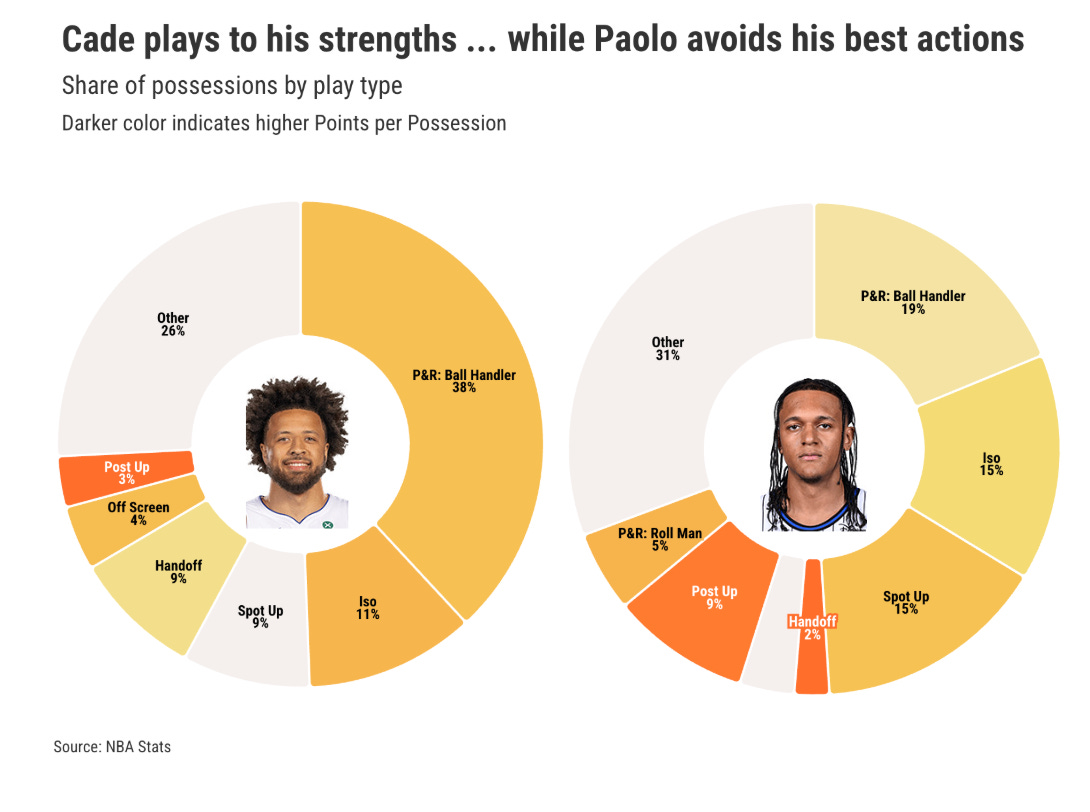
Paolo could be posting up much, much more. He’s 6’10”, “built like the Undertaker”, and they’re his best play type, yet they constitute less than 10% of his possessions. Instead he spends most of his time in the same actions as Cade - ball handler and isolation scorer - where he is significantly less effective. Michael Pina wrote a terrific piece early in the season outlining this frustration with Banchero:
“Banchero’s problem is based more on how and when he takes his field goals, not necessarily where they come from . . . We’re talking about forced, erratic, low-probability attempts that are the midnight snack Banchero absolutely must cut from his diet—isolation plays where he surrenders high ground instead of leveraging the physical advantages that make the 6-foot-10, 250-pound forward unguardable”
I encourage you to read the full Pina article, flush with videos of Paolo’s “midnight snacks”, but overall Paolo’s 0.88 points per possession is just about average in the NBA.18 He’s just about average in the NBA.
It’s not clear Paolo knows what he wants to do on the court. It’s not clear the Magic know how they want to use him. It’s not clear the Magic know what to do with the group they’ve assembled in Orlando.
5) Team-Building
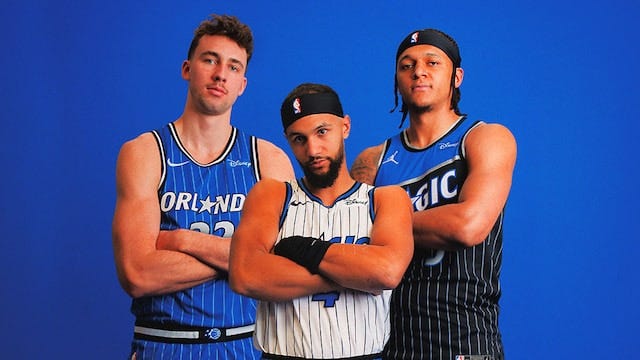
The Orlando Magic selected four players with top eight picks in 2021, 2022, and 2023: Jalen Suggs fifth and Franz Wagner eighth in 2021, Paolo Banchero first in 2022, and Anthony Black sixth in 2023. All four are objectively good NBA players, and fine picks under the “best available player” drafting strategy. Technically, they form a complementary unit: Anthony Black is a Point Guard (albeit a 6’7” one), Jalen Suggs is a Shooting Guard, Paolo and Franz are Forwards, and the team traded for a Center, Wendall Carter Jr., a year before all of this. On one hand, it’s a testament to building a team through the draft.
The problem is that they’re not a complementary unit in practice.19 Suggs and Black are both the energy guy, the defensive menace that all teams need, but do they need two? Especially when they don’t shoot well enough to space the floor? Paolo and Franz are do-it-all “Swiss-Army knives” at Power Forward, except “all” does not include shooting. Wendall Carter Jr. is not a stretch big by any stretch of the imagination. The team around Paolo, who’s biggest critique has been his lack of shooting, can’t shoot.
Well that’s why they got Desmond Bane! In theory yes, but he’s shooting a career low 36% on the lowest attempts since his rookie year. If his shooting picks up the Magic’s ceiling is significantly higher, and the Paolo noise is significantly quieter, but that’s a lot to put on the (admittedly ginormous) shoulders of a non-star.
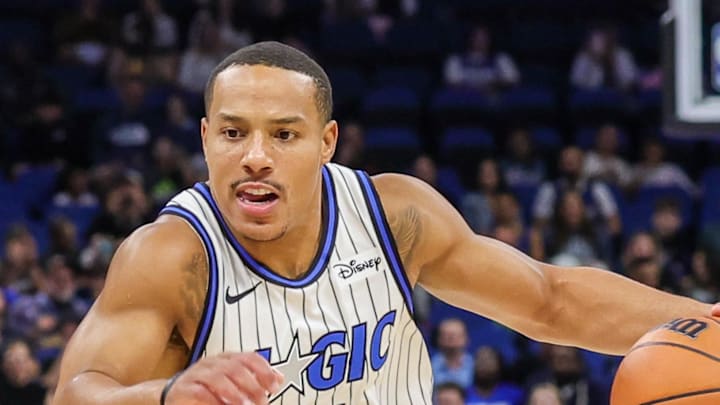
The Power Forward overlap is the sharpest team-building question in Orlando. Paolo and Franz are the same size, with largely the same skillset, which makes them essentially interchangeable. It’s easier for defenses to scheme against and risks falling into a my-turn-your-turn offense. The answer may be trading one of the two, even if that means the once-savior of the franchise gets shipped away.
Meanwhile, the Pistons have built an ideal unit around Cade. Jalen Duren is the dominating post-presence and perfect pick & roll partner. Duncan Robinson and Tobias Harris are the knockdown, veteran shooters for Cade kick-outs. Ausar Thompson is the energy guy. Isaiah Stewart is the defensive enforcer. The team just works (as evidenced by their second-best record in the NBA).
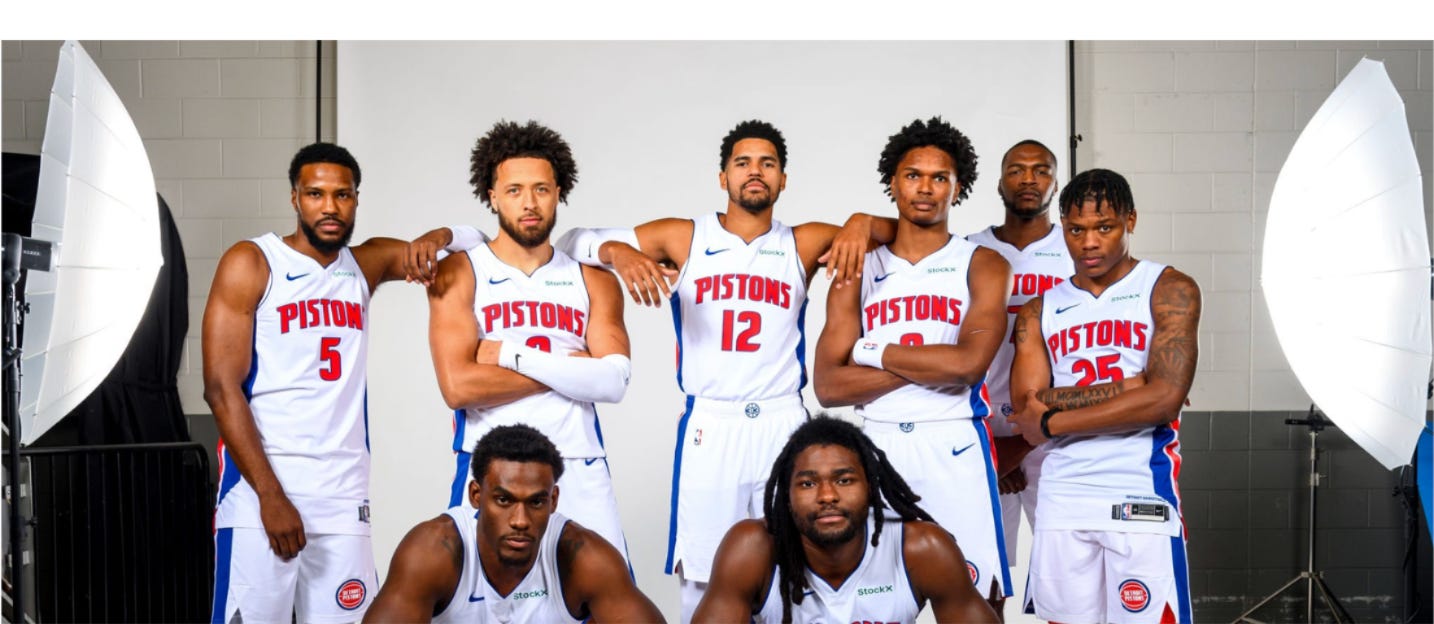
Beyond the current rosters, the Pistons did more than the Magic to ease their stars’ transitions into NBA life. General Manager Troy Weaver got Cade real veterans to help guide his development; before Tobias Harris and Duncan Robinson the Pistons rostered Tim Hardaway, Dennis Schröder, Taj Gibson, Danilo Gallinari, and Kelly Olynyk. They weren’t All-Stars, so Cade was still the best player on the Pistons, but they were guys who had been around the NBA block and helped mold Cade and his other young teammates into the juggernaut they’ve become.
Paolo hasn’t had that. The best player on his rookie team was second-year Franz Wagner, the guy he was brought in to replace? After Franz, and maybe second-year Jalen Suggs, it was probably Markelle Fultz, a former number one pick turned bust. Not a great example for the latest number one pick. Paolo’s only true vets over the years have been Terrence Ross, Michael Carter-Williams, Gary Harris, and one year of Kentavious Caldwell-Pope.
The Magic’s team-building strategy focused on letting their young, core group grow together, which is defensible. After all that’s what the Pistons have been doing with Cade, Jalen Duren, Isaiah Stewart, and Jaden Ivy, and it’s clearly worked. The difference is that Cade was always the clear starting Point Guard, and the clear leader of the team. In Orlando, because of the overlapping skillsets and ages it’s not clear that Paolo is the best player on the team, or even at his position. Add in the lack of veteran presence, and the result has been a young team trying to find their way in the league, while competing with one another for the same roles.
Paolo has (at least momentarily) lost the competition at Power Forward. If he was still playing quarterback, Jamahl Mosley likely would have benched him in favor of Franz by now. If they had to trade one of the two, most believe they’d choose to let Paolo go. He simply hasn’t fixed his flaws.
All is not lost for Paolo. He’s in just his fourth NBA season, still just 23 years old, a few years away from what should be his prime. In his two healthy NBA years he’s been a Rookie of the Year and an All-Star. He hasn’t necessarily gotten worse in this injury-plagued season, he just hasn’t gotten much better. Cade was in a similar position in his fourth year. I wouldn’t be surprised to see the narrative switch for Paolo next season the way it has for Cade.
Montverde’s most recently famous alumnus is Cooper Flagg, but they’ve been an institution in high school basketball for years. Cade played with seven future NBA players at Montverde: Scottie Barnes, Moses Moody, Ryan Nembhard, Day’ron Sharpe, Precious Achiuwa, Caleb Houstan, and Dariq Whitehead.
The fact that OK State hired his older brother as an assistant coach may have helped them in the Cade sweepstakes.
It wasn’t Markelle Fultz was it? It couldn’t be Markelle Fultz.
Paolo Napoleon James Banchero has the 91st best name in NBA history, according to the Ringer’s Tyler Parker. In my opinion, Cade Cunningham was snubbed from the list.
His Montverde teammate Scottie Barnes won.
Analytically, they even have similar play styles, despite playing different positions.
Though it should be noted, despite ranking Paolo fifth, he described him as a “usage-hog, who racks up points inefficiently, gets assists at the cost of turnovers, and may or may not actually help his team win games”. So it goes with Paolo takes.
Not to mention the game in which he missed an NBA record 31 shots.
Kirk Goldsberry recently compared Paolo to Josh Smith, as an example of a player stagnating at a key phase of his career.
Occam’s Razor and all that.
Which accounts for the added value of a three.
Shots from between 10 feet from the basket and the three-point line.
25% of Dwight’s field goal attempts were dunks. Paolo only dunks 5% of the time.
I can’t tell if this is an insightful turn of phrase or extremely obvious. Probably the latter.
Yes, this sentence is intentionally confusing.
I would list comps here, but it is too easy to cherry pick, oh I don’t know, Will Riley of the Washington Wizards. I’m not saying Will Riley is better than Paolo Banchero.
It must be mentioned that the best part of Orlando’s roster is Orlando Robinson, a classic nomen-culture fit.
Nice work, Chris. Thorough and enlightening.
Great in-depth analysis! Really looking forward to this series and matchup even more now.