

What Makes a Good GM?
Plus Checking in on the Copycat Candidates

Happy New Year and welcome back to Charting Hoops in year two! This week’s main piece is actually a collab, and you can find it over at HoopsHype. It’s a fun one, in which I looked into the General Managers of the NBA, specifically what they did before becoming GM and how that background impacts their success in the team-builder role. Here’s a sneak peak.
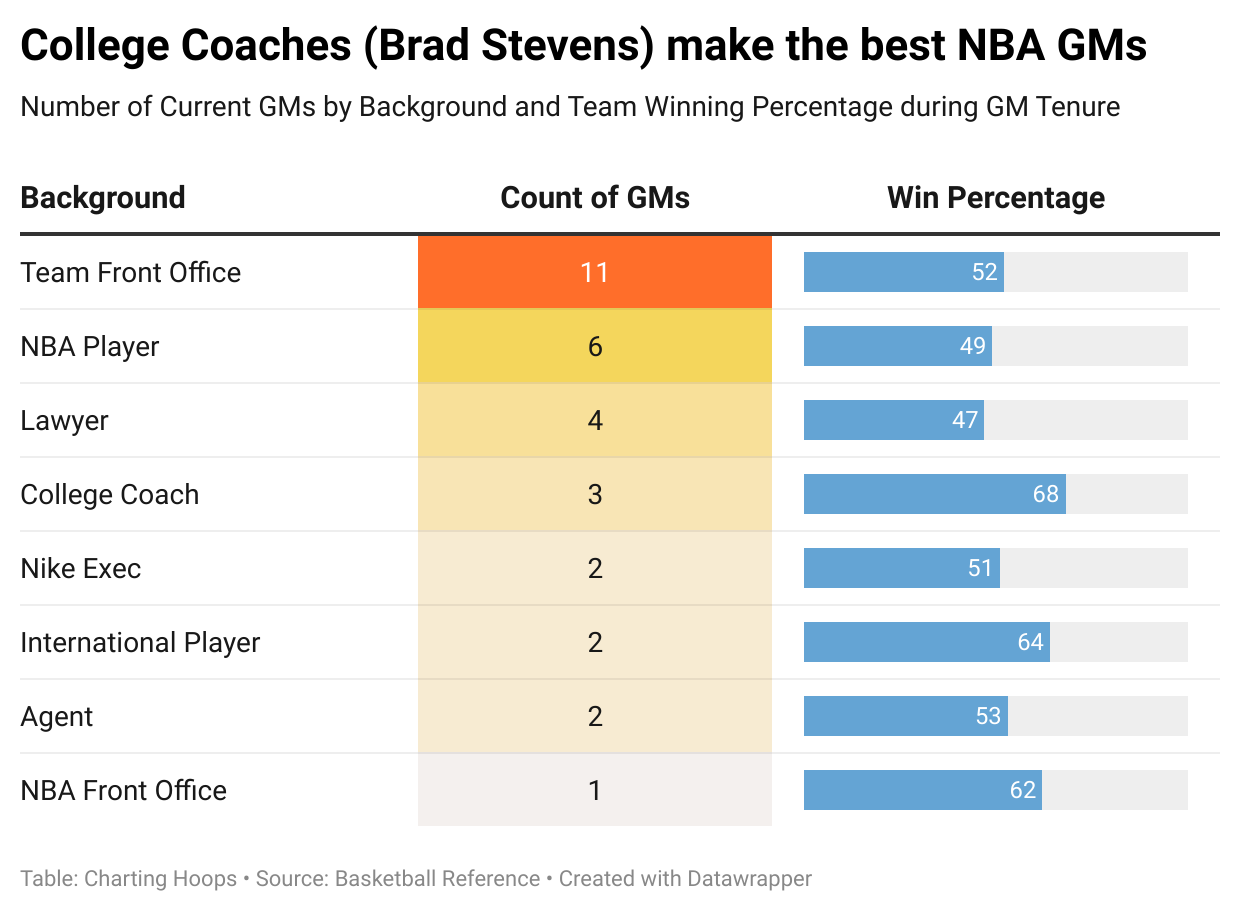
Copycat Candidate Check-In
At the start of the NBA season I wrote a piece about three play styles that helped last year’s best teams win games. They were the trends - namely foul-seeking drives, full court pressure, and double big lineups - that dominated the offseason news cycle, and were expected to become even more prevalent as the rest of the NBA tried to replicate the success of their three main proponents, the Thunder, Pacers, and Rockets respectively.
Examining every 2025-26 opening day roster, I highlighted the teams that were best - and worst - set up to capitalize on these trends. Now that we’re almost halfway through the season, I thought it would be good to test my predictions. As we did the first time, let’s take them one by one.
Foul Seeking Drives
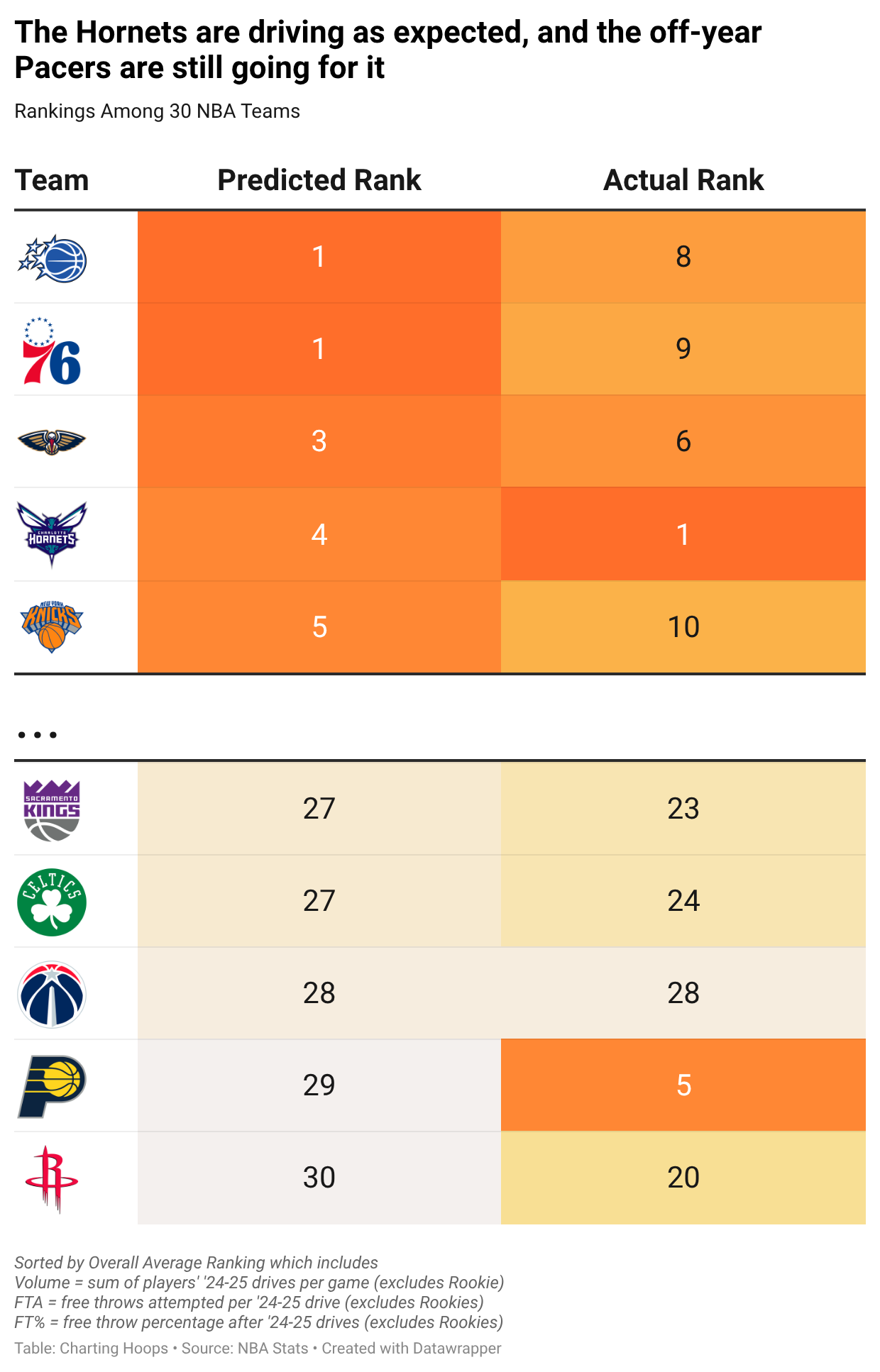
I expected the Magic and 76ers to lead the league in my “foul-seeking drives” stat, which accounts for the overall number of team drives, as well as free throw attempts and free throw percentage that come as a result of those drives. Reassuringly, both teams are in the top ten, as are the rest of my top five predictions, led by the Charlotte Hornets. LaMelo Ball, Colin Sexton, Miles Bridges, and even Kon Knueppel are all averaging 10 or more drives per game for the Hornets (which places each of them in the top 10% of the league). That quartet is getting nearly six points from made free throws every game as a result of those drives.
The Miami Heat, with their newfangled, weird, pick-and-roll-less offense, actually make the most drives of any team in the league (61.2 per game), but they don’t draw many fouls on the drives. So, after the Hornets the teams capitalizing most on foul-seeking drives are the Portland Trailblazers, Oklahoma City Thunder, Chicago Bulls, and Indiana Pacers (more on them in a minute).
The Trailblazers and Thunder have the Max Verstappen and Lewis Hamilton of the NBA: the top two drivers in the league. Portaland’s Deni Avdija and OKC’s Shai Gilgeous-Alexander rank number one and number two in total drives and resulting free points. Avdija in particular is blazing new trails with his drive numbers: he increased his aggressiveness markedly, doubling his drives vs last year up to 20.8 per game, three more than second-place Shai, and he gets a full free throw attempt more than Shai every game. We have a new king of the foul-merchants.
My bottom five predictions are all bottom ten in the league as well, with the notable exception of the aforementioned Pacers. I had them as one of the least drivey teams, but they have proven me wrong, sitting at fifth in the league. It’s not helping them win games, but it’s admirable that a team without their star Point Guard, as well as a host of other injuries, keeps sacrificing themselves in the lane. Andrew Nembhard and Pascal Siakam in particular are each slashing into the lane 13 times per contest, and T.J. McConnell gives them 10 more. I suppose I could have seen this coming, despite the age and lack of experience as the go-to guy, because these are all players who will play hard for as long as they can.
If it’s not the Rockets, Pacers, or Wizards, who is ignoring this trend the most you may ask? Technically the Milwaukee Bucks, but that’s only because the Nuggets are good at shooting free throws. Why does Jamal Murray’s free throw percentage matter you rightly follow up? As a team, the Nuggets are seventh in free throw percentage after drives, which boosts them in my “foul-seeking drive” rankings; they are dead last however, by a country mile, in absolute number of drives and fouls drawn:
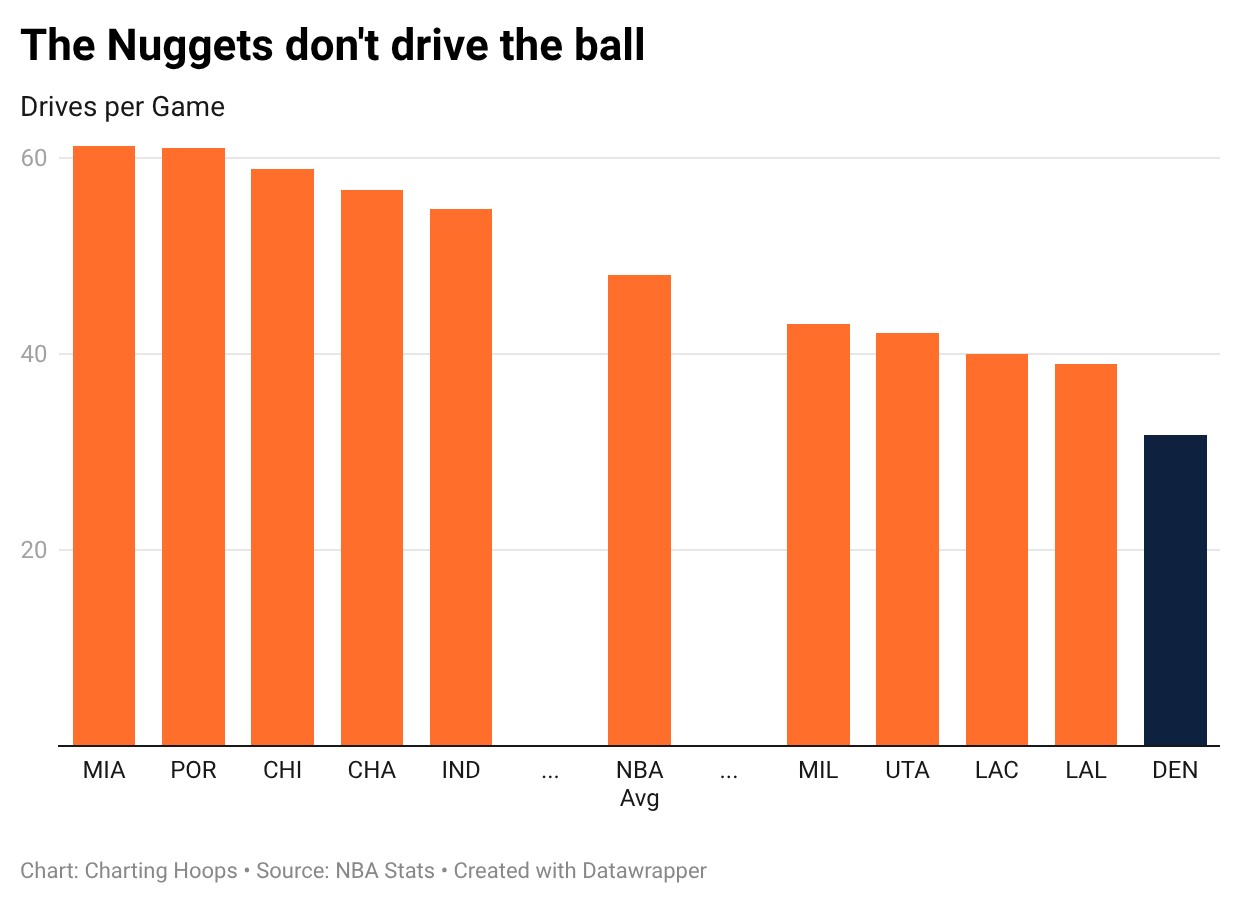
After Jamal Murray, the Nuggets leading driver is Nikola Jokić … with 4.1 per game.
Full Court Pressure
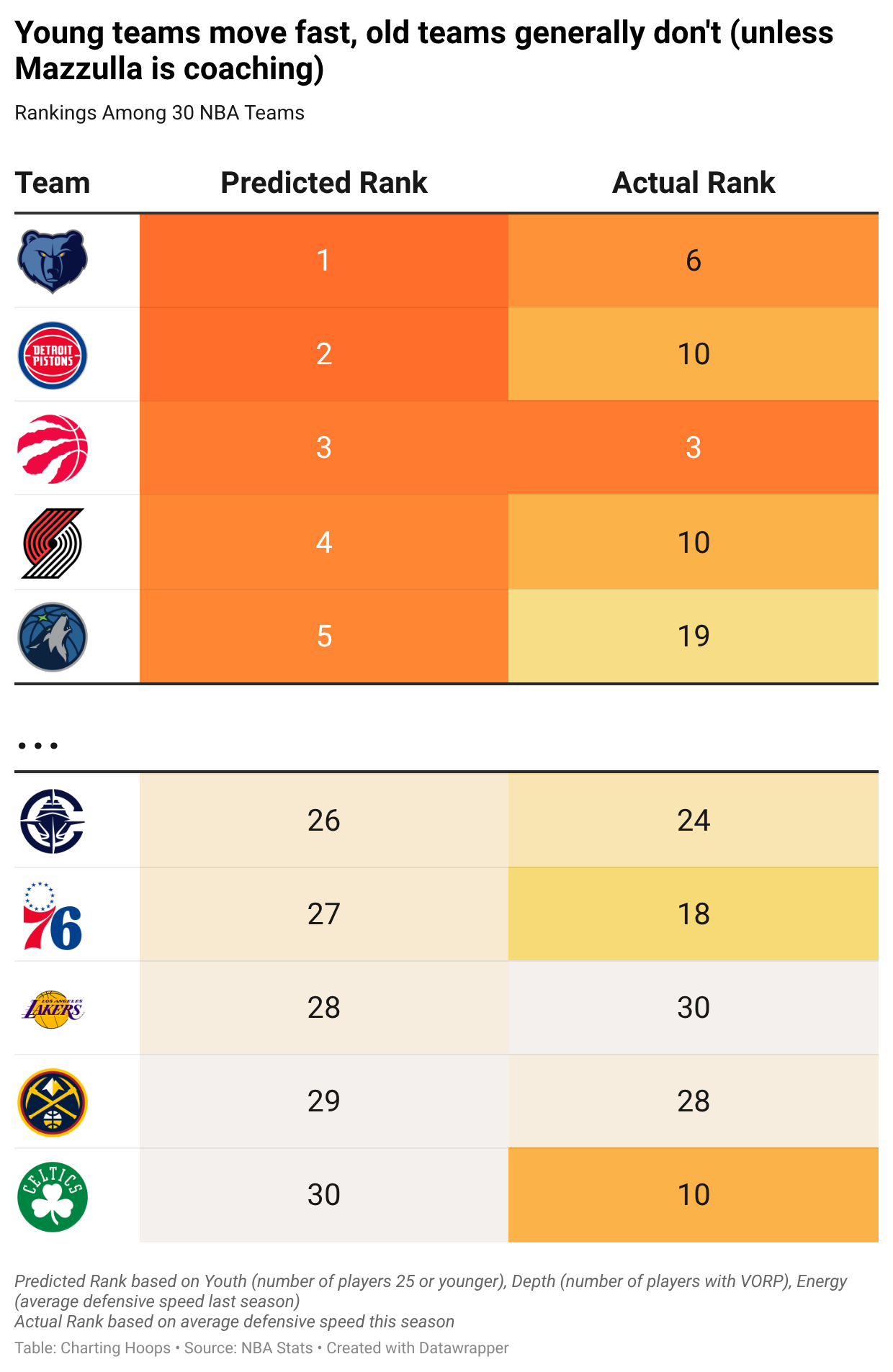
I, unfortunately, don’t have access to Second Spectrum and their pressing data (if you do, let me know in the comments how this holds up), so I relied on average defensive speed as a proxy for playing hard-nosed defense, end-to-end. Like in the prior trend, the four teams I expected to lead this category are in the top ten league-wide; only the Timberwolves are playing slower than expected. Interestingly, Anthony Edwards, the best athlete on the team and (in his eyes) in the league, is the slowest defender on the team - yes even slower than his 38-year-old teammates Mike Conley and Joe Ingles. As the Timberwolves’ offensive engine, Ant clearly gives himself a breather on the defensive end, moving at an average speed of just 3.7 miles per hour.
The Clippers, Lakers, and Nuggets are all old and slow, as predicted. James Harden moves at the slowest average speed on defense in the entire league (3.4 mph1). Lebron and Luka are next, and Nikola Jokić isn’t much faster.
The Sixers are moving faster than I expected, but that’s partly because their older, slower guys have missed a lot of games, and aren’t playing many minutes when they do suit up. The bigger surprise is the other “gap-year” team, along with the surprisingly drive-heavy Pacers, the Boston Celtics. Again, with a coach like Joe Mazzulla at the helm, I probably could have seen this coming. Even if Sam Hauser and Luka Garza aren’t the fastest guys in the league, Mazzulla is not going to let them jog back on defense.
Double Big Lineups
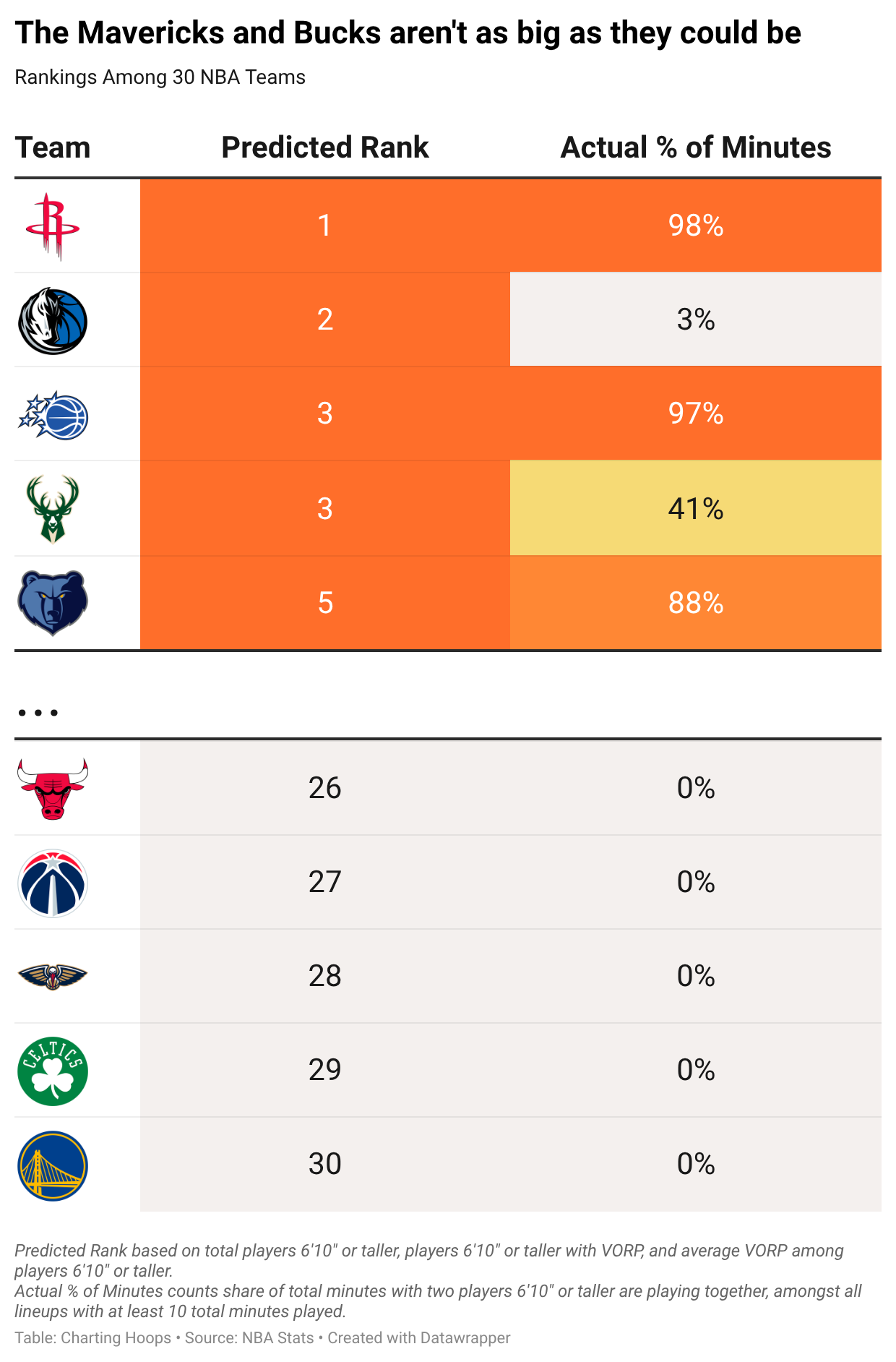
Houston started one of the biggest five-man lineups of all time on opening night, at an average height of 6’10”. Between Alperen Şengün, Kevin Durant, Steven Adams, Jabari Smith Jr., and Clint Capela, the Rockets have five great players 6’10” or taller and they play them together often. In fact, the Rockets have played without at least two bigs on the court only 2% of the time this season; that’s about one minute per game.
Dallas had the potential to play like their Texas-neighbors, with a roster featuring Anthony Davis, Dereck Lively II, Daniel Gafford, Dwight Powell, and Moussa Cisse. But like its conceptualist, the Nico Harrison project has been sidelined this season. With one injury after the next, none of Dallas’s five bigs have played more than 560 minutes in their 35 games to date, which works out to less than 16 minutes per game. The only double big lineup Head Coach Jason Kidd has played featured Davis with Lively, but we won’t see that again now that Lively has undergone season-ending foot surgery.
The Bucks double big lineup has also been put on ice. Head Coach Doc Rivers was starting and playing Giannis Antetokounmpo and Myles Turner together at the start of the season. Then, Giannis got injured forcing the Bucks to play smaller and experiment with staggered lineups.
The bottom of this table was easier to predict. With their tallest players topping out at 6’9”, the Warriors and Bulls don’t have the roster optionality to play two bigs even if they wanted to. The Wizards, Pelicans, and Celtics could with a few specific lineups, but they’ve chosen to entirely stagger their bigs’ minutes thus far.
That translates to a 55 minute 5k or a 7 hour and 43 minute marathon.