

Start, Bench, Cut: Denver Nuggets Edition
Cameron Johnson, Christian Braun, or Peyton Watson?

In 2002 Daniel Kahneman won the Nobel Prize in Economics “for having integrated insights from psychological research into economic science, especially concerning human judgment and decision-making under uncertainty.” He (along with his colleague Amos Tversky1) essentially invented the field of behavioral economics by discovering a series of mental heuristics (or shortcuts) and organizing them into a unified understanding of how people make decisions.
The Nobel specifically cited Kahneman’s formulation of prospect theory, describing how individuals assess losses and gains in reality, as opposed to how “homo economicus” assesses them in the textbooks I had to read in Introductory Mircoeconomics.2
Prospect theory opens up the study of decision making to include concepts like loss aversion (the pain of losing something hurts more than the joy of making the same gain), reference points (judging gains and losses based on their current baseline rather than the final total), framing effect (the way a choice is presented changes the decision), and probability weighting (humans are bad at probabilistic thinking). These concepts are stacked on top of other cognitive fallacies like anchoring, herd behavior, the peak-end rule, the endowment effect, and the hot hand, as well as a whole host of human biases that favor the present, the recent past, consistency, familiarity, the status quo, and more.
Which is all to say, it’s hard for humans to make sound decisions.
The Denver Nuggets have a decision to make.
Their top three players will make a combined $141 million in salary in the 2026-27 season,3 about 85% of the salary cap. Add in the rest of their roster as it currently stands, and they break the threshold into the second apron.4 That’s a scary thing (I’m told. It’s very confusing5), but they do have a way out of it. It’s a very real, very consequential version of the popular social media game Start, Bench, Cut. The players in question are
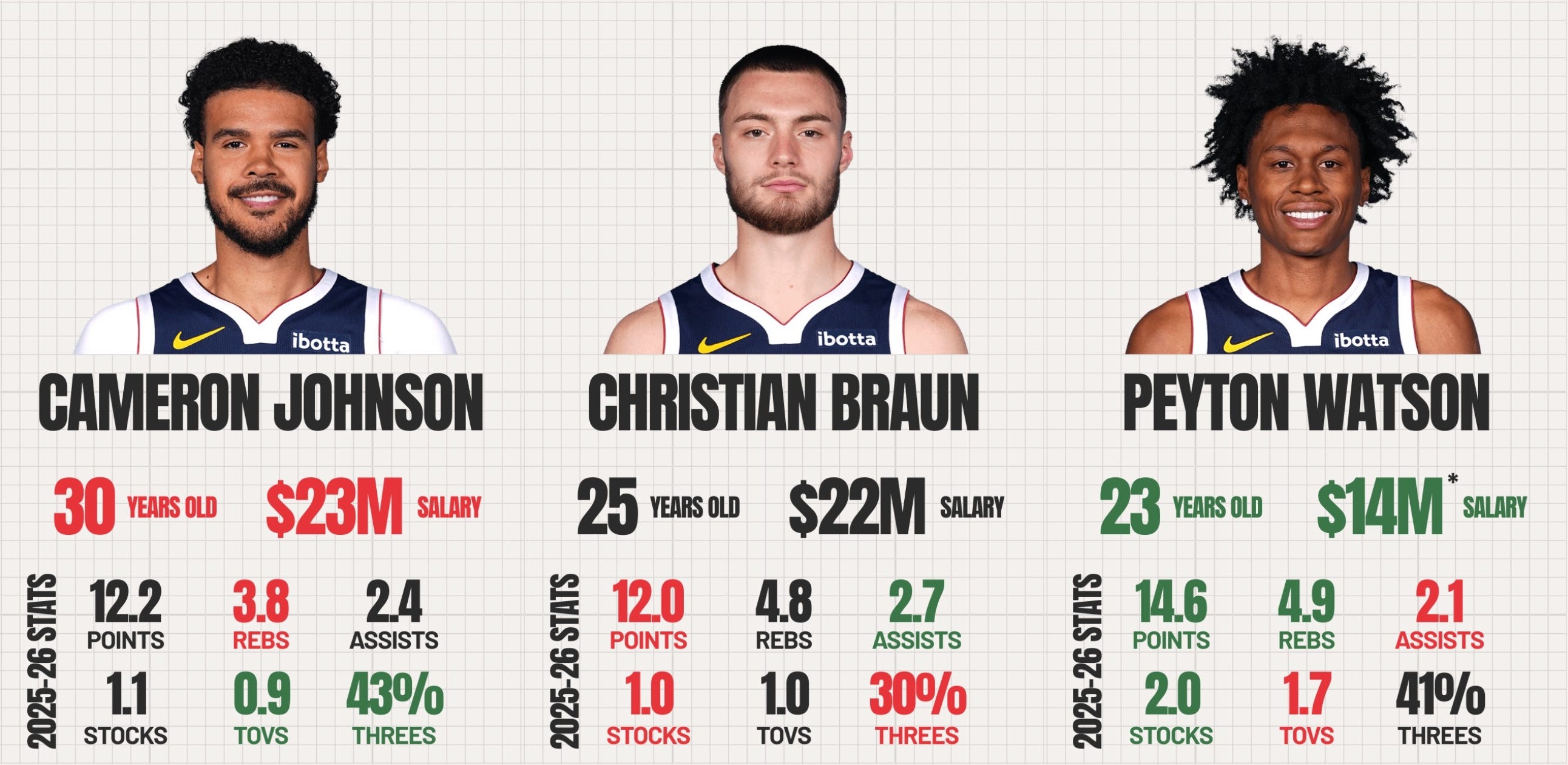
Most of the internet seems to be leaning toward starting Johnson, keeping Watson on the bench, and letting Christian Braun go to another team willing to pay him $125 million over the next five years. Sam Vecenie and Bryce Simon leaned this way on their Game Theory podcast on the topic. Mike Shearer recently posted a great overview of the situation in Denver, and when I pressed him to play GM he concluded “if you’re honest about maximizing title chances, you probably need to swallow hard and attach whatever needs to be attached to Braun’s contract, move him, and keep Johnson and Watson.” I asked the biggest Nuggets fan in my life, and he started Peyton Watson without “a moment of hesitation” and brought Cam Johnson off the bench.
These are completely justified, completely defendable takes by smart basketball people. Still they may be falling into a cognitive bias or two. I would go a different direction, with the fallacies I fancy.
Recency Bias
Christian Braun disappointed in the 2025-26 season. That much is undeniable. After a breakout 2024-25 season,6 his third year in the NBA, he’s regressed. Scoring is down. Rebounding down. Assists, actually up . . . by 0.1 per game. Steals down. Blocks down. Two point percentage down. Three point percentage fell off a cliff, from 40% down to 30%, the lowest mark of his career by a wide margin.
Smart basketball analysts will look at his Basketball Reference page and come away disappointed and ready to move on. But watching his games (and as a Nuggets fan I’ve watched almost all of them) it’s clear that the reason for the statistical decline was simply a lack of confidence, stemming from an ankle injury he sustained last November. He missed 23 games, tried to come back in January, his body said “Absolutely not!” and he sat out another 12.
“The rehab process is not something I’ve been through,” Braun said. “I’ve never been a part of the injured bunch. I’ve been a part on the other end, where you’re on the court trying to keep things afloat. But it’s tough. I don’t think any of the injuries were preventable things. It was just tough breaks.”
A lot of Braun’s game, on both offense and defense, relies on his explosiveness. He scored 403 fast break points in 2024-25, 70 more than anyone else that year, and he finished a lot of those breaks with dunks over would-be chase-down defenders. Last season, it was clear he didn’t trust his ankle’s ability to support the takeoff required, so in the same transition situations he often settled for softer lay-ups or just dribbling it out to set up a half-court offense.7
The good news for Nuggets fans is that Braun recently indicated that he believes by the start of training camp he’ll be 100% healed and at that point, “everything else will get back to where it’s supposed to be.” The optimist in me chooses to believe him, but the recency bias is pessimistic.
Especially when Cameron Johnson finished the season extremely strong (he had a slow start to the year shooting the ball, but in March and April he averaged 45% from three) and Peyton Watson had a breakout season of his own.
Peak-End Rule
While Braun’s most recent season was a disappointment, Watson’s was a gratification. Despite joining the Nuggets from the same draft class (2022),8 Watson is a year younger, so both had their breakouts in their age-23 seasons. Braun’s was actually better on almost every dimension.
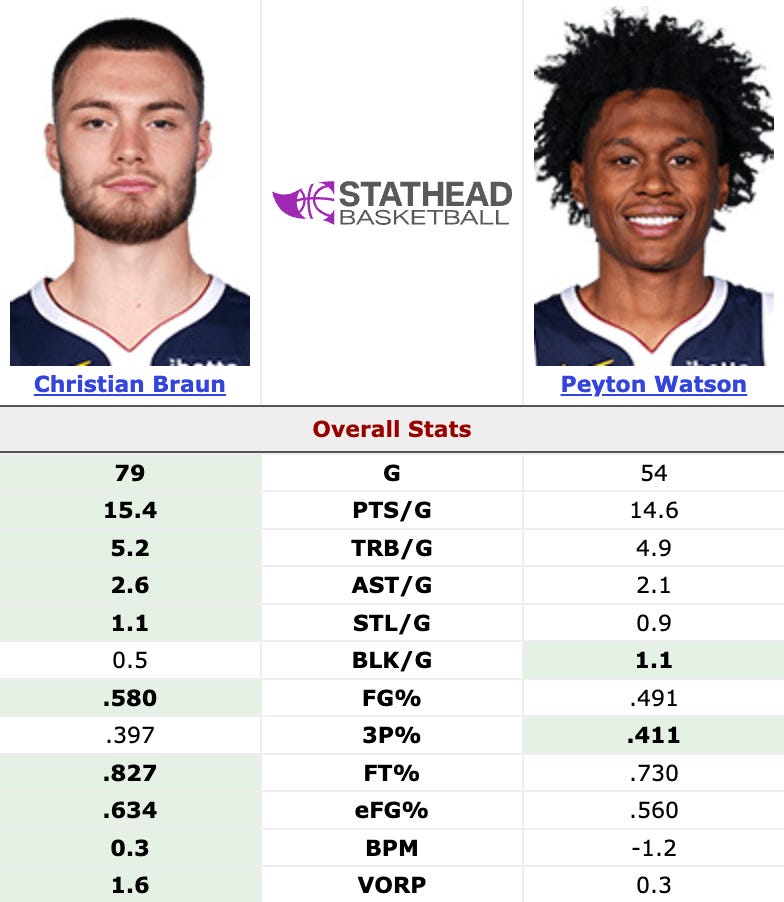
But Watson had the higher peak.
The peak-end rule tells us that people judge an experience largely based on how they felt at its peak and at its end, rather than on the average of every moment of the experience.9 While Watson’s end-of-season numbers may not have matched Braun’s, his peak far surpassed them.
Nikola Jokić hyperextended his left knee four days after Christmas, and would end up missing almost all of January. As a team, the Nuggets were up to the challenge of playing without their superstar, going 9-5 without Jokić, but nobody stepped up more than Peyton Watson. In those 16 games, Watson averaged 22 points, 6 rebounds, 3 assists, a steal, and a block-and-a-half.
And the thing is, that fits neatly into the narrative10 with Watson; he is an extremely athletic, exciting, high-upside player. It makes sense that he would rise to the occasion, when given the space and usage to show what he can do on a basketball court.
But the fact remains that it was a small sample. The disappointment in Braun’s season wasn’t just the on-court regression, but the fact that it happened after the Nuggets committed to paying him $125 million. That contract was awarded based on one season of success; if the Nuggets pay Watson what he wants (reportedly around what Braun is making), they’d be making the same mistake based on an even smaller sample of performance.
The sample is small, because Watson got hurt.
Gambler’s Fallacy & Probability Weighting
Humans are not good at understanding randomness or measuring probabilities. Sports injuries are random events that hit certain players with a certain probability. That’s an overly complicated way of saying, no one knows which of Braun, Watson, or Johnson will be healthiest next year or over the rest of their careers.
All three dealt with serious injuries last season (Braun appeared in just 44 games, Watson and Johnson in 54), and they will likely deal with more in the future. Johnson is the oldest of the group (at 30 he’s at the end of his athletic prime, while Braun and Watson are just entering their’s) and has only played over 60 games once in his seven-year NBA career. Watson is the youngest, but as a high-flying aggressive player he flirts with injury often. He’ll rotate hard to go after blocked shots and tries for the highlight reel dunks whenever he can - he actually strained his hamstring shortly after one of those dunks.
Braun, meanwhile, is generally solid. He obviously took a long time to come back from the torn ligaments in his ankle, both physically and psychologically, but if I were a gambler,11 I’d bet Braun misses the fewest games over the next few years among this trio.
Endowment Effect
Studies have found that people are more likely to retain an object they own than they are to acquire that same object when they do not own it. If you give me a mug then offer to buy it back from me, I may charge you $20 for it; if you offer to sell me the same mug for $10 I’d turn my nose up at your audacity.12
So what could the Nuggets get back for these three guys?
Cameron Johnson is in the last season of his deal before becoming an unrestricted free agent. He’s owed $23m, but is still a very capable NBA starter that teams (Memphis has been thrown around) should be willing to take a flyer on in return for another slightly lower salary, slightly lower quality player going back to Denver.
The most commonly discussed transaction for Peyton Watson is a sign-and-trade. The Bucks and Clippers have expressed interest, apparently, but they know the salary crunch position Denver is in, limiting what they might offer back. The Nuggets could probably get a few players and picks - the Game Theory podcast I cited above threw out AJ Green and picks from Milwaukee or Derrick Jones Jr. and Kris Dunn and a pick from LA.
Christian Braun would be the hardest to move because of his last season of underperformance against that $125m salary. The Nuggets would likely have to attach picks (which they do not have a lot of anymore), to essentially salary dump him.
Moreover, as the endowment effect tells us, the Nuggets value Braun more than another team who might want him. But in this case, I think they should.
As mentioned earlier, Braun is a menace on the break. His 403 fast break points are the most any player has scored in transition this decade! Of course, that’s not just Braun’s doing; he’s catching passes from one of the best outlet valves in NBA history, Nikola Jokić. Jokić led the league in rebounds AND assists last season, the first player ever to top both categories in the same season, and he LOVES any opportunity to win on the margins, including and especially looking ahead for fast break outlets. It’s a match made in heaven.13
(As a side note, Jokić and Braun - “big buddy, little buddy” - seem to really like each other, so if keeping Braun in Denver keeps Jokić happy, that’s all the more reason to do it.)
The Basketball Fit
Cameron Johnson is the best shooter of the three, no doubt,14 and that’s what the Nuggets wanted when they got him in the Michael Porter Jr. trade last offseason. Shooting is always helpful in the modern NBA,15 but it’s not the biggest need in Denver right now.
The rest of the Nuggets, excluding Cam Johnson, connected on 39.3% of their threes last season, which would have ranked first in the NBA. Jamal Murray, Spencer Jones, Aaron Gordon, Julian Strawther, Jalen Pickett, Bruce Brown, and Nikola Jokić are all above average NBA three-point shooters. More to the point, Peyton Watson made 41% of his attempts last season (and 44% - higher than Johnson’s average - during his peak) while Braun had a two-season sample of 39% shooting from beyond the arc before last year’s slump.
What the Denver Nuggets need is defense. The team had the best offense in the league, but just the 21st best defense, a profile that has never won the NBA Finals.16 By most of the advanced metrics, Braun is still the best defender among the three, even in his down year on a bum ankle.
He is the one that takes the matchup with Shai Gilgeous-Alexander, Jalen Brunson, Stephon Castle, Anthony Edwards, or whoever the other team’s best Guard happens to be that night. If the Nuggets let Braun walk, who do they put on Shai? Not Jamal Murray, his offensive load being what it is. Aaron Gordon and Spencer Jones are tough defenders, but don’t have the lateral speed for that assignment. Peyton Watson is long and quick, but he’s not the guy to stop Shai. Cam Johnson would foul out in mere minutes. Julian Strather? Bruce Brown? 6’0” Tyus Jones??
The Nuggets also need back-up ball-handlers, which all of these guys are about the same level of “sure, I guess” on, and Power Forwards off the bench given Aaron Gordon’s injury history the last few Aprils, which leans us toward keeping Watson as a back-up.17
All that said, cutting Braun would be the same type of overreaction that caused them to sign him to too big of a deal last summer. Overpaying Watson is the same exact overreaction.
Braun’s stock couldn’t be lower. Watson’s is pretty high, but for a good reason, and I’d take a flyer on his upside just to see where he can go. Which leaves us at: Start Braun, Bench Watson, Cut Johnson.
But wait! Keep scrolling down the “Behavioral Economics” Wikipedia page and you’ll find:
Familiarity Bias - the tendency of people to return to what they know and are comfortable with.
Christian Braun and Peyton Watson are home-grown stars. As a Nuggets fan, I’ve watched them play a lot of basketball, and I like watching them play basketball for my team. Christian is so exciting on the run, as is Peyton in the air. I’m fully succumbing to familiarity, and I’m ok with that.
Who passed away in 1996, and therefore was not included in the Nobel Prize since they do not award posthumously.
I actually had a great Microecon professor freshman year, and later had the opportunity to take Behavioral Economics from another leader in the field, Robert Shiller.
Nikola Jokić makes $59 million, Jamal Murray $50 million, Aaron Gordon $32 million.
After their rival Oklahoma City Thunder forced them to match a two-year, $12 million offer for Spencer Jones.
This article will assume the Nuggets want to and will get out of the second apron, but it should be noted:
Owner Stan Kroenke can afford it. He is unbelievably wealthy, having married into the richest family in America.
The second apron eliminates prior trade exceptions, but the Nuggets only have a small (~$2 million) one from trading Hunter Tyson last season.
They also wouldn’t be able to trade first round picks from seven years out, but they have already traded a lot of their future draft capital (mostly to Oklahoma City).
Finally they would lose access to the mid-level exception in free agency. The last time they used the taxpayer MLE was to sign Dario Šarić, who played 16 games in Denver and added 0.0 win shares.
Overall, the second apron restrictions are less annoying for the Nuggets than they would be for other teams.
Braun doubled most of his counting stats from the year prior, with improved efficiency.
Braun dunked just 0.66 times per game last season, down from 1.19 times per game the season before.
Braun was drafted 21st in 2022 by Denver. Watson was taken nine picks later by Oklahoma City, then dealt to Denver the same night.
For some reason, the most commonly cited example has to do with colonoscopies.
There is also a narrative fallacy, when people use narratives to connect the dots between random events to make sense of information.
Ignoring my advice to pay attention to fallacies, like one literally named after gamblers.
It’s for this reason that I’m honestly surprised so many “fair” deals get done in the NBA or any sport for that matter.
Or at least the high altitude of Denver.
The Game Theory podcast has him as a top-5 shooter in the league.
You win by scoring more points than the other team, and you score points by shooting.
The closest team is probably the 2022-23 Nuggets, who were 5th on offense, 16th on defense.
Honestly, if Aaron Gordon goes down again next Playoffs, I don’t know that this hypothetical matters anyway; he’s that important to their championship aspirations.
My gut says cut Braun, but you're right, it'd probably be an overreaction to last season when he was hurt. I'd definitely regret that if he comes back healthy and looks like he did in 2025.
At the same time, I feel like Watson and Cam have so much upside. Watson seems like he has a lot of potential to be a really impactful two-way player. Cam looked great last season, but at times he seemed unsure of his role, almost like he didn't want to step on any toes. I tend to think (and hope) that that will no longer be the case next year.
I can't answer your poll question because I want them to keep all three. 😂
Also, I need to re-read Thinking Fast and Slow 😂