

Mapping the WNBA
2026 Starting Lineups by the Numbers

The WNBA season is underway, and to get you acquainted with who is taking the court I’ve put together a visual guide to every team. In the past, I’ve looked at starting lineups from the opening day games, but given injuries to key players this year I’ve decided to highlight each team’s “best” starting lineup. Best is subjective, and I’m not a WNBA coach, but I made my best evaluations and used Her Hoop Stats as a guide. This gets us close enough to make some initial observations on the 2026 WNBA.
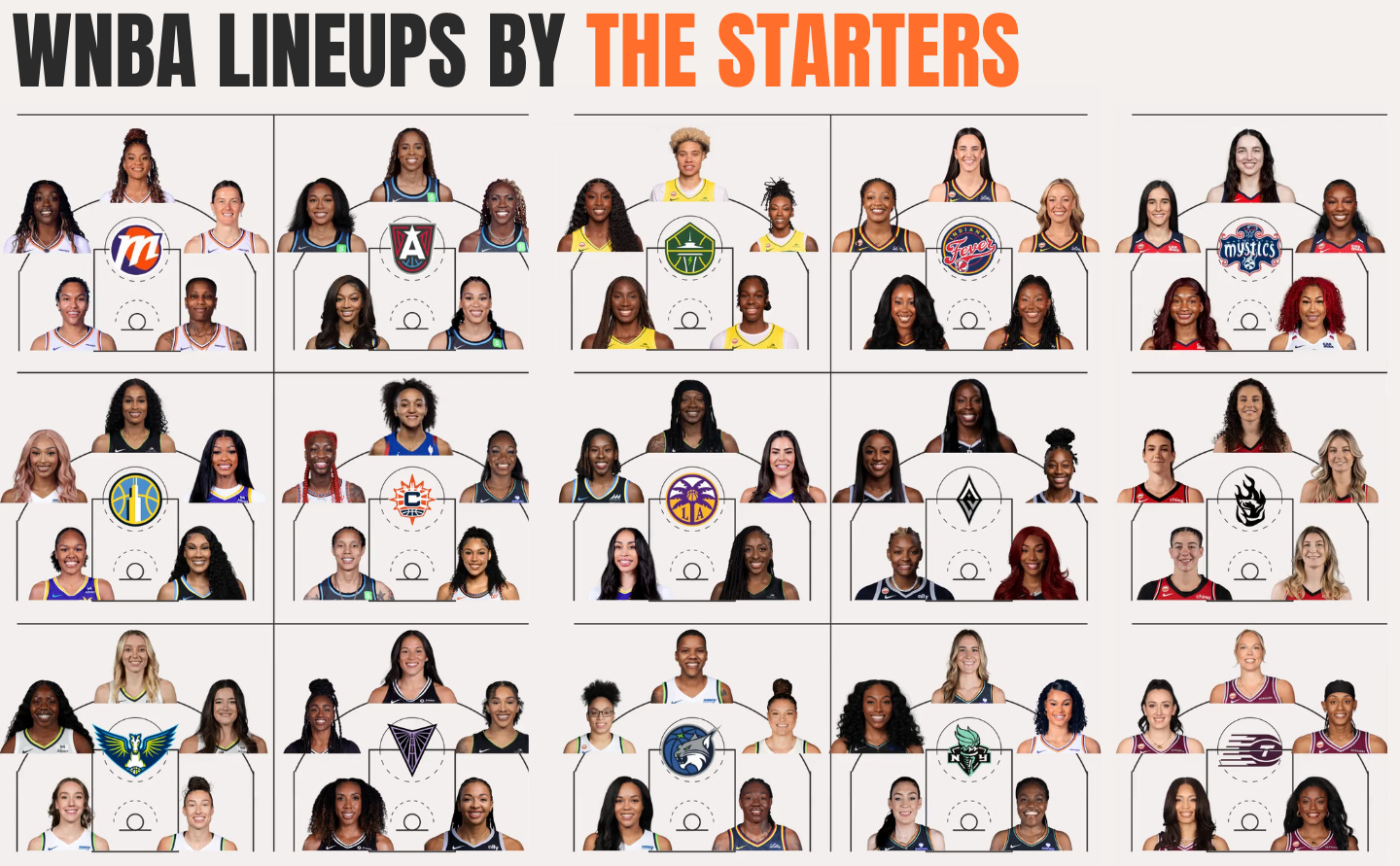
The first thing to note is that this starters1 map looks pretty different than the same map from a season ago. For starters, there’s two new teams with the Portland Fire and Toronto Tempo joining the league and filling out their rosters in last months’ expansion draft. So of course every player in Portland and Toronto is new to their city, but across the league there are a lot of faces in new places.
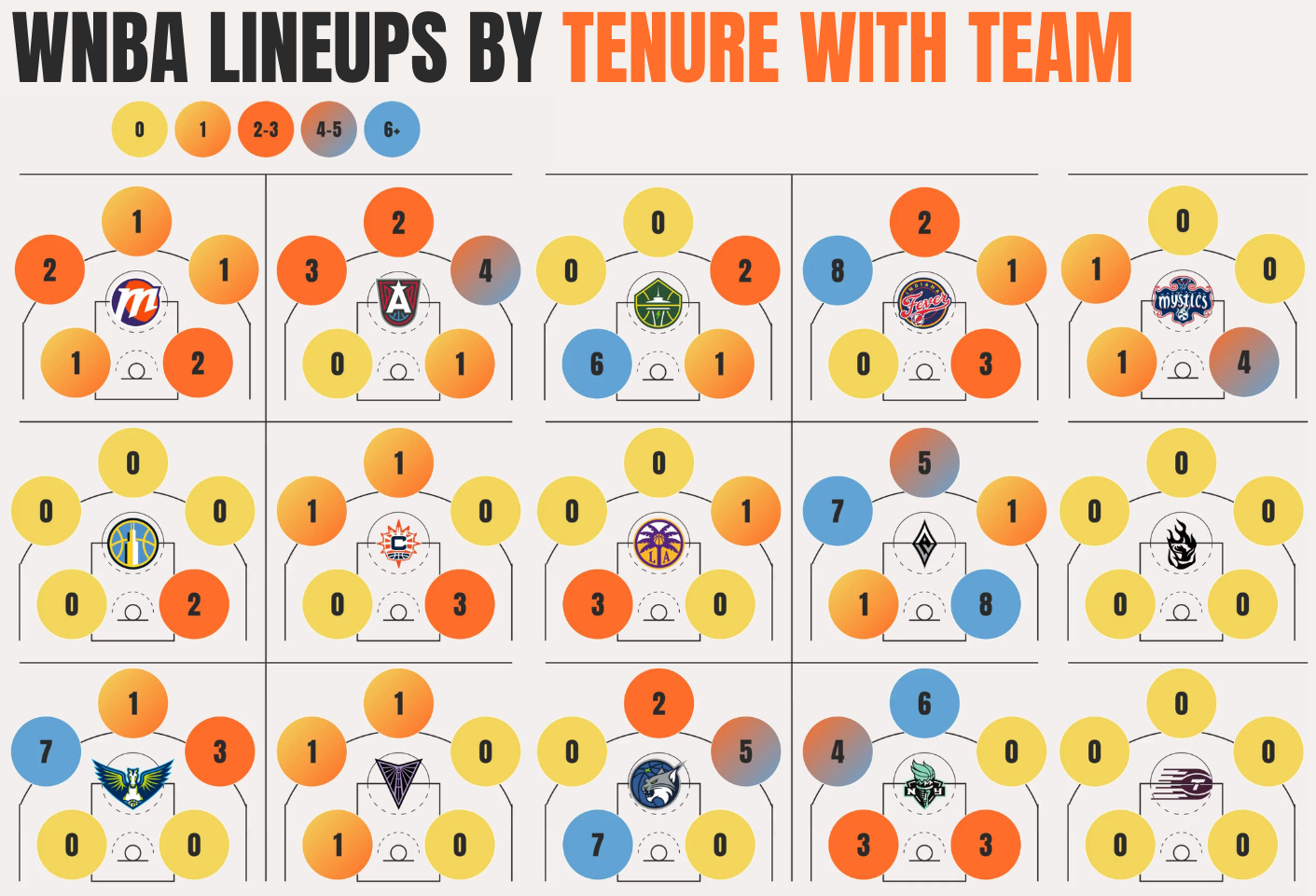
To orient you to the map above, the yellow circles represent the players who are brand new to their team (0 years of tenure), orange are the players who have been in the same cities for a few seasons now, and blue are the true loyalists.
Across the entire league, the average starter has spent just a season and a half with their current team. Even in Phoenix, where the entire starting five is made up of returning players,2 all of them were new to the team in the last year or two.
The defending champion Las Vegas Aces are the only outlier, returning every key piece and starting three different players with over five years of service with the team. A’ja Wilson has been with the Aces organization for eight years now, the longest current streak in the W.3
As mentioned Portland and Toronto are all brand new, and Chicago is almost as yellow. The Sky returned just one starter from last season’s team (Kamila Cardoso) as they traded Angel Reese to Atlanta and Ariel Atkins to Los Angeles, lost Kia Nurse in the expansion draft, and bumped Courtney Vandersloot down the depth chart after signing Natasha Cloud and Skylar Diggins.4
Diggins moved to Chicago from Seattle, who return just two starters themselves as they look to rebuild around a young core. The Storm lost three veterans in the offseason between Diggins, Gabby Williams signing with the Valkyries, and Nneka Ogwumike returning to LA.
Nneka isn’t new to LA, having spent the first 12 years of her career in Los Angeles, but from last year’s team the Sparks also returned just two starters (Kelsey Plum and Dearica Hamby). They sent two starters (Rickea Jackson and Azurá Stevens) to Chicago. It all comes full circle.
This amount of offseason movement is atypical,5 driven by a one-off change in the offseason: the new collective bargaining agreement. As I wrote a few weeks ago,
Knowing that the old CBA was set to expire, and that salaries would increase significantly, almost every player in the league timed their contracts to end last season, meaning almost every player in the league was a free agent this offseason.6
Of course the other outcome of the revamped CBA is that, across the board, salaries are significantly higher. There are 35 blue circles in the visual below, representing the 35 players earning over $1m to play WNBA basketball in 2026.
Some front offices, though, are showing they are willing to spend more on top level talent than others.
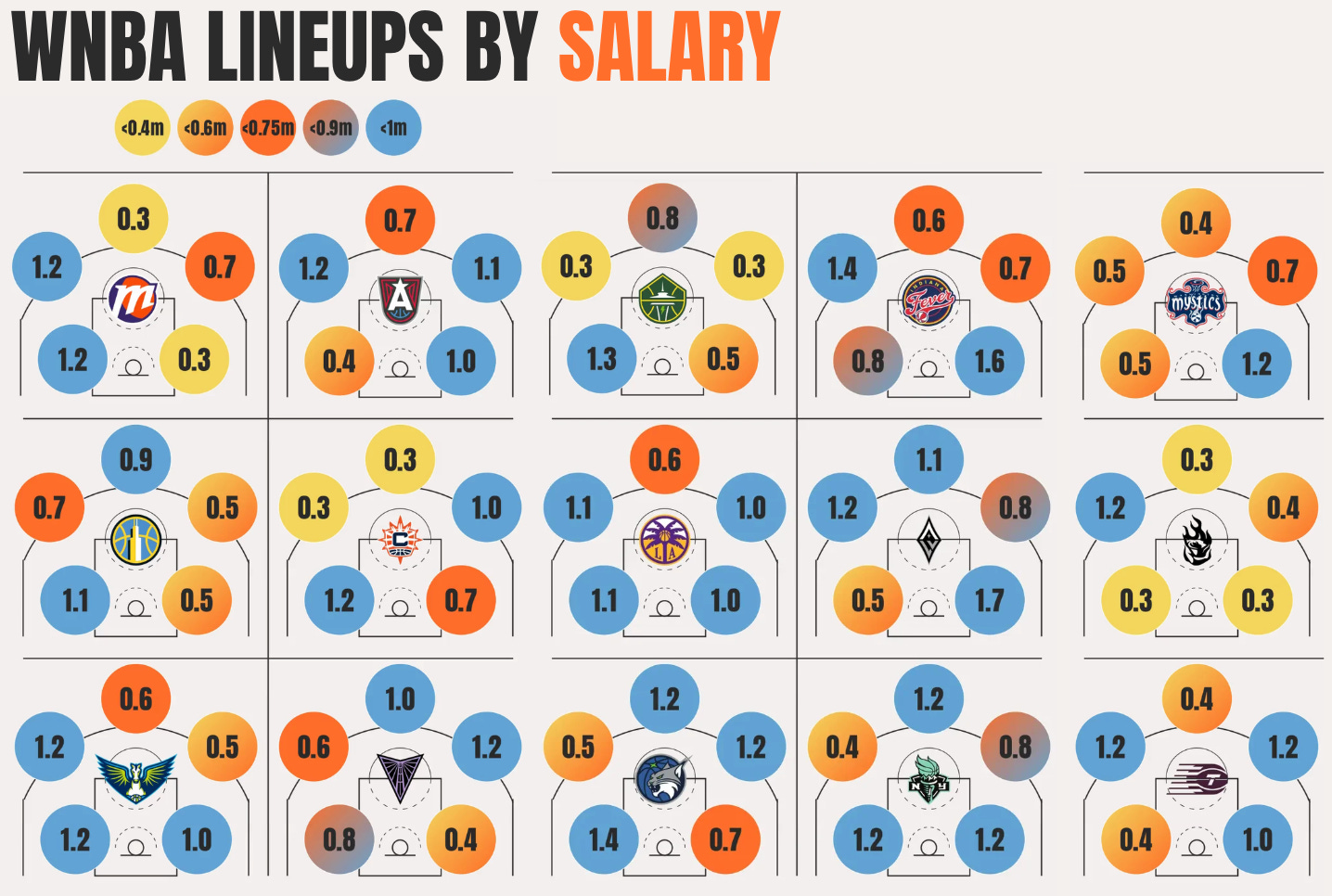
The Las Vegas Aces’ starting five will make a combined $5.2m this season, $100k more than any other team (the Minnesota Lynx are second at $5.1m, assuming you include Napheesa Collier’s super-max). The Sparks are paying four of their five starters $1m or more and the Liberty are paying three starters at least $1.2m!
On the other end, the Seattle Storm are paying their starters an average of just $620k. As mentioned, they roster a much younger core, and three of their starters are still on their rookie-scale contracts.
We can also use this format to see which teams are prioritizing which side of the ball in their roster construction. The maps below show each player’s percentile ranking in Neil Paine’s LAKER metrics7 for offense and defense.8
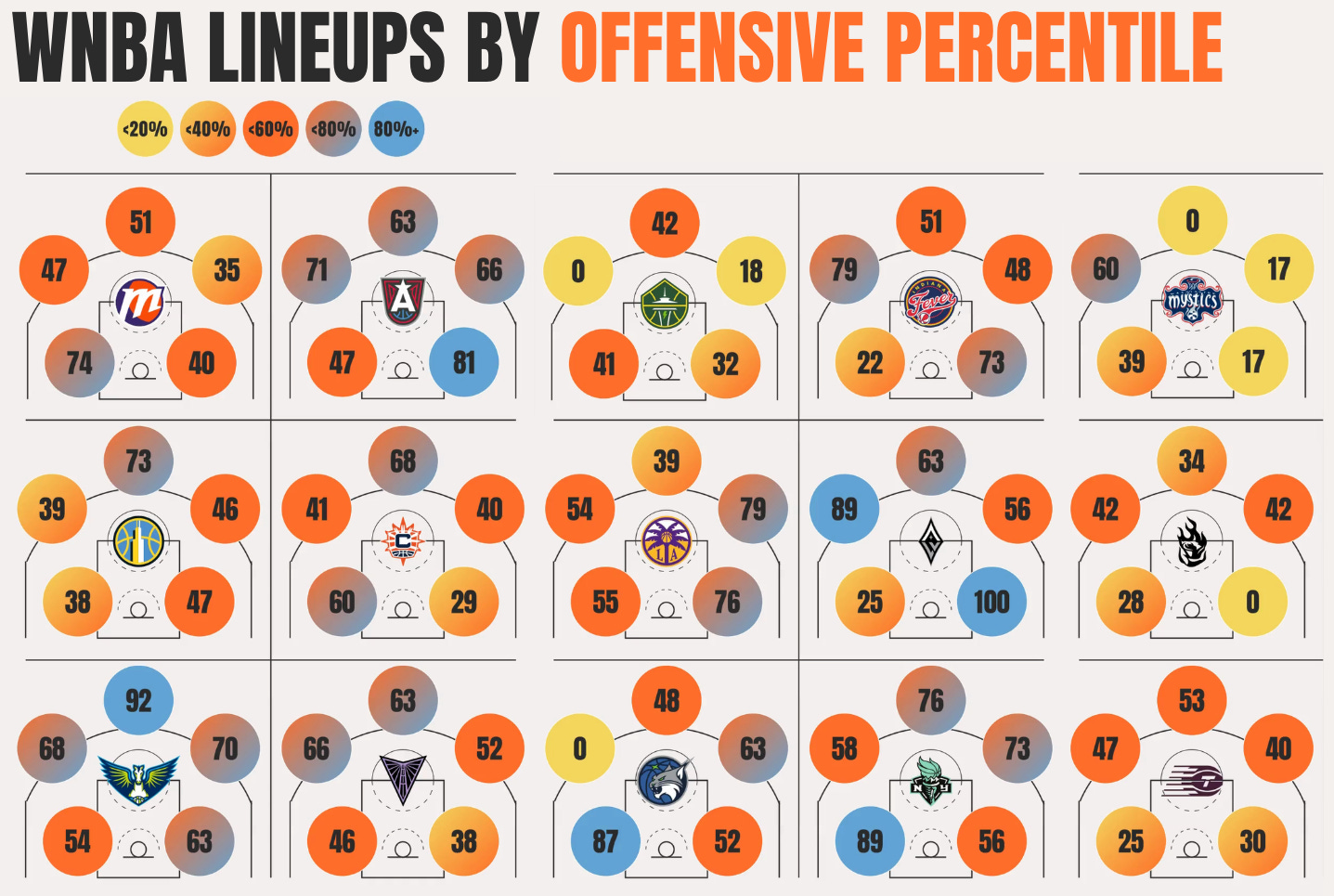
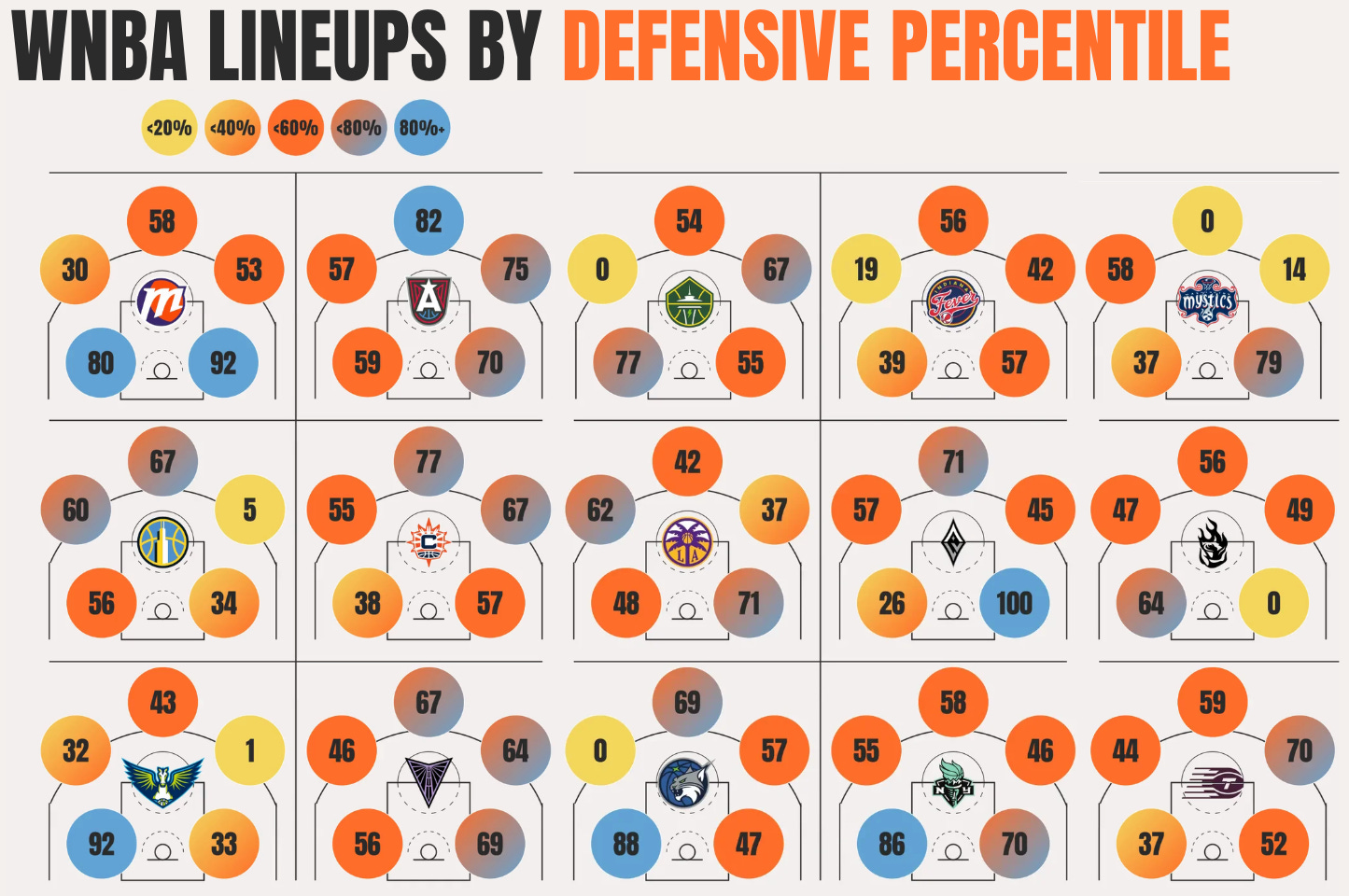
The Mercury figured out how to slow down the Aces in their opening game, but the Sparks quickly found out how hard that can be. Las Vegas is the only team with two top-10 percentile offensive players (A’ja Wilson and Jackie Young), and four of their five starters are above average. The Dream, Wings, and Liberty also profile as offensive powerhouses.
It’s no fluke that the Phoenix Mercury held the Aces to 66 points though. Their backcourt of Alyssa Thomas and Natasha Mack are elite defensive stoppers. Elsewhere in the league, the Atlanta Dream and Golden State Valkyries were already strong defensive teams last season, and added the league’s most prolific blockers (Angel Reese to the Dream) and stealers (Gabby Williams to the Valkyries) in the offseason. And A’ja Wilson is also the best defensive player in the W, because of course she is.
For contenders, the Indiana Fever look don’t pop out here. Their defense will likely be shaky throughout the season (we saw Dallas put up 107 points on them in the opener), but the belief is that Kelsey Mitchell continues being one of the best offensive guards in the league, and both Aliyah Boston and Caitlin Clark continue growing.
Yes, Caitlin Clark, one of the preseason frontrunners for MVP, is currently rated as just slightly above average. Of course, that’s based on her WNBA pedigree of a good Rookie year and a Sophomore shooting slump that ended after just 12 games due to injury.
Let’s go rapid fire through some other ways to break down these WNBA lineups:
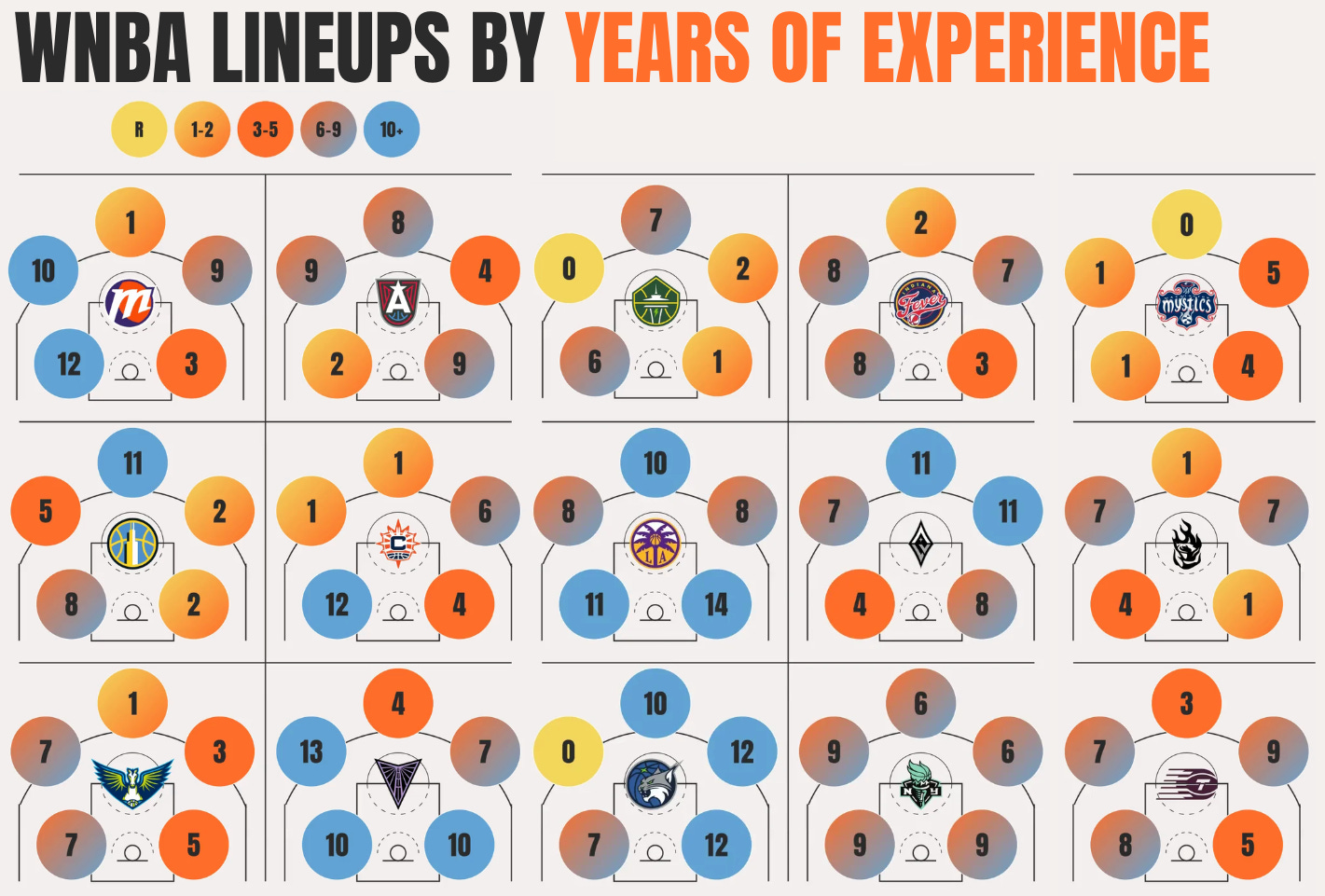
The Sparks (with Nneka Ogwumike in year 14), Valkyries, and Lynx have the oldest starting units in the league
Washington, Seattle, and Dallas have the youngest starting units
Three Rookies are starting: Flau’jae Johnson in Seattle, Georgia Amoore in Washington, and Olivia Miles in Minnesota
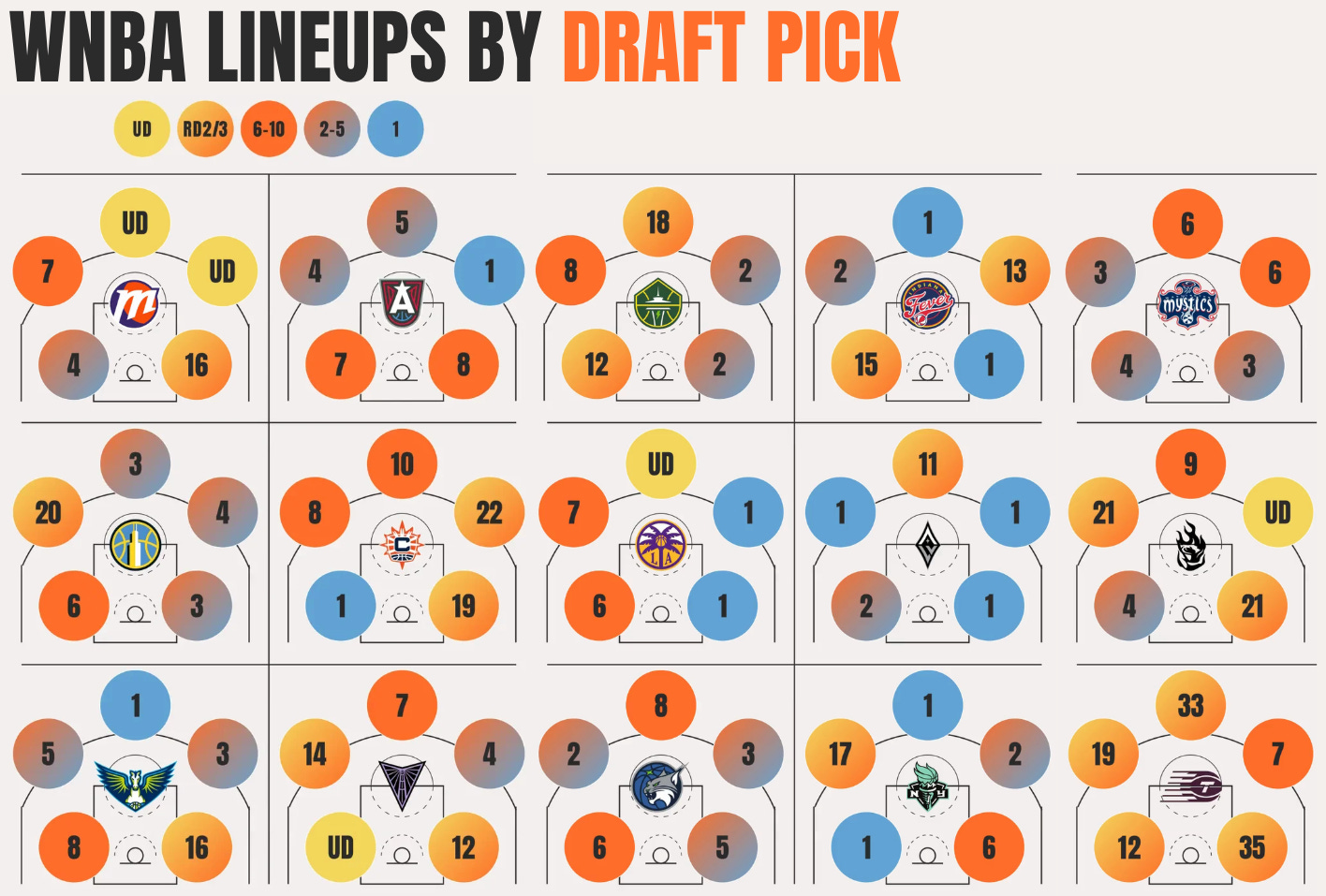
The Aces have three number one picks and a number two pick in their top five. That’s not fair
Neither the Fire nor Tempo have a single top three pick. Hard out there for an expansion team
Five undrafted players are among their teams best, including two in Phoenix (Monique Akoa-Makani and Sami Whitcomb)
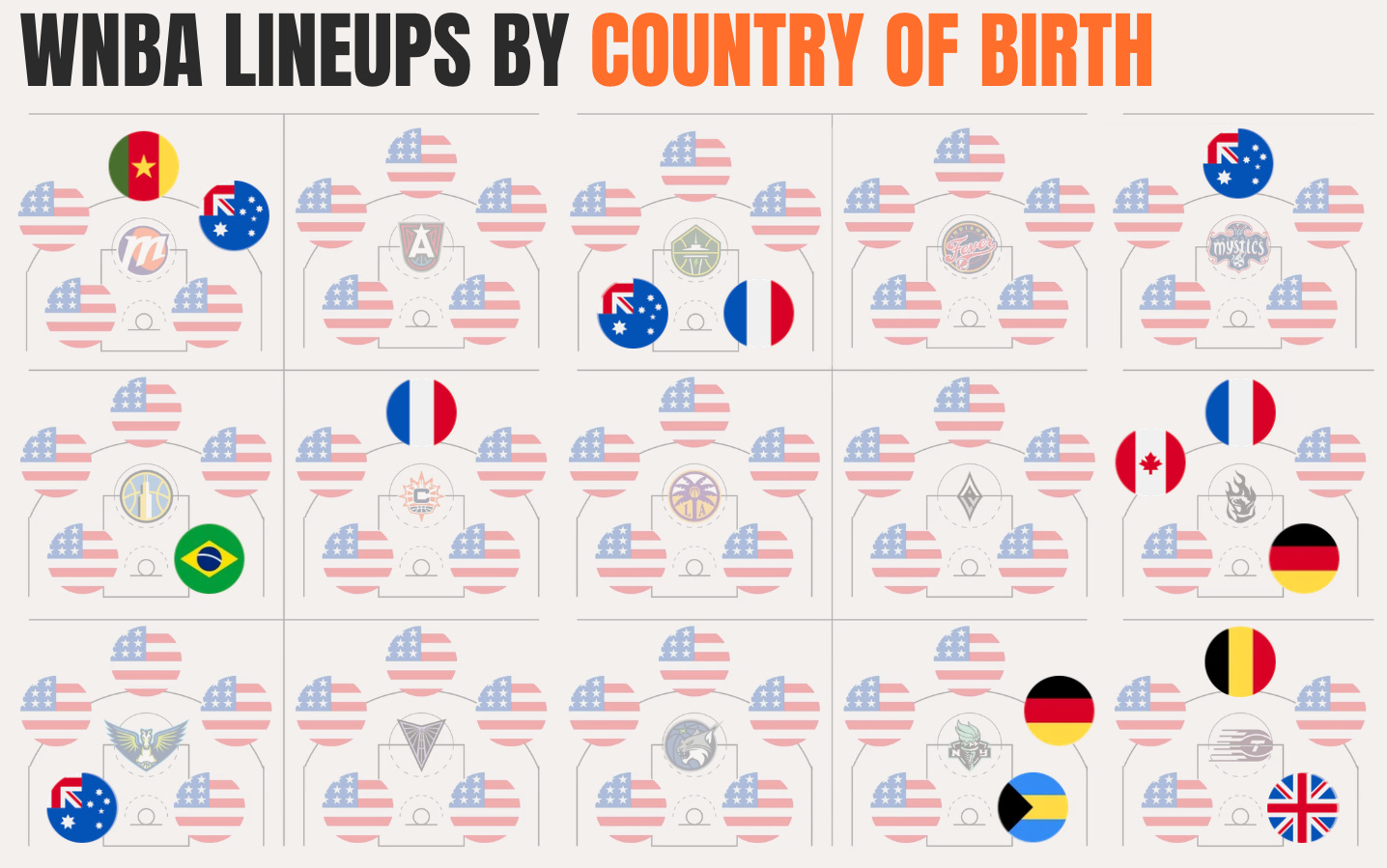
Four teams (Mercury, Storm, Liberty, Tempo) start two international players each and the Fire start three (Carla Leite from France, Bridget Carleton from Canada, and Luisa Geiselsoder from Germany)
Australia is still the most represented international destination among these starters (boasting Sami Whitcomb in Phoenix, Ezi Magbegor in Seattle, Georgia Amoore in Washington, and Alanna Smith in Dallas), but France (Dominique Malonga in Seattle, Leïla Lecan in Connecticut, and Janelle Salaün in Golden State) is catching up.
Only six teams - less than half the league - are all-American
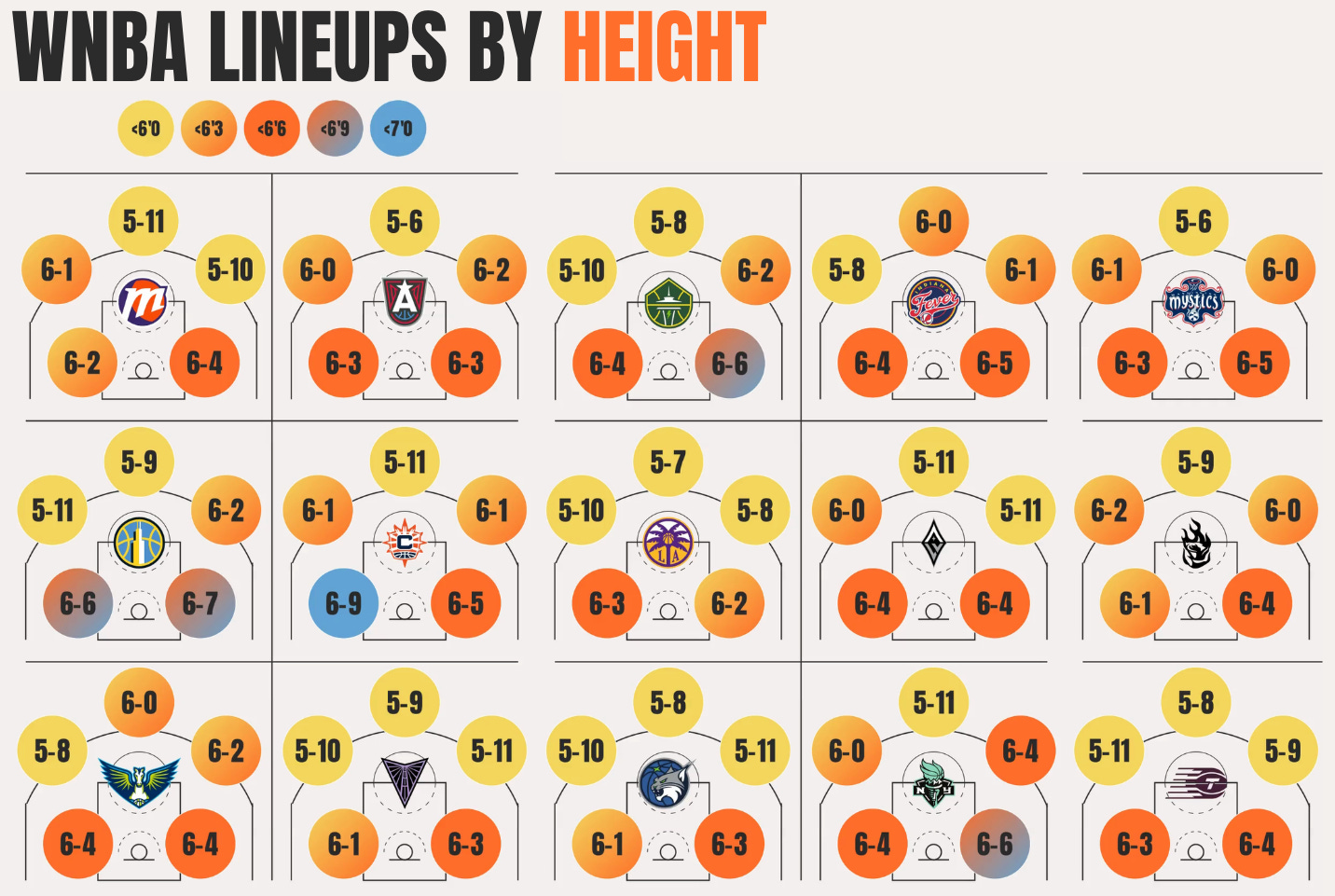
Brittney Griner, now with Connecticut, continues to be the tallest player in the W
The Chicago Sky have both the second (Kamilla Cardoso) and third (Azurá Stevens) tallest starters in the league
Georgia Amoore, Washington’s Point Guard, is the shortest in the league at 5’6”
For simplicity I’ll be using the term “starters”. Don’t come at me if someone listed here doesn’t technically start in the first game or two!
They did lose a key starter as Satou Sabally signed with New York, but her replacement in the top five, Sami Whitcomb, was also on the Mercury last season.
Tied with Kelsey Mitchell who the Fever drafted in 2018. Though technically, Wilson was drafted by Las Vegas about two minutes before Mitchell was drafted by Indiana, so Wilson has the slight edge.
Two perfect nomen-culture fits.
That said, we may see more turnover next year as 20 of these 75 starting-level players are in the last year of their contracts.
Literally every eligible player (i.e., not on their pre-defined rookie contracts) in the league was a free agent this offseason except for two players named Brown: Lexie on the Seattle Storm and Kalani on the Phoenix Mercury.
Average over the last three years.
Zeroes indicate a Rookie with no WNBA games to evaluate yet.