

Charting Happiness
When was your city's peak sports moment?

Happy Thanksgiving-eve everyone! As you go around the table tomorrow night expressing what you’re grateful for, I imagine some of you might have sports on your mind (and the TV; Go Pack!).
I’m certainly thankful for Jokić passes, Steph’s physics-defying shots, and a healthy LeBron. I’m also thankful for three decades of memories made in baseball stadiums, basketball arenas, and Cal football games with friends and family. So this week, I’ve applied a little data (as I do) to highlight some things to be grateful for in the sporting world. I’ve included almost every pro team across the four major US sports, so I hope you can find something that sparks a happy memory.
Around 6pm on Saturday December 30th, 2000, a 60-degree afternoon in the warm Florida winter, Miami Dolphins running back Lamar Smith broke free for a 17-yard, game-winning touchdown. Sports fans across the city celebrated this latest victory, and the entire year of Miami sporting success. They were as happy as they’d ever be.
It had been a great year all-around for the Miami teams:
The Heat won 52 games in the NBA, slightly better than expected, and made it all the way to a Game 7 in the Eastern Conference Semi-Finals. They fell to Patrick Ewing’s Knicks by a single point,1 a tough loss, but Heat fans could look back on the season content. Fans packed the brand new American Airlines arena all year to watch their favorite players, driving attendance to new heights. It was a fun roster of players with nicknames like Monster Mash, Thunder Dan, Tim Bug, and Big Cat. Of course, at the center of it all was Alonzo Mourning, Mr. Heat himself, playing in his prime. He won Defensive Player of the Year and finished third in MVP voting for the second season in a row.
The Florida Panthers had a third place MVP finisher of their own in 2000, Pavel Bure. He led the NHL in goals, recording a hat trick on four different occasions, and his Panthers made the playoffs as well. Unfortunately, they faced the eventual champion New Jersey Devils in the first round, and were unceremoniously swept, but for a team making its third playoff appearance in just seven years of existence, it was an exciting run. Plus, fans could optimistically look forward to having the fourth pick in the following year’s draft.
The Marlins were the only team not contributing much in Miami, finishing a hair under 0.500 to miss MLB’s playoffs, though the team did have a top-10 minor league system, which would help them win the World Series three years later.
With the Marlins playing average ball, it would have normally been a quiet summer in Miami. Instead, the dog days were filled with the arrival of the Miami Sol to the WNBA. Over 8,000 fans packed into American Airlines arena each game day to watch the women play their inaugural season, and the team went 13-19, actually one of the better starts in expansion team history. The team disbanded just a few seasons later, but fans didn’t know that at the time, and could simply enjoy the product on the floor.
Which brings us back to the Dolphins. The team was expected to finish an even 0.500, but went 11-5 to capture the AFC East, and earn a home-field matchup against Peyton Manning’s Colts. Indianapolis took control early, going into halftime with a 14-0 lead, but the Dolphins fought back and scored with 40 seconds remaining to force overtime, which opened the door for Lamar Smith’s game-winning run. And the Miami crowd goes wild!!!
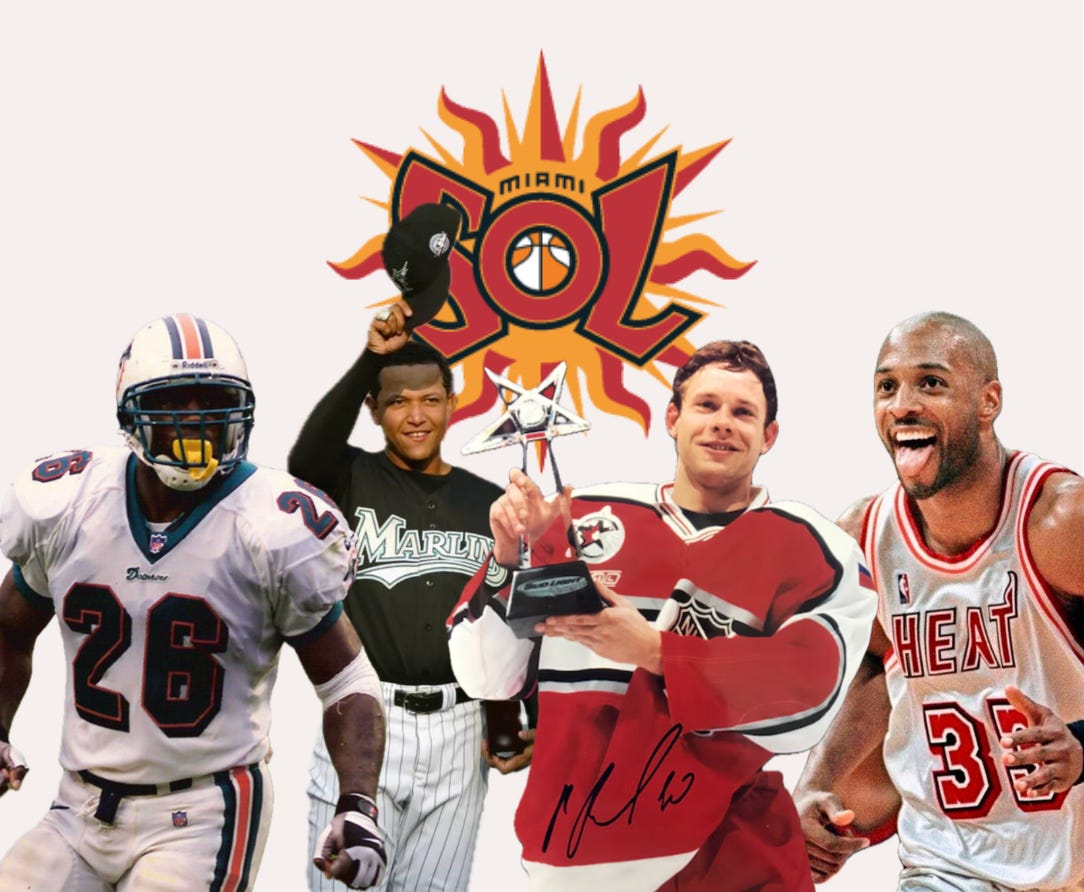
To recap: Miami sports fans got their fifth professional sports team, saw three of their teams in the playoffs, cheered for two stars among the top-three players in their leagues, and set new attendance records. It would never get better for Miami.
That’s according to my very scientific, precise, incontrovertible measure2 of sports fan happiness.
What is Happiness?
Yep, we’re charting happiness this week. So the natural first question is, what is happiness? Well lucky for you, dear reader, I audited PSYC 157: Psychology and the Good Life in undergrad and recently refreshed my memory with Michael Schur’s How to Be Perfect: The Correct Answer to Every Moral Question.
The main thing to note is that happiness is more than just winning. Of course winning a championship is an important factor, and I account for it accordingly, but only one city per league gets to lift the trophy at the end of the season. Plus a city has won multiple championships in the same year just 12 times since 19803 so it’s not a particularly interesting way to answer the happiness question.
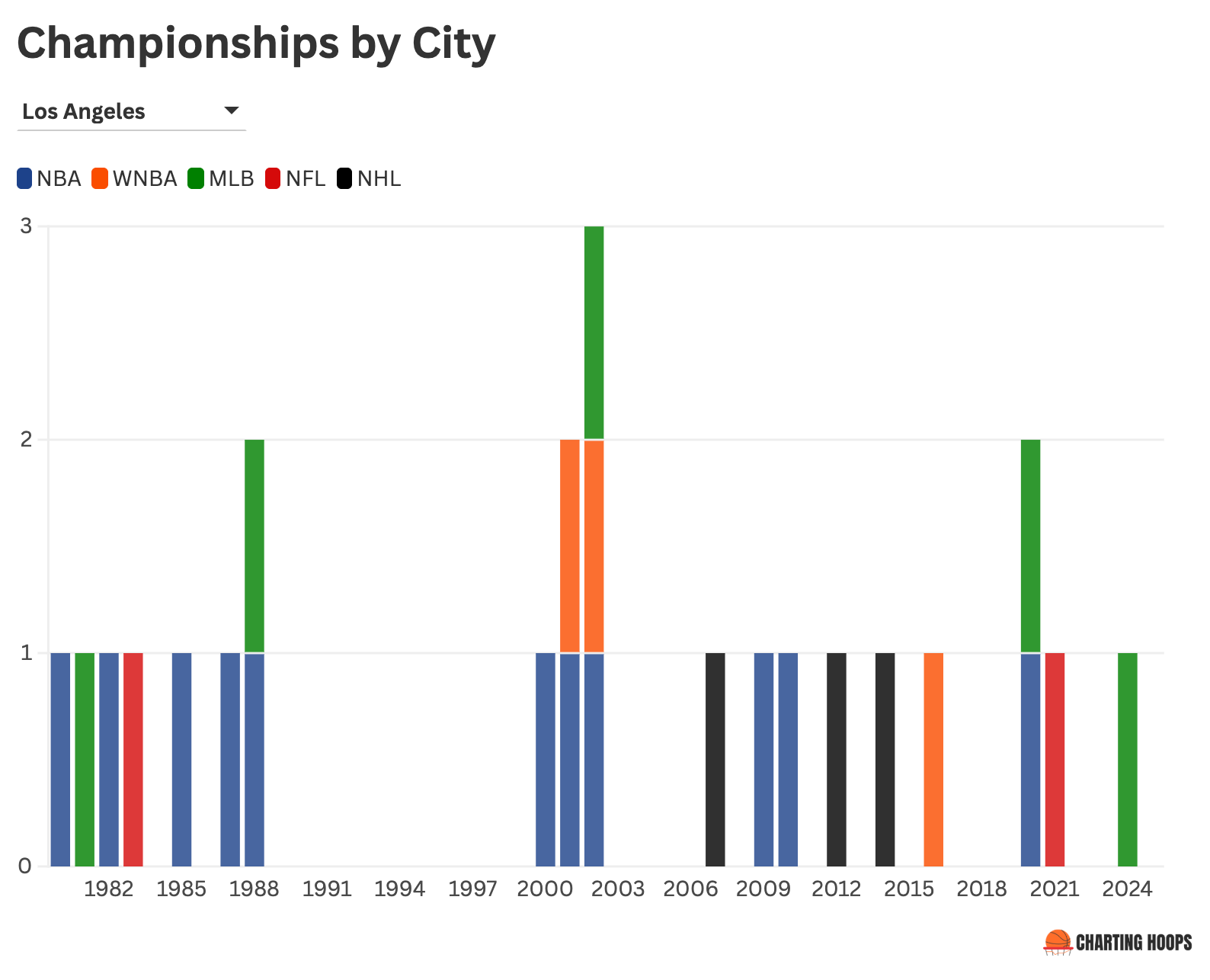
We could extend the championship window, and start to identify periods when certain cities are repeatedly winning titles, aka “Title Town, USA”. And sure, maybe LA was happiest in the early 2000s when the Lakers and Sparks were winning titles every season, and maybe NYC was happiest in the 1980s with an Islanders four-peat and a couple of Giants and Yankees trophies.
But I’d argue that there is so much more to the happy fan:
That “pinch me I must be dreaming” feeling that comes with getting to watch one of the best athletes in the world compete for your team, your city, night in and night out.
The “we’ll get them next season” outlook backed up by a solid core of young players or promising draft picks.
Getting a new team, and adopting them as your own.
There’s also the sadness factors: finding out your favorite player has been traded away, and you don’t have the American Express jersey insurance. The dread and disappointment from a promising season going off the rails. Having a team you’ve cheered for your whole life up and move to another city without even a wave goodbye.
At the end of the day, there is just the pure joy that comes from spending a few hours with a community watching and rooting for a common goal, supporting your favorite team, favorite players, and YOUR city.
How do you Measure Happiness?
Ok, but how do we measure a city’s peak sports happiness? This is a chart-centric publication after all. Is it just where Tom Brady happens to be?
Happiness is an ambiguous, loose concept, but this emotion wheel does a good job breaking out the various components which we can match metrics against. For instance . . .
Accepted: How many teams played for your city?4 Did you recently gain a new one? Did you recently lose one?
Peaceful: Did your teams make minimal trades relative to the rest of the league and maintain a calm roster steadiness? Did they fire their coach (negative)?
Interested: Did your teams have players in the MVP conversations?
Trusting: Did your teams come close to preseason expectations (positive)? Or were they way off (negative)?
Content: Did your teams make the playoffs?
Proud: Did your teams win a championship?
Powerful: Were any of your teams in the midst of a dynasty (winning three or more championships in a five-year span)?
Optimistic: Did your teams have players getting Rookie of the Year votes? Did your teams have high draft picks for the following season?
Playful: Was attendance significantly higher than usual? A catch-all for the other things that bring fans to games, like just a fun, playful group to root for.
Each of the nine factors is weighted equally, except for winning a championship (1.5x) and losing a team (-2x). Contributions are standardized across leagues, to account for differences in things like award voting behavior, season length, and attendance capacity.
Final methodology note: there is a “fading factor” so certain accomplishments (namely gaining or losing a team, winning a championship, or having a Rookie of the Year candidate) in one year still provide some value in the years following. As one of the hosts of the Casuals podcast, a Boston Celtics fan, said upon his team getting eliminated from the playoffs this year:
We won the championship last year - it was less than 12 months ago we experienced that ultimate euphoria. So there’s still some residual feelings left. Like “ok this team has given me what I wanted to see in the not so distant past.”
I collected literally millions of data points to measure these nine components back to 1980. That should be enough to decisively determine a city’s level of happiness re: its sports teams, right? Right.5
Charting Happiness
Let’s start with the Miami6 example from above.7 In these charts, a taller steamgraph (aka “blob”) means more happiness.
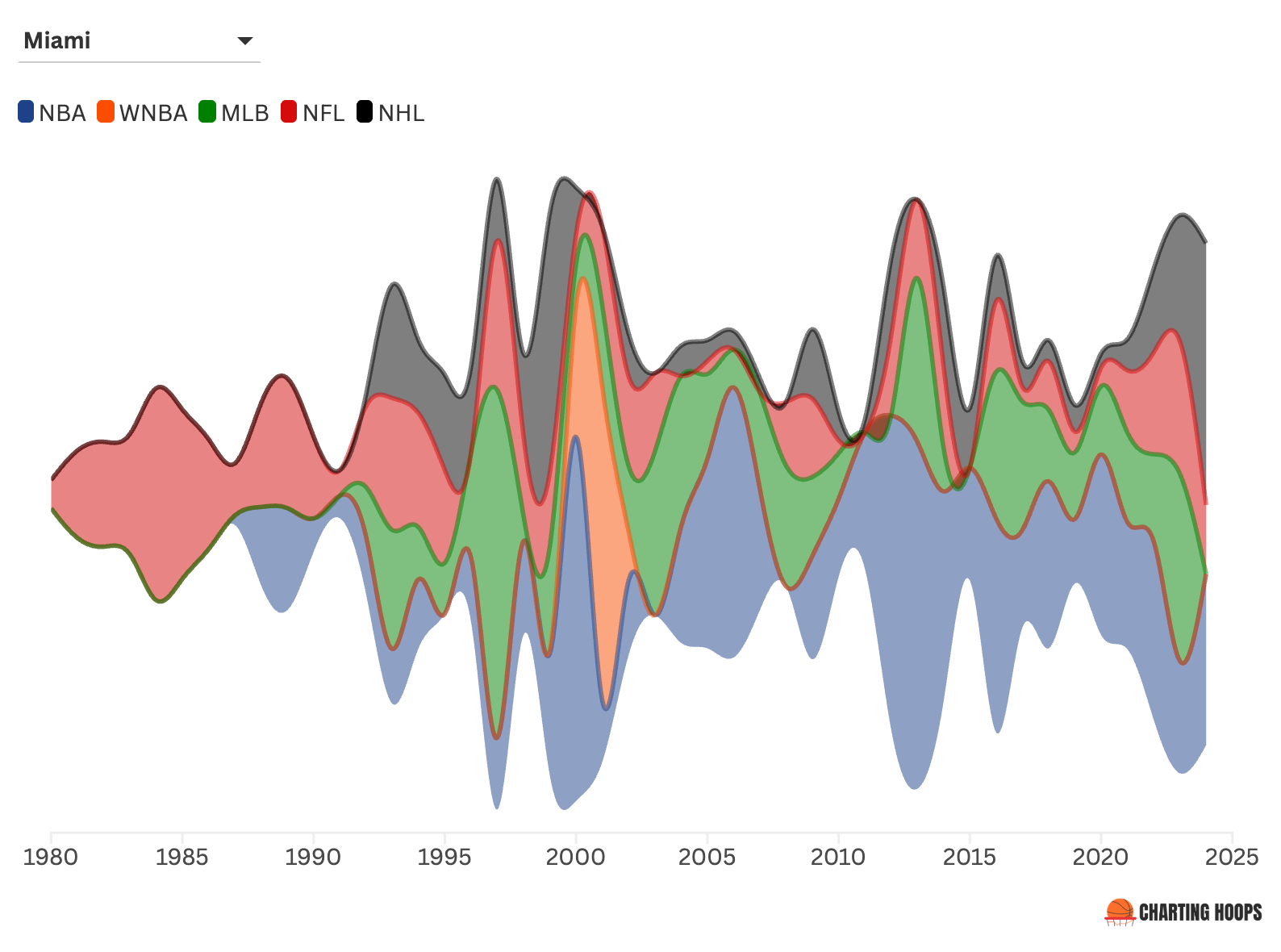
The 2000 peak is clear, with contributions across sports. Compare that to 2006, 2012, or 2013, when the Miami Heat won the NBA championship but overall happiness was lower due to the loss of the Sol and less happy Panthers and Dolphins.
So championships aren’t the only thing. No city reflects this more than Boston:
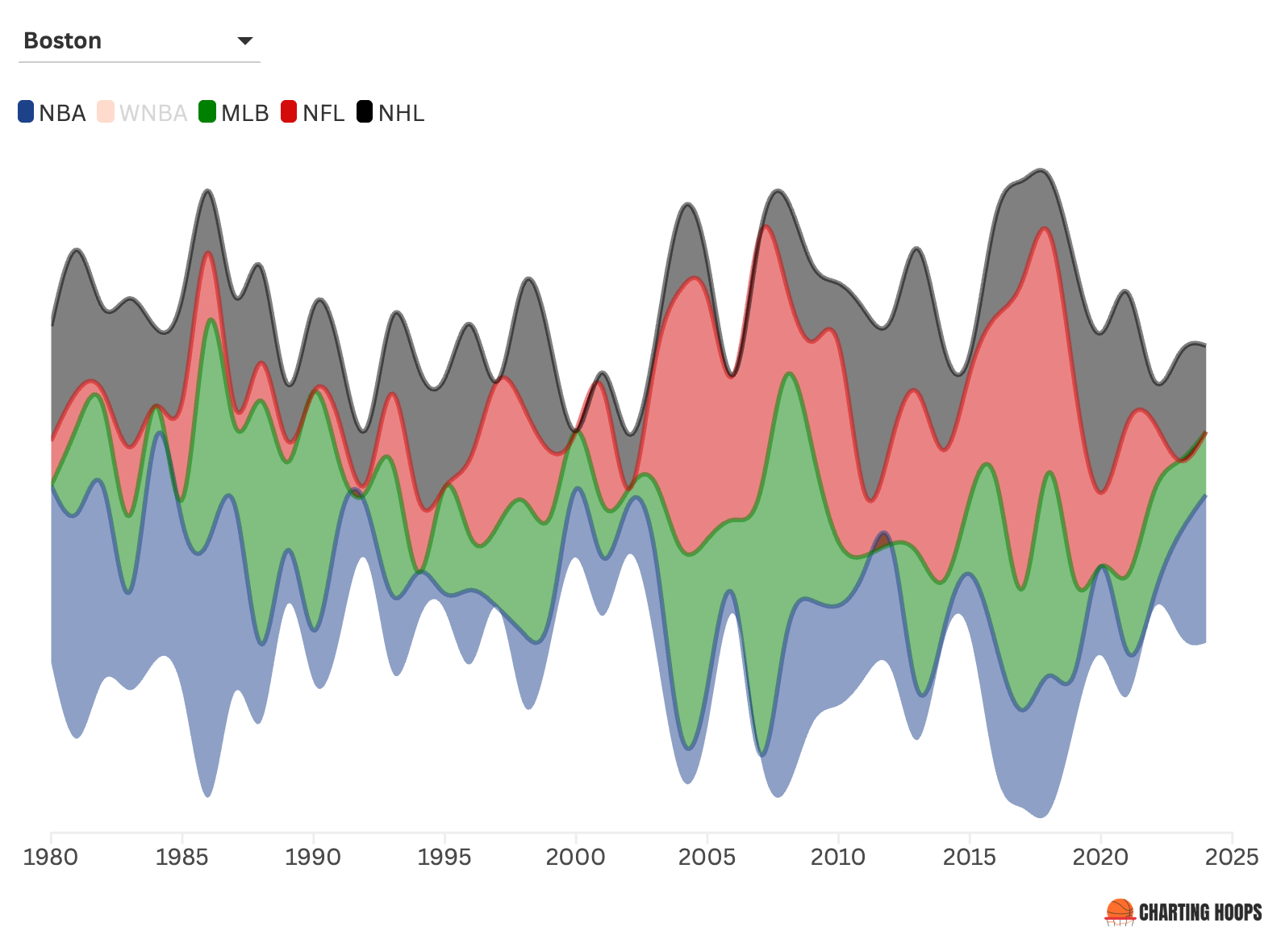
It seems like Boston throws a parade every year. Since 1980 they’ve had celebrations for the:
Celtics in 1981, ‘84, ‘86, ‘08, ‘24
Patriots in 2001, ‘03, ‘04, ‘14, ‘16, and ‘188
Bruins in 2011
Red Sox in 2004, ‘07, ‘13, and ‘18
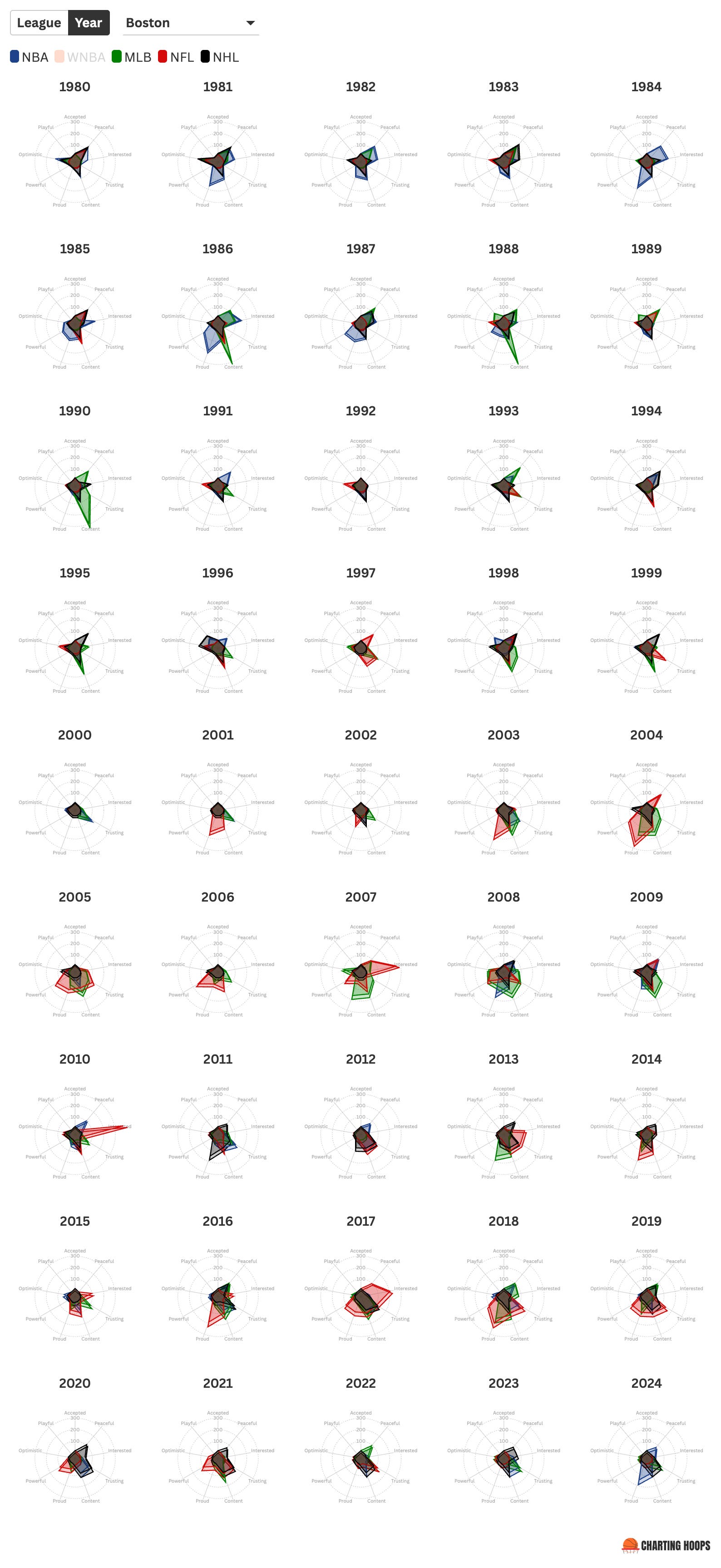
All of these were happy years, but it was actually 2017, the rare year without a trophy, that I deem the happiest.9 All four teams performed to expectations and made the playoffs, plus Tom Brady won MVP and every other Boston team had a player get some votes (Mookie Betts & Chris Sale for the Red Sox, Isaiah Thomas for the Celtics, and Brad Marchand for the Bruins).
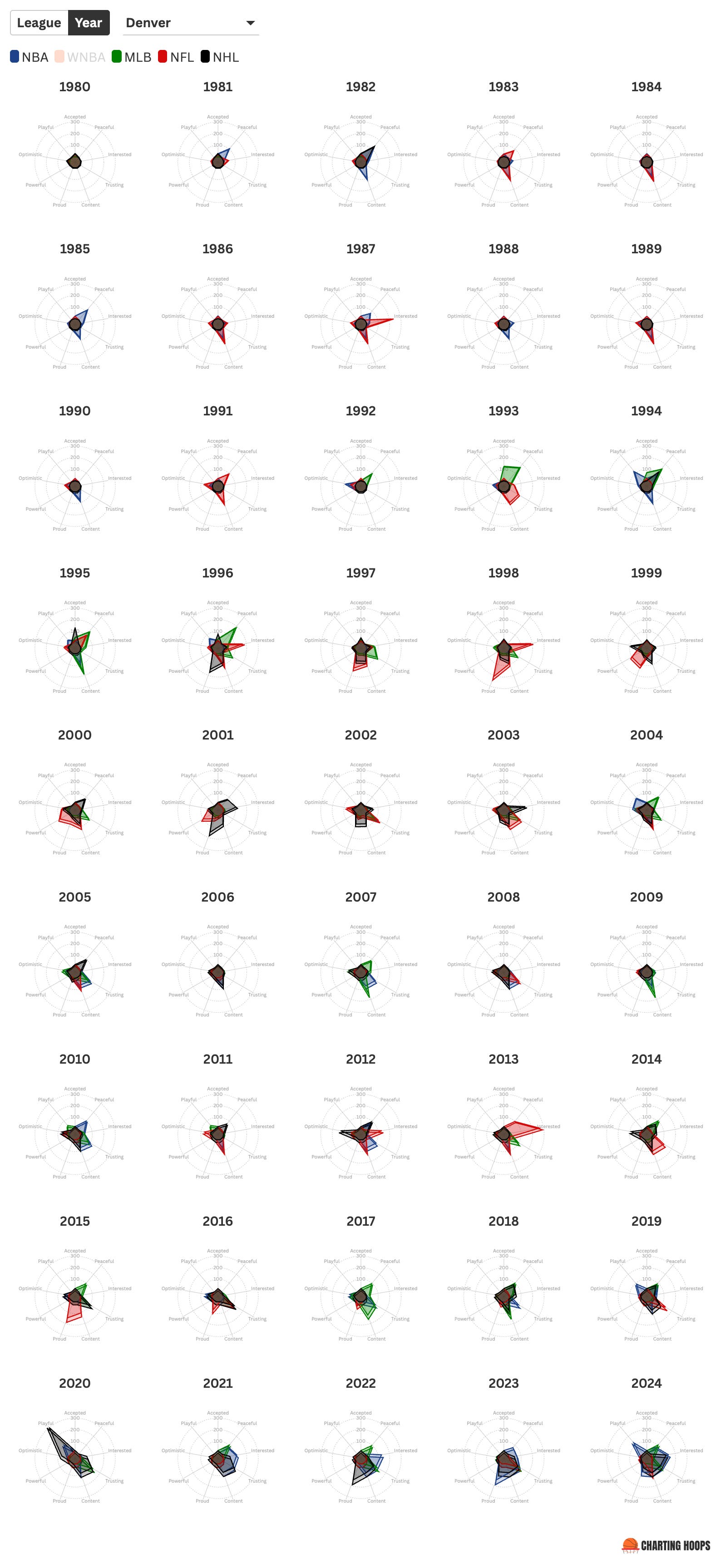
The radar charts help show what drives happiness in Boston.10 There were no trophies (“Proud”) in 2017, but enough from everything else to make it the happiest year in Boston sports history.
Feel free to continue reading as normal, or jump to the cities you’re most interested in. You can also explore the charts yourself: steamgraphs here and radars here.
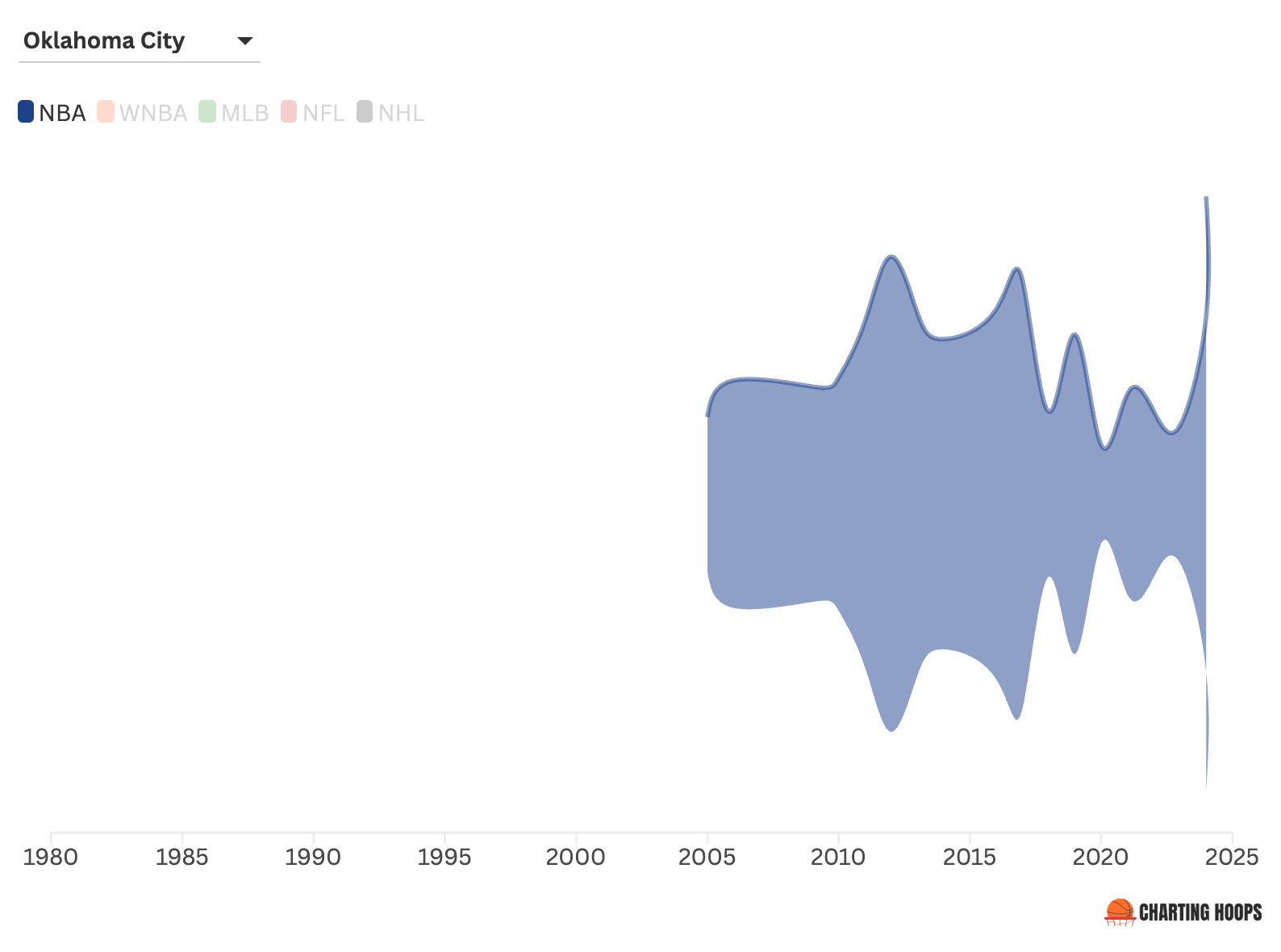
Championships do matter more if you’re the only show in town. Oklahoma City is undoubtedly the happiest they have even been:
But in most places, one team is generally not enough to carry a city to peak happiness. Take Chicago in the 1990s. Michael Jordan’s Bulls won six NBA titles in eight years, a sustained dynasty, during which his Airness won four MVP awards.
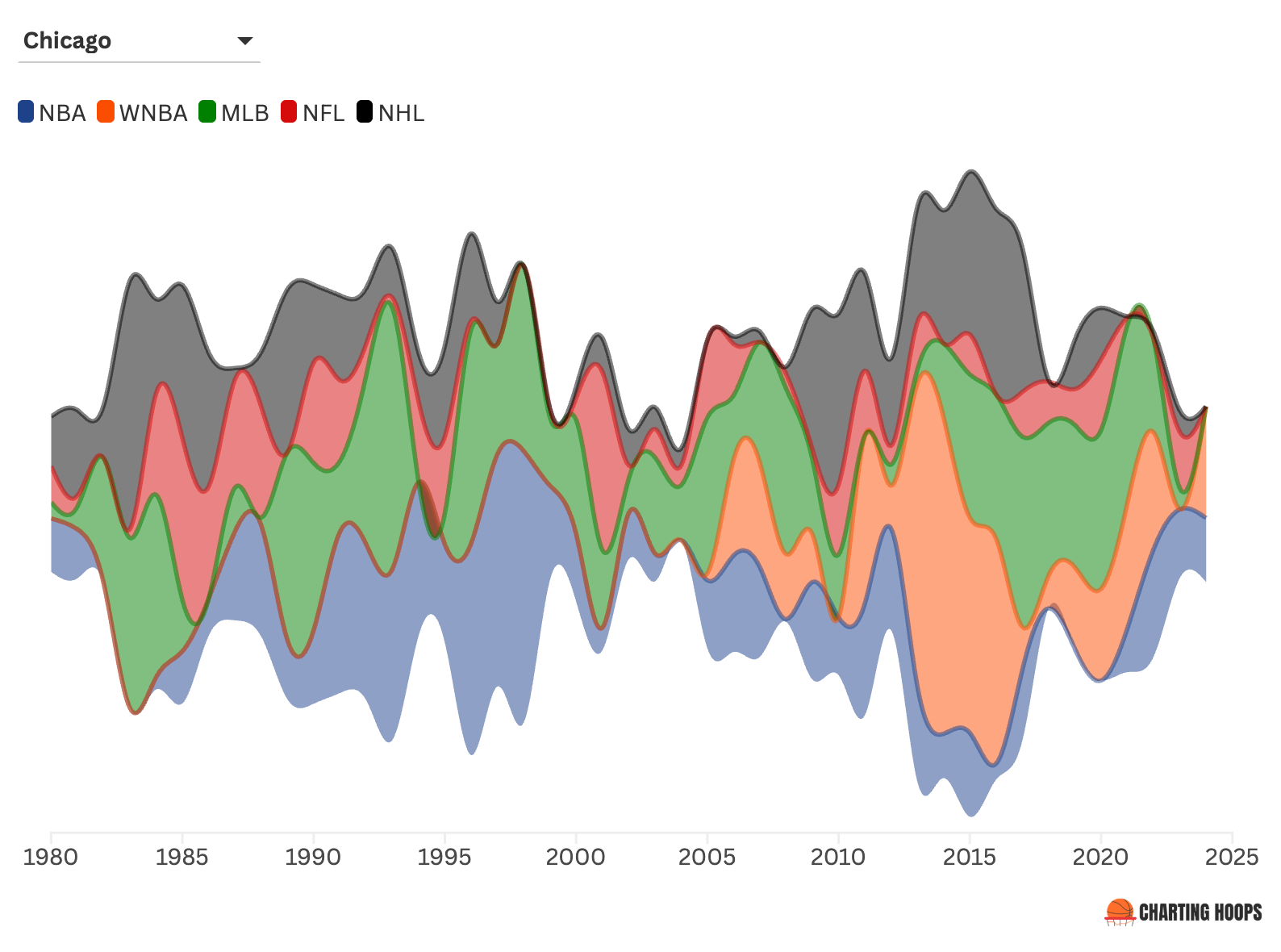
But peak happiness in the Second City arrived in 2015, when the Sky (non-existent in the 1990s) set attendance records and Elena Delle Donne won MVP, the Cubs made the NLCS, the Blackhawks won the Stanley Cup, and the Bulls, even in a down year, made the Conference Semis and had the runner up Rookie of the Year in Nikola Mirotić.
Some cities can’t seem to get their teams to line up. Kansas City for instance:
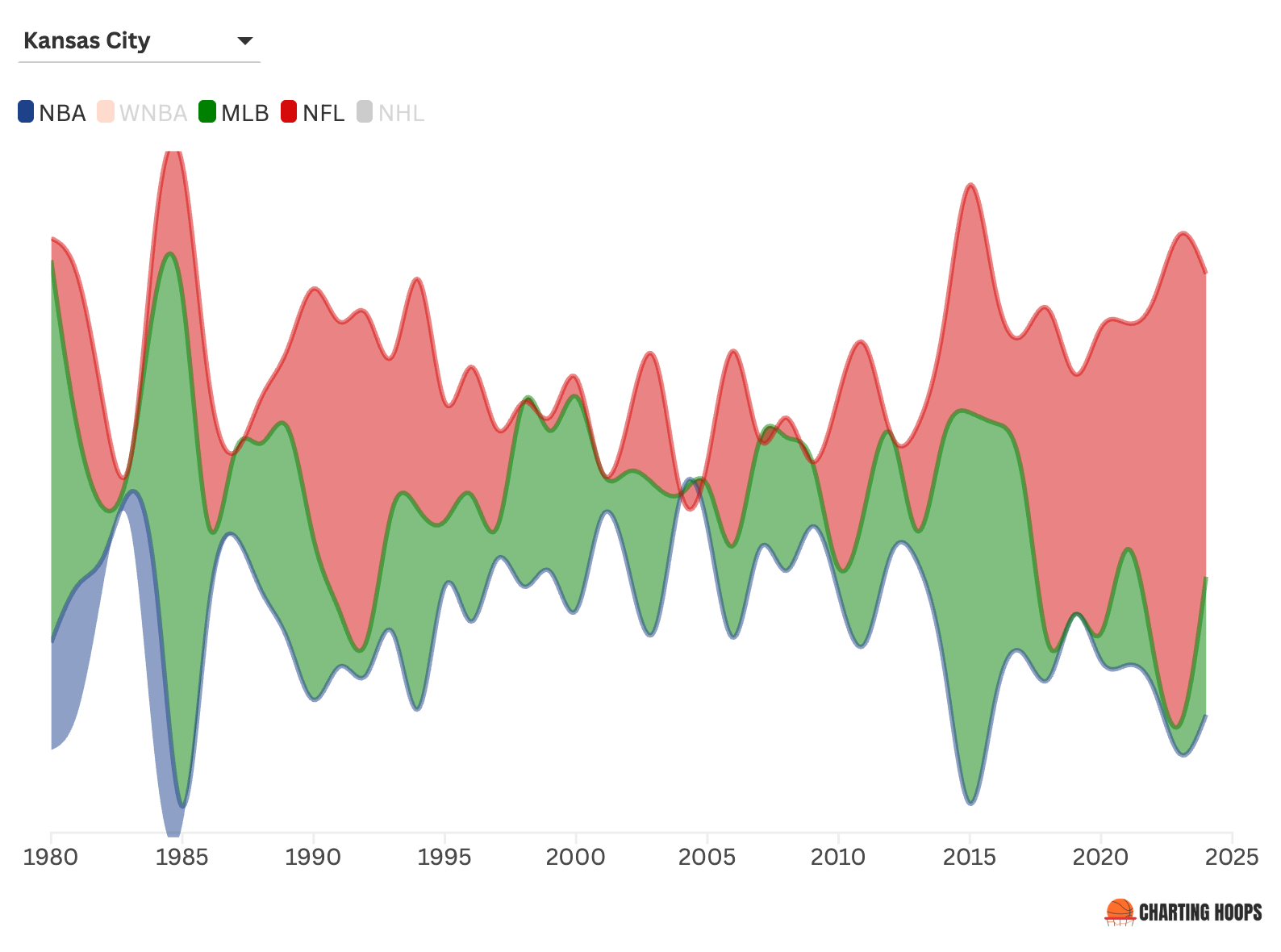
For three and a half decades from 1980 to 2015, there is a lot of red (for the NFL Chiefs) and a lot of green (for the MLB Royals), but no year is particularly high, because when the Chiefs were good the Royals tended to be bad, and vice versa. Finally in 2015 both teams were simultaneously happy, as the Royals won the World Series and the Chiefs made the playoffs with Rookie of the Year Corner Back Marcus Peters.
Outside of that year, there are two examples of one team driving an outsized share of happiness in Kansas City: the George Brett Royals in 1985 and the Taylor Swift Patrick Mahomes Chiefs in 2023.
Like Shai Gilgeous-Alexander in OKC, one-team cities tend to be reliant on a few key people. Here’s Edmonton:
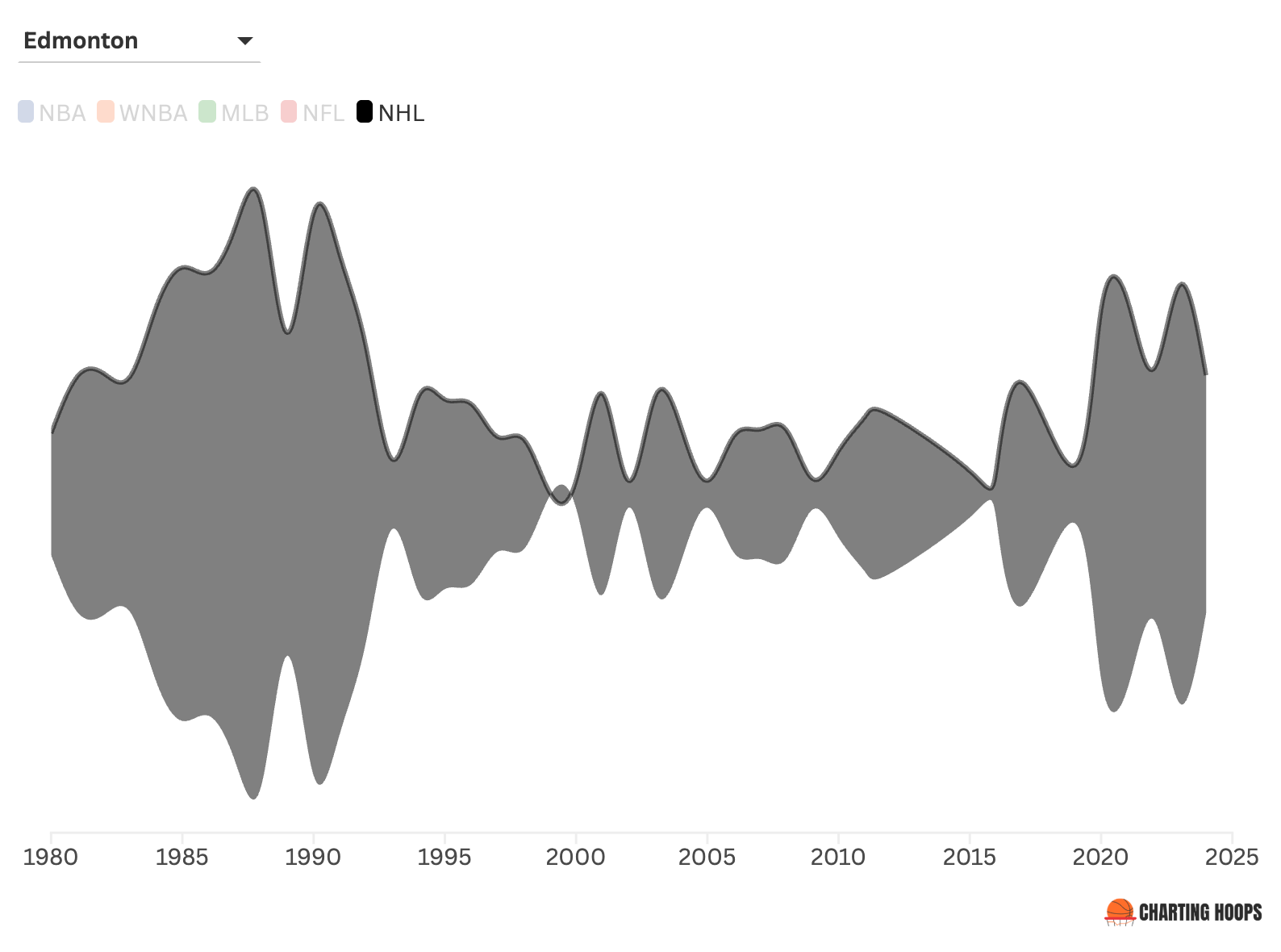
The city won four Stanley Cups in five years during the 1980s with Gretzky at the helm. But when The Great One left for the LA Kings he essentially took two decades of happiness with him. The city has started to remember what happiness feels like in recent years, hitting win expectations and making the playoffs with Leon Draisaitl and Connor McDavid winning MVPs, but back-to-back Stanley Cup losses doesn’t help.
Or Green Bay:
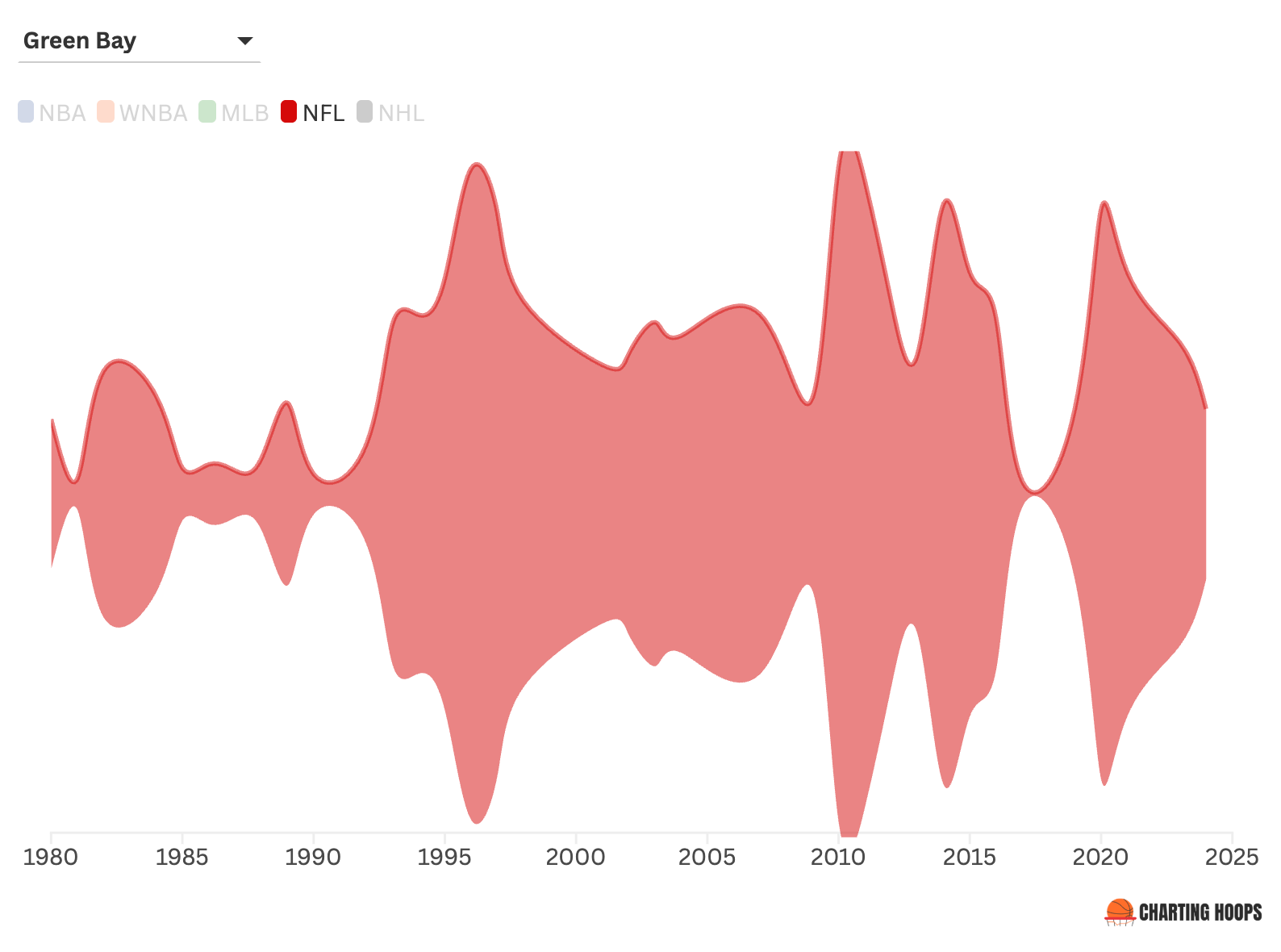
“Yay, we have Brett Favre winning MVPs and Super Bowls! Oops Brett Favre left. But wait, we have Aaron Rodgers winning MVPs and Super Bowls! Oops Aaron Rodgers got hurt. Ok, he’s back and won two more MVPs! And . . . now he’s on the Jets.”
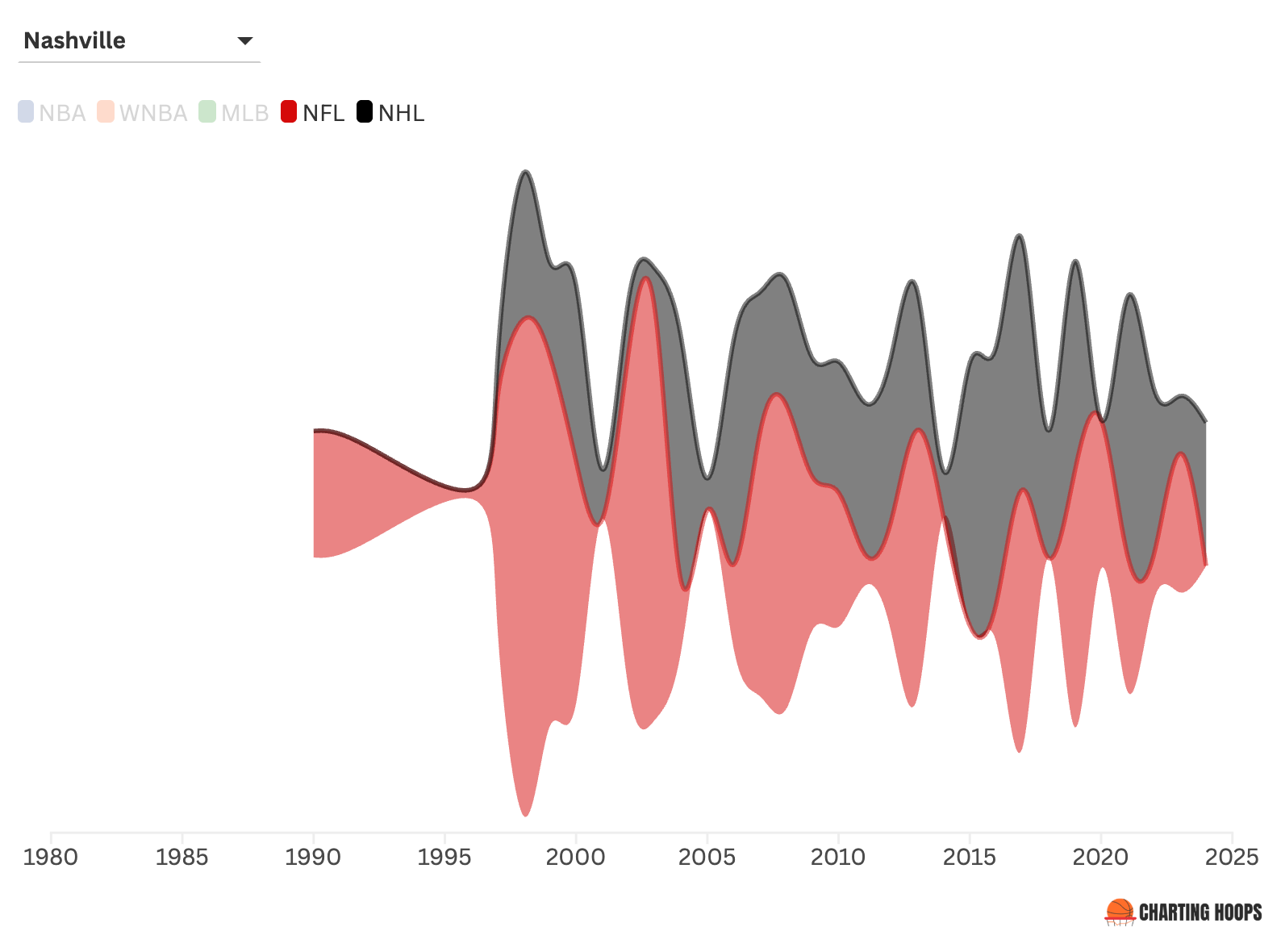
The arrival of a new team or a star player can rejuvenate an entire city. Nashville is a good example, getting the NFL Titans in 1997 and the NHL Predators in 1998, still the peak happiness year in the city:
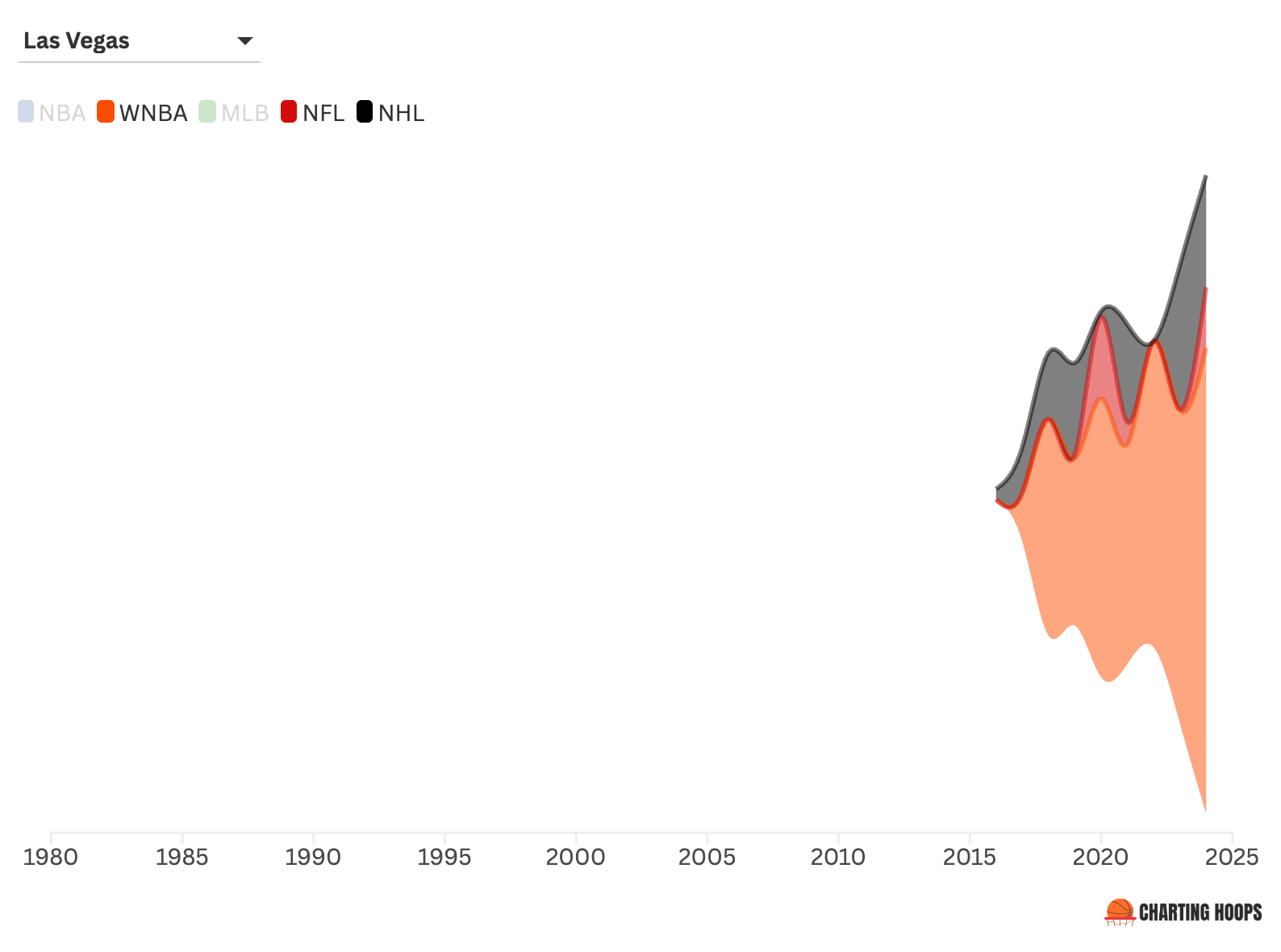
More recently, Las Vegas has gotten the NHL Golden Knights in 2017, WNBA Aces in 2018 (who won titles in 2022 and 2023 with (then) three-time MVP A’ja Wilson), and NFL Raiders in 2020:
Indianapolis is another good example, peaking in 2000 when the Fever joined the WNBA, the same year the Pacers last made the NBA Finals.
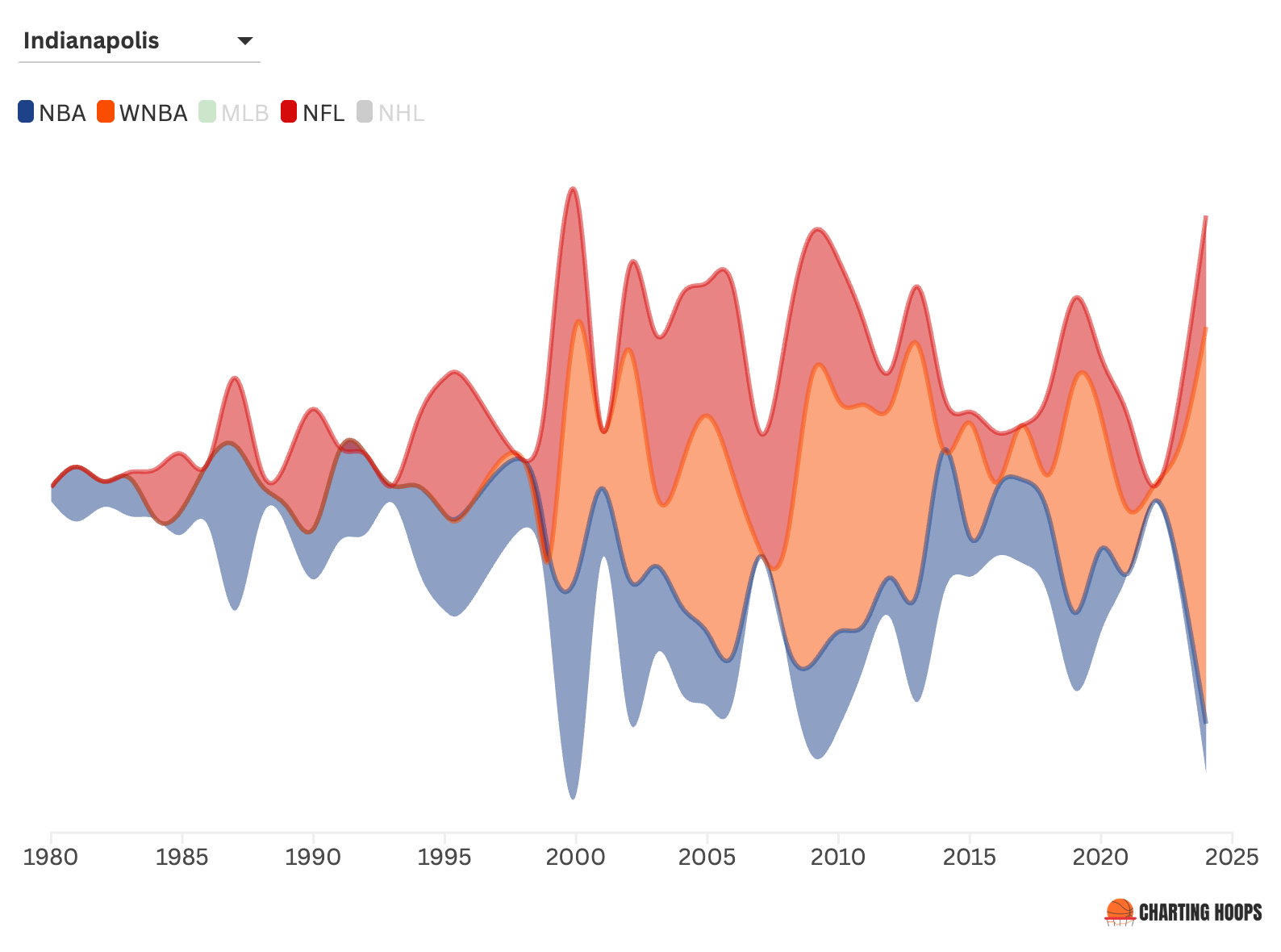
We can also see the “Caitlin Clark effect” in Indianapolis’s happiness, with Fever attendance skyrocketing the year she got to the city.
Phoenix got three new teams in three years in the late 1990s (NHL Coyotes in 1996, WNBA Mercury in 1997, and MLB Diamondbacks in 1998) and everything came together about a decade later.
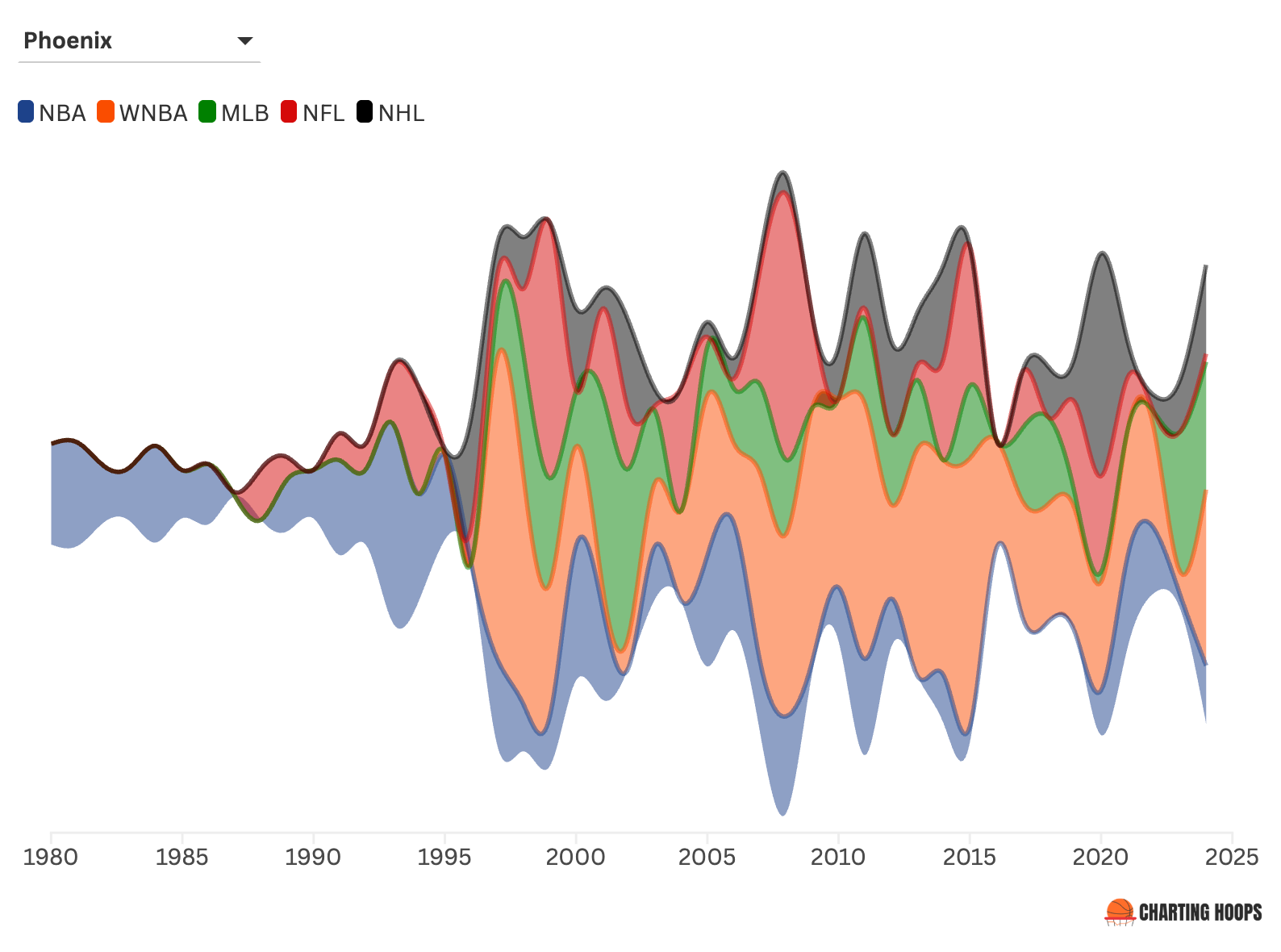
After a bit of a lull in the city, happiness has been on the rise, thanks to exciting basketball players: Diana Taurasi played her swan song season in 2024, shortly before Kevin Durant and Bradley Beal arrived to much fanfare (and few wins). I would’ve expected this to drop in 2025, as both basketball teams go through resets, but the Mercury made the Finals and the Suns are off to a hot start. Still, the Coyotes officially moving to Utah stings for the (couple thousand) hockey fans in the desert.
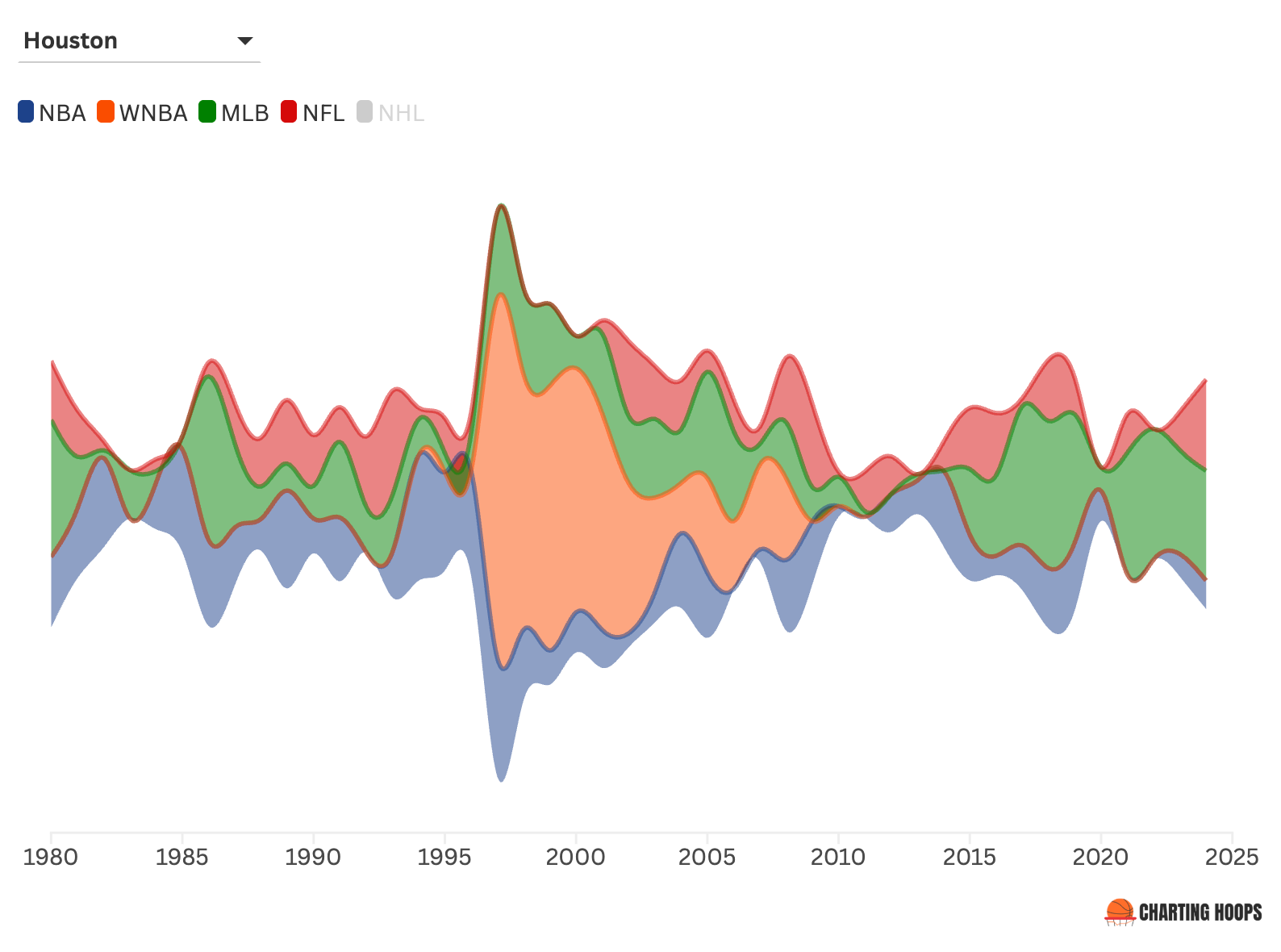
Speaking of losing a team, here’s Houston. The Comets were responsible for much of the city’s happiness thanks to back-to-back-to-back-to-back titles, and their departure in 2009 left a big hole:
Or Winnipeg. They lost their Jets to Phoenix in 1996 (who Phoenix has now lost to Utah) leaving them with no professional sports. It makes for a fun shaped chart, but it was no fun to be a sports fan in Winnipeg in the 2000s.
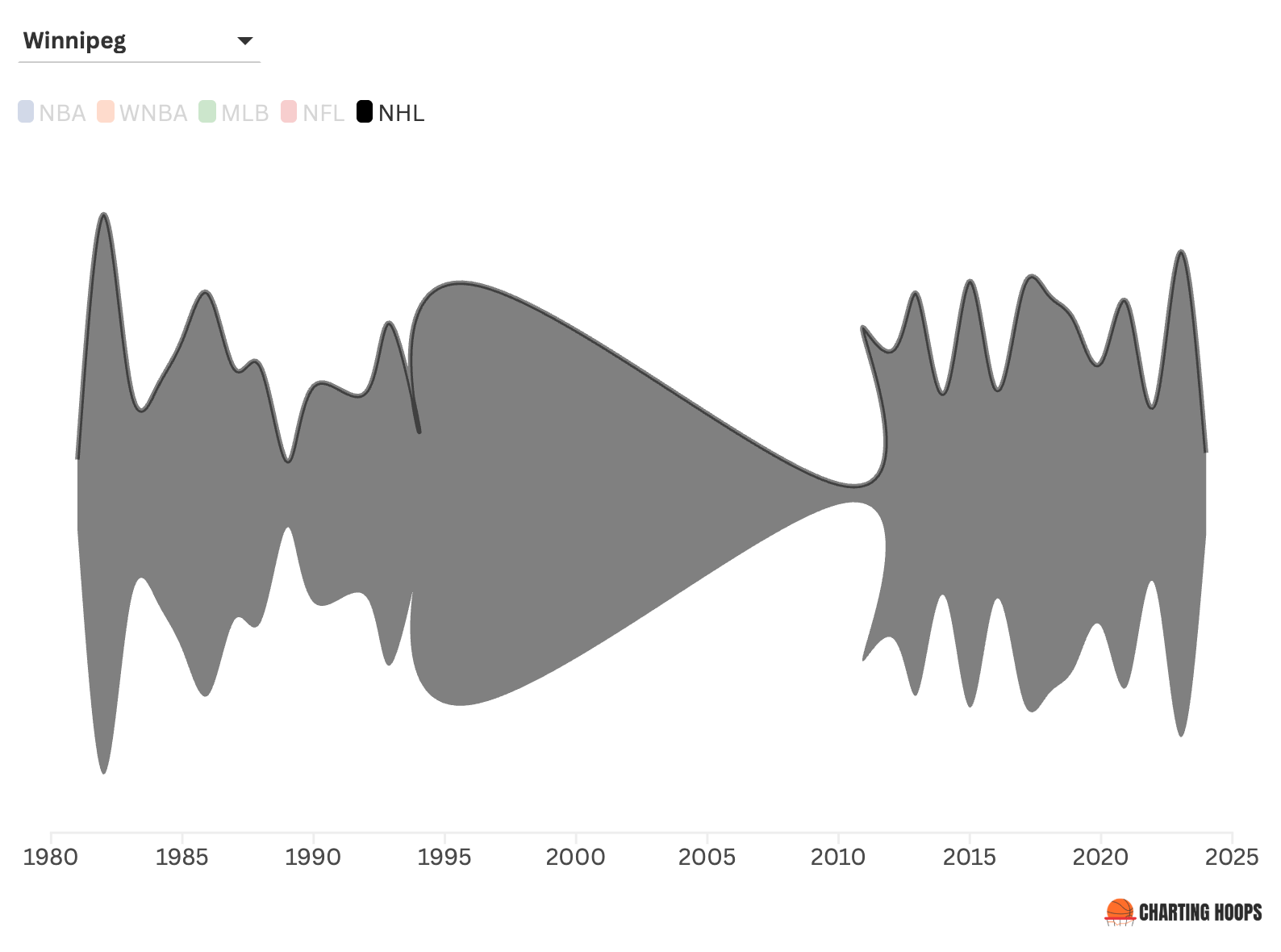
The Jets returned as a new franchise in 2012 and are now on a streak of seven playoff appearances in eight years. Winnipeg is just happy to have someone to root for again.
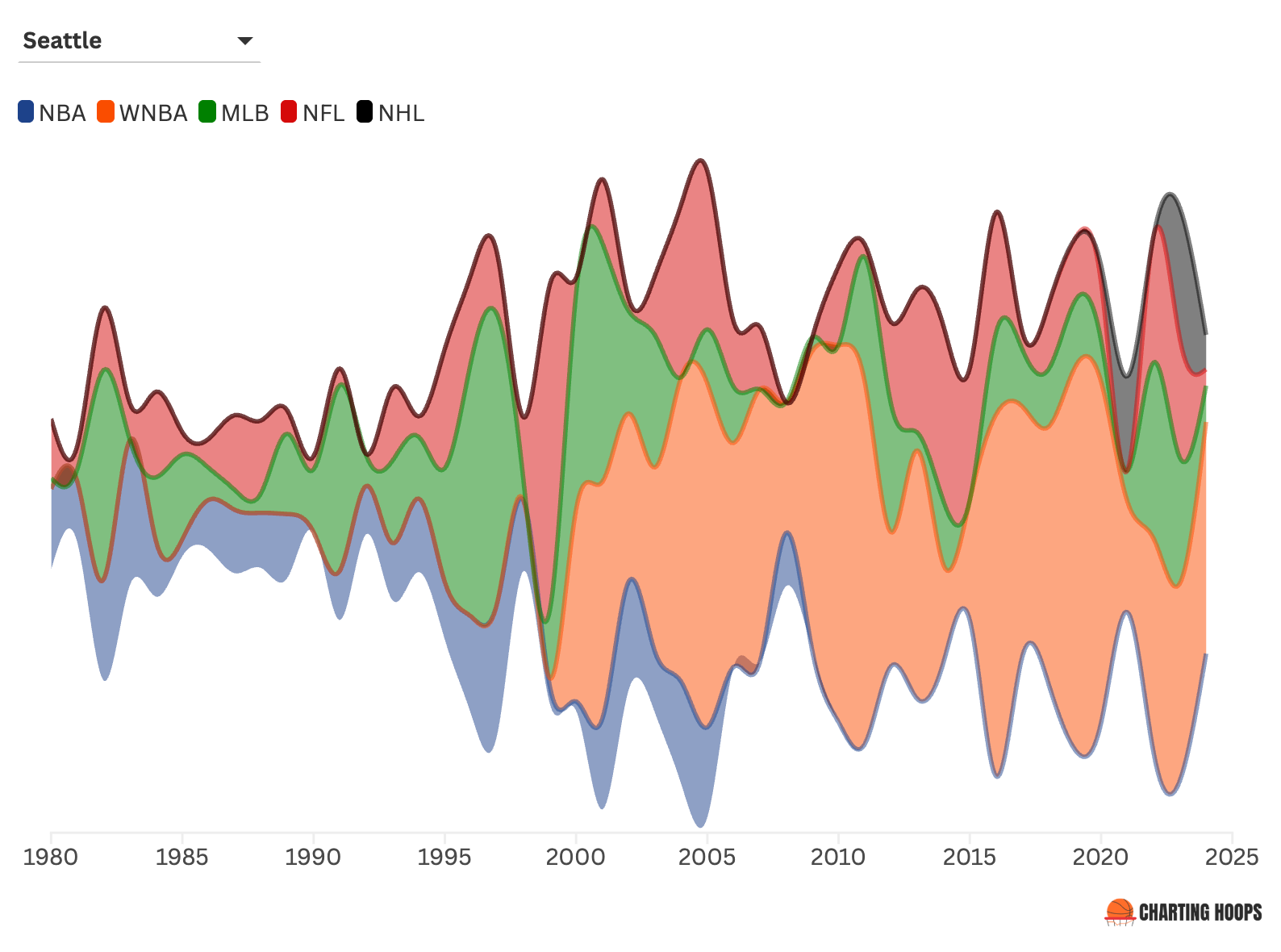
Seattle weathered the loss of the Super Sonics a bit better, thanks to solid Storm and Seahawks years in the 2010s, and now the addition of the Kraken in the NHL, but the squeeze in 2009, the first year without an NBA team, is noticeable.
The biggest falloff in happiness, however, was not due to a lost team but just a classic case of under performance in Toronto.
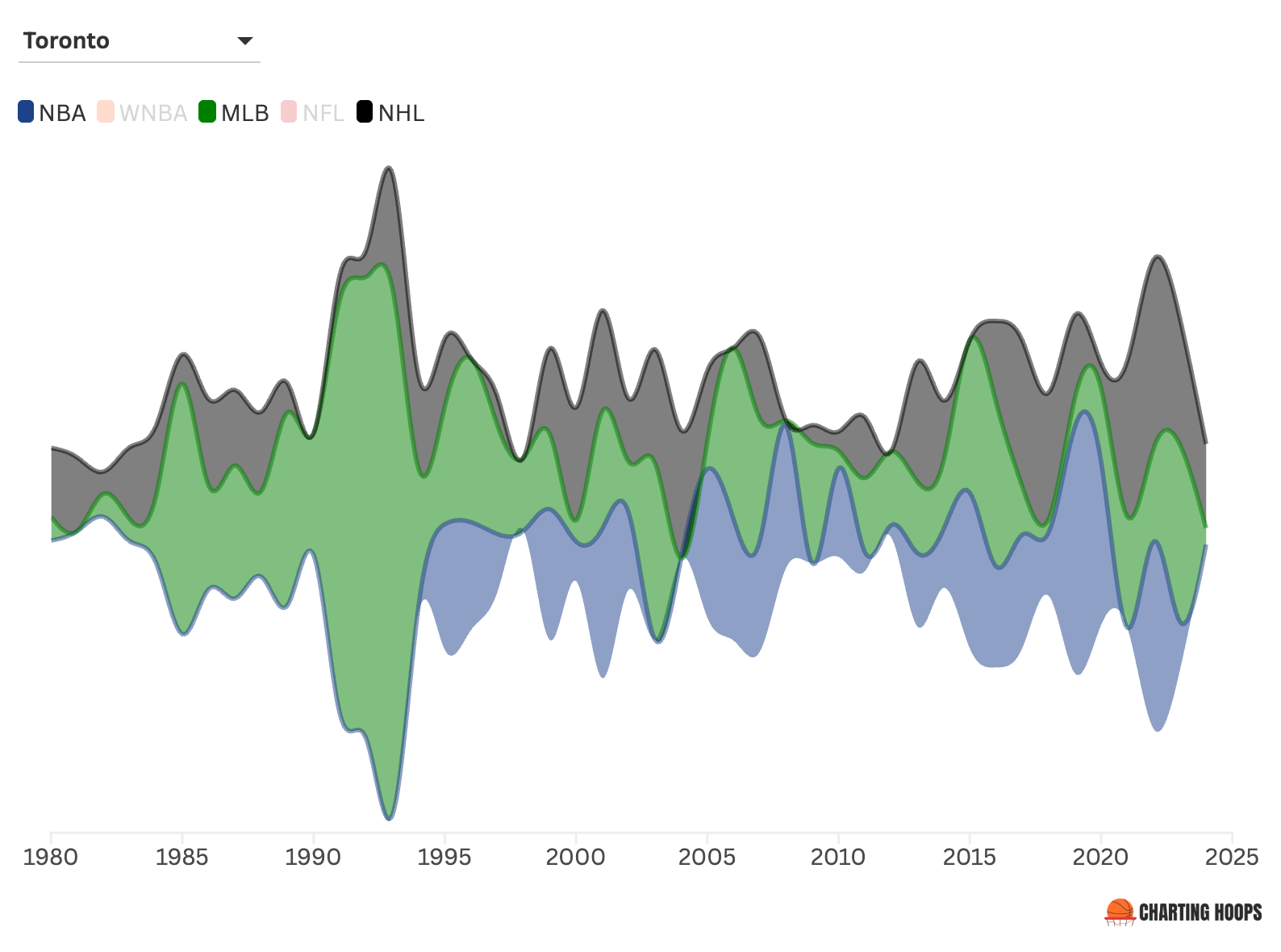
The city was at its happiest from 1991 to 1993 when the Blue Jays went three straight years hitting win expectations, making the playoffs, driving increased attendance, and having a player with MVP votes.11 They won the World Series in 1992 and 1993.
After that the Blue Jays fell off hard, not making it back to the playoffs until 2015, over 20 years later. The Raptors (which Toronto got in 1995) and Maple Leafs didn’t do much in those two decades either.
It was up to the Blue Jays to bring back happiness in 2015, with Josh Donaldson winning MVP and taking his team (including José Bautista, David Price, Edwin Encarnación, and Russell Martin) back to the playoffs. The Raptors also made the playoffs that year while the Maple Leafs finally had some hope in the number one pick for the next year, which they used on Auston Matthews.
The Raptors won the NBA title in 2019, a high for the city, but then Toronto got even happier in 2022 as all three teams hit expectations to make the playoffs, the Raptors had Rookie of the Year Scottie Barnes, and Auston Matthews had turned into an MVP for the Maple Leafs.
Detroit had some of the saddest years, going into negative happiness on my scale.
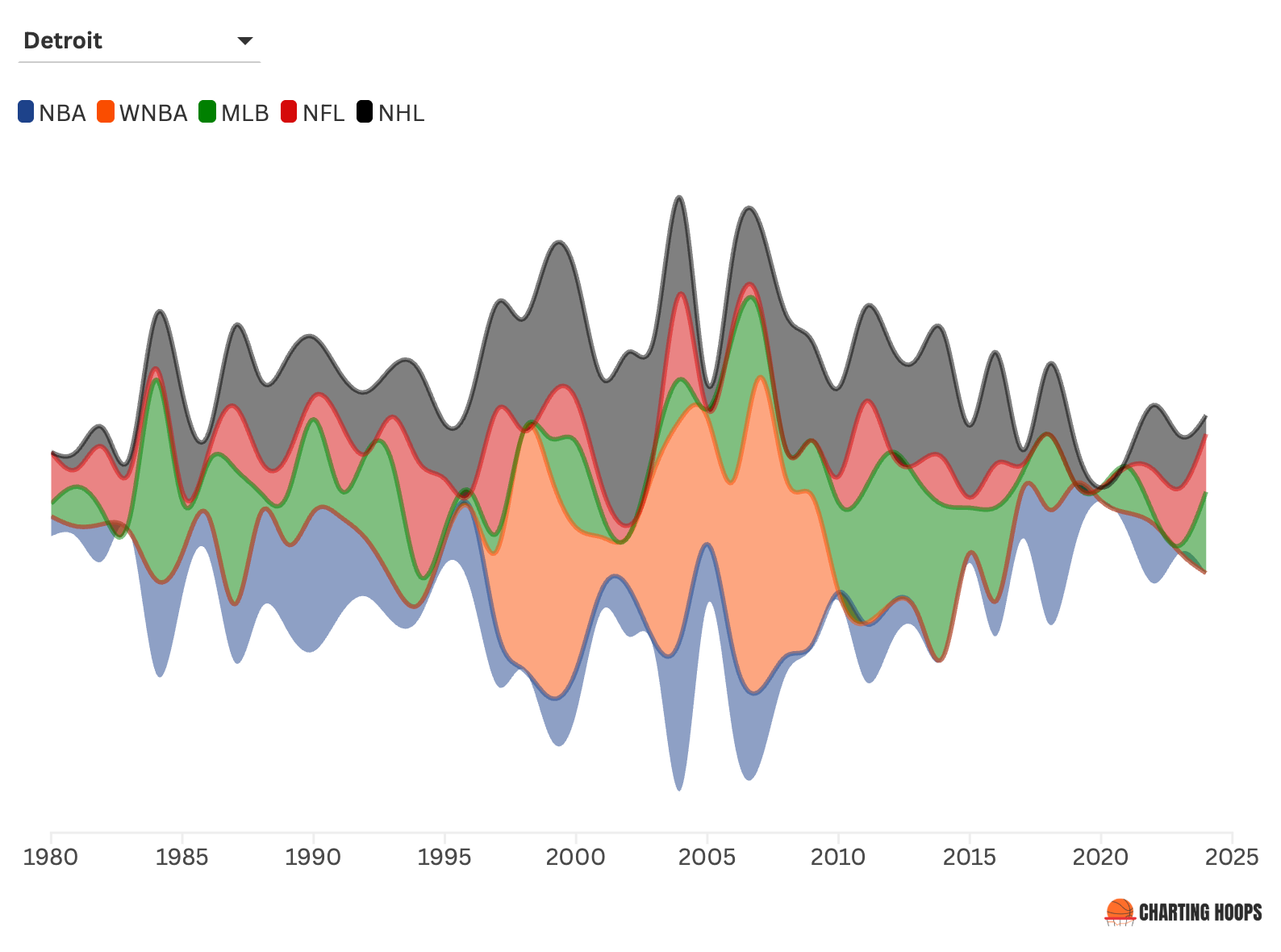
The city had basically no reasons for happiness coming from any of their four teams in 2020. They had lost the WNBA Shock a few years before. The Lions, Red Wings, and Pistons all finished with 25% fewer wins than expected. The only smidge of hope came when the Pistons landed the number pick, which they’d use on Cade Cunningham the next year. The Tigers meanwhile were the only team to hit the over on wins … with 23 in the Covid shortened season, placing them as the third worst team in baseball.
Four cities, Milwaukee, San Diego, and St Louis hit peak happy over 40 years ago, in the early 1980s. All three were driven by baseball back then, the days of Robin Yount winning the MVP with the Brewers, Tony Gwynn (now Mr. Padre) was just a rookie in San Diego, and Lonnie Smith, Ozzie Smith, and Keith Hernandez were the stars in St. Louis.
Dallas and Denver have experienced peak happy most recently, both rising steadily since the turn of the century.
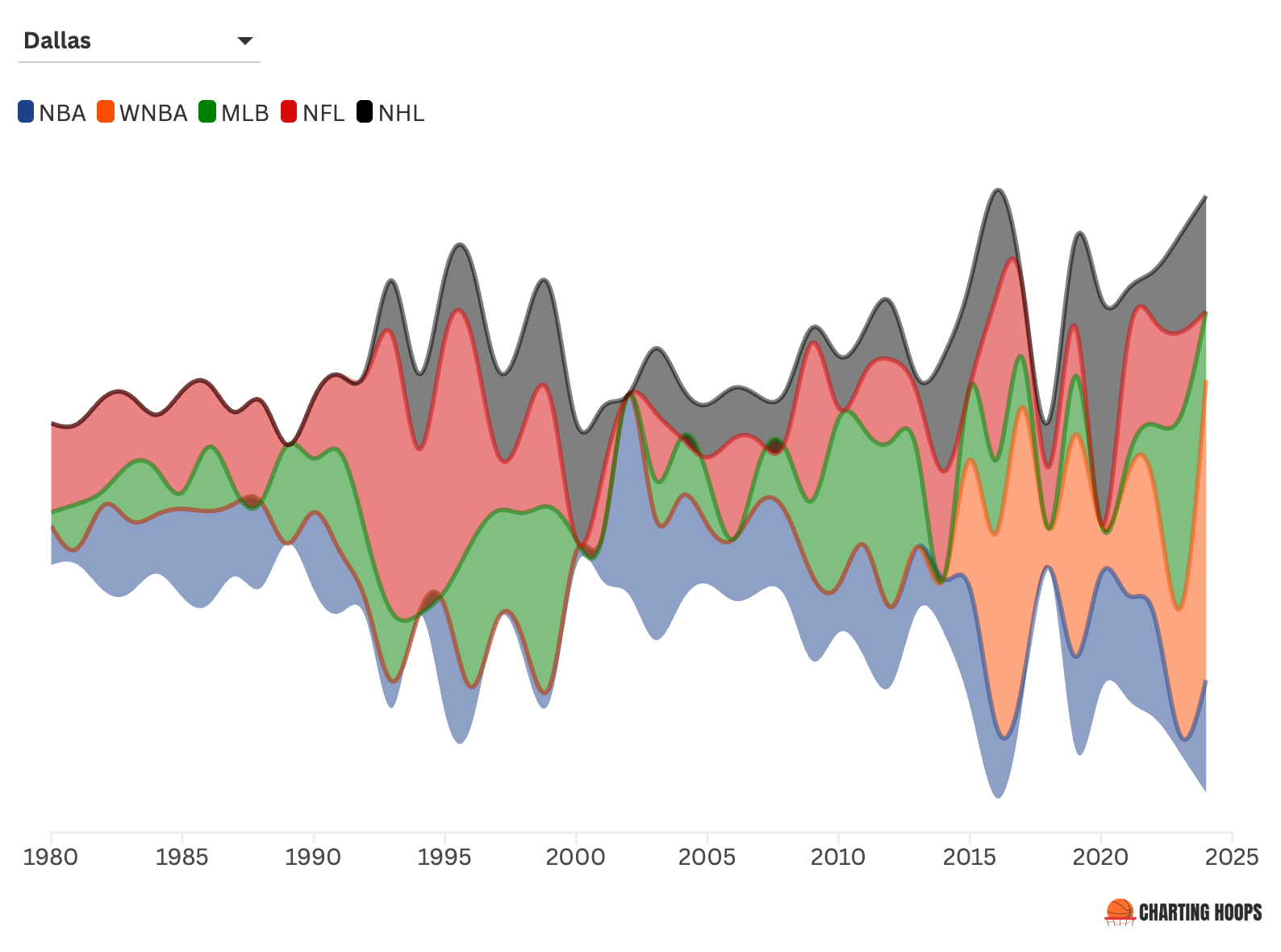
For Dallas, the happiest year prior was 1993, ironic considering the 1992-93 Mavericks were one of the worst teams of all time, winning just 11 games. But fans could write them off for the year, and instead get ready for the number two pick in next year’s draft (Jason Kidd) and focus on the Cowboys winning the Super Bowl behind MVP Emmitt Smith.
It’s been a steady rise in happiness since, with big jumps coming in 2016, when they got the WNBA Wings and all four other teams made the playoffs, and 2019 when Luka Dončić won NBA Rookie of the Year. Of course, now losing Luka will make a dent.
Denver’s increase has also been thanks to an Eastern European basketball player.
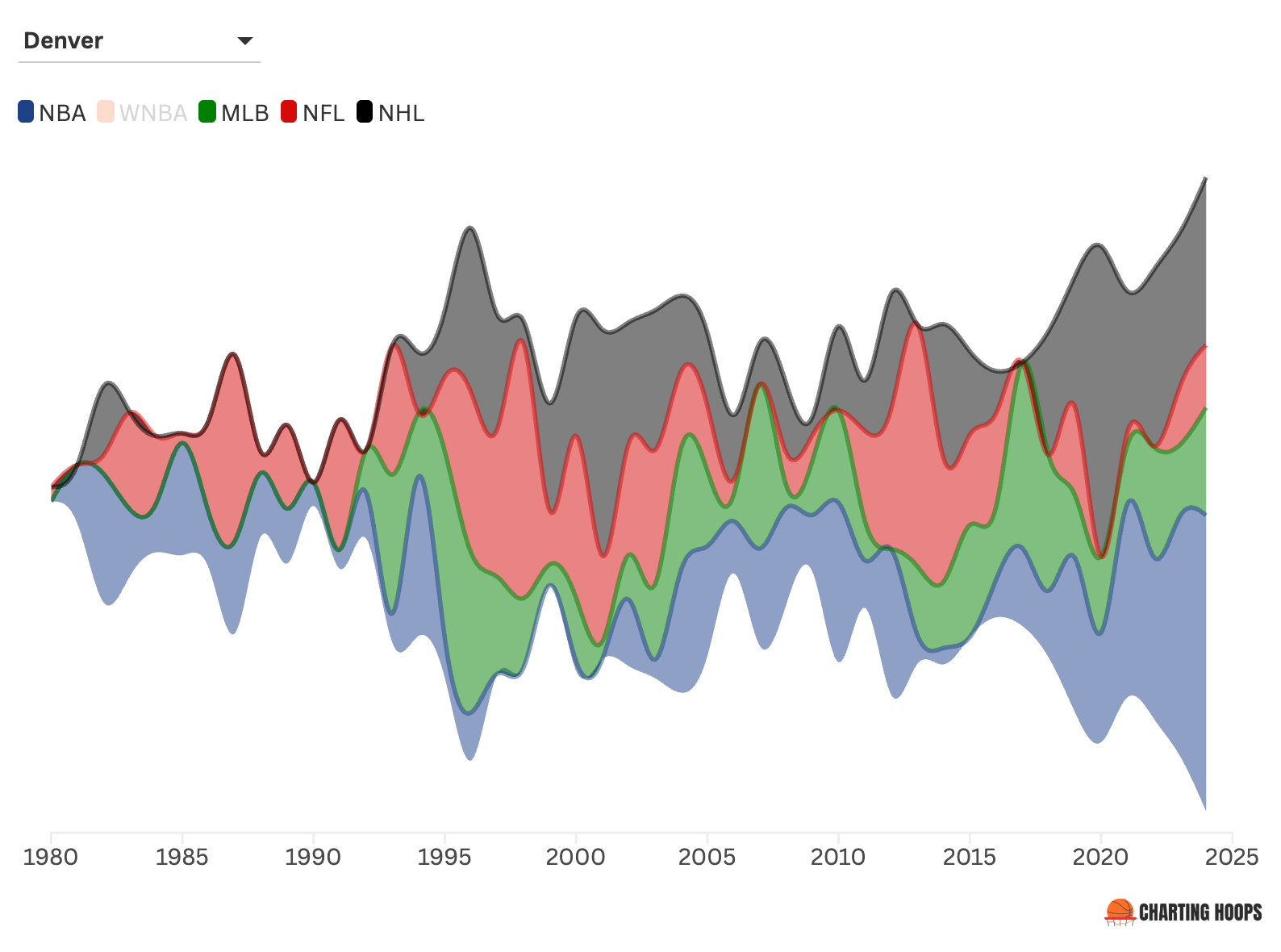
But before Nikola Jokić, Denver had John Elway winning the 1983 NFL MVP and leading the Broncos to their second straight Super Bowl (though they lost both).
In 1996 the Avalanche moved to Denver and won the Stanley Cup in their first year in the Mile High City, while the Nuggets and Rockies made the playoffs and QB/RB combo John Elway/Terrell Davis finished second/third in NFL MVP voting.
The next 20 years were relatively steady, until the big jump to peak Denver happiness in 2020 driven by Avalanche attendance (they made the playoffs with MVP runner up Nathan MacKinnon and Rookie of the Year Cale Makar) and the Nuggets making the Bubble playoffs.
The city stayed happy, with the Avalanche winning the Stanley Cup in 2022 and the Nuggets winning the Larry O’Brien in 2023, with by-then multi-time MVPs in MacKinnon and Jokić.
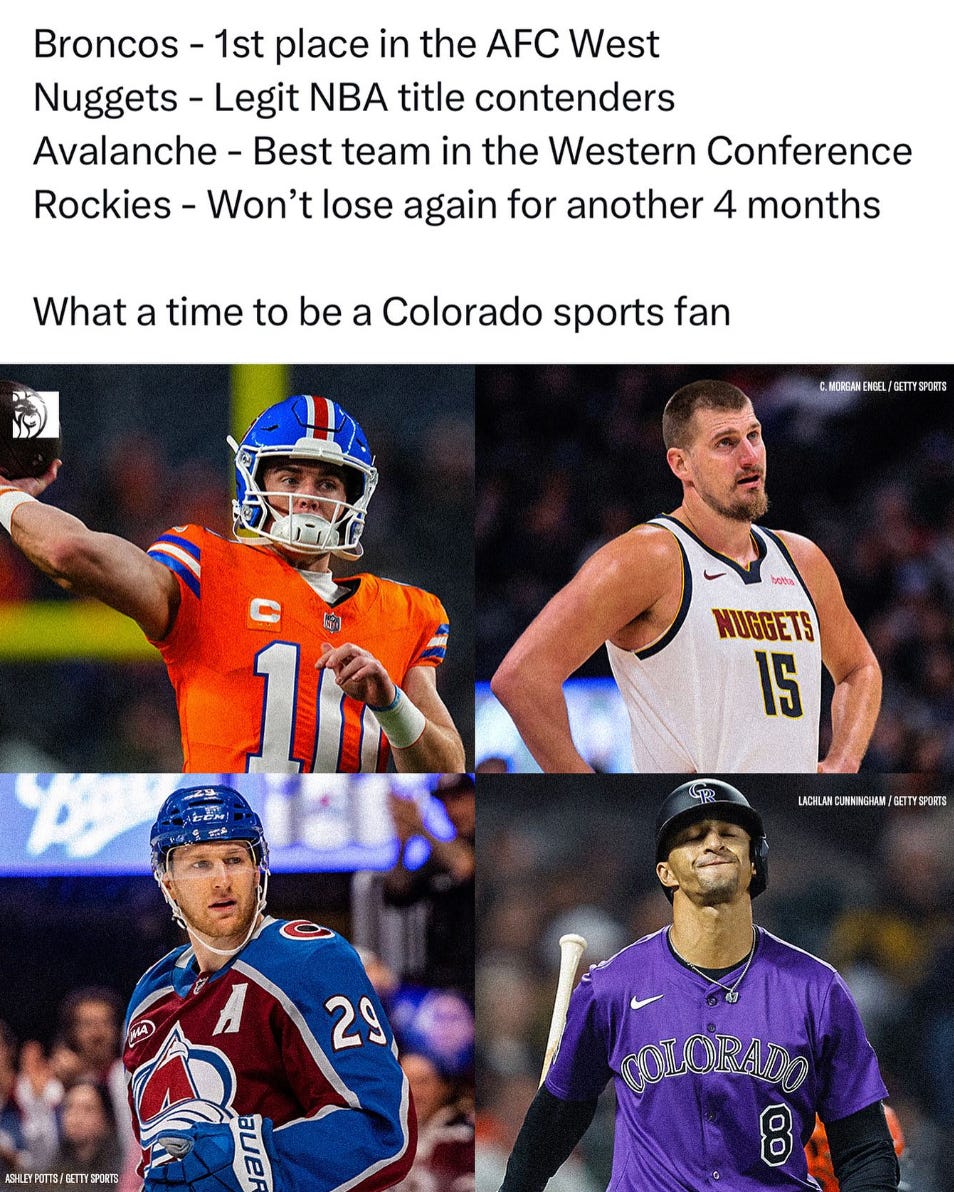
It might be even better in 2025:
Philadelphia happiness has been relatively steady, with a few notable outliers, for better and worse:
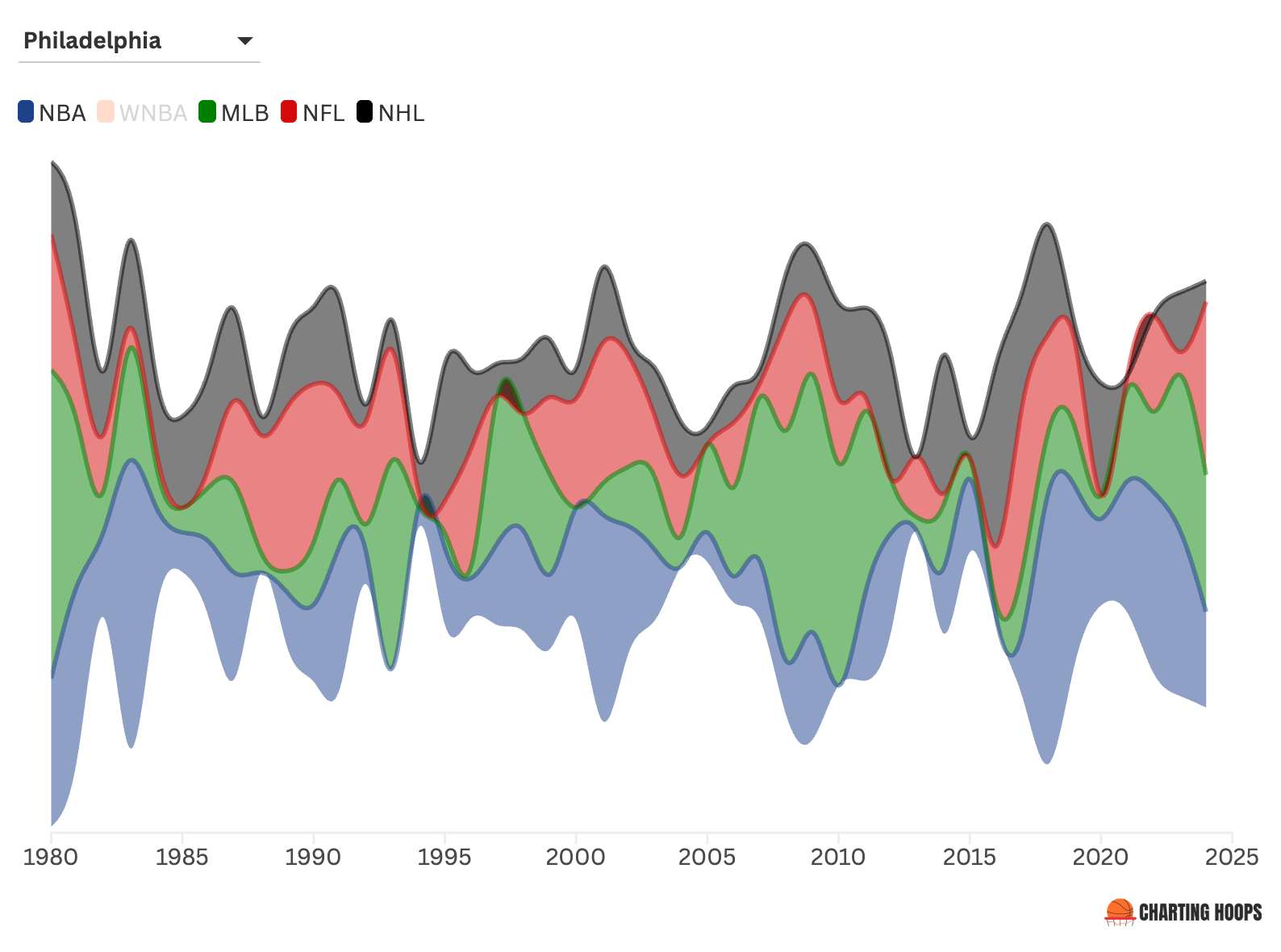
Better: 1983 - 76ers won the NBA championship with Moses Malone as MVP and Dr. J finishing fifth; Phillies made the playoffs with Mike Schmidt, Al Holland, and John Denny; Flyers made the playoffs with Mark Howe and Bobby Clarke.
Worse: 1994 - All 4 teams missed the playoffs; Phillies finished well behind expectations.
Better: 2008 - Phillies won the World Series with Ryan Howard, Brad Lidge, and Chase Utley, while the Eagles, 76ers, and Flyers all made the playoffs.
Worse: 2013 - Only the Eagles made the playoffs, and lost in the Wildcard.
Better: 2018 - The Process has arrived? 76ers attendance increases, partly to watch Ben Simmons win Rookie of the Year and cheer the team on in their first playoff appearance in six years. The Eagles and Flyers also made the playoffs, as expected. Also, Gritty arrives.
Worse: 2021 - The Process is over? The 76ers and Eagles make the playoffs, while the Phillies and Flyers miss.
Better: 2023 - Joel Embiid wins MVP for the 76ers and everyone but the Flyers make the playoffs, but that was expected.
On the other side of Pennsylvania, Pittsburgh is another herky-jerky city:
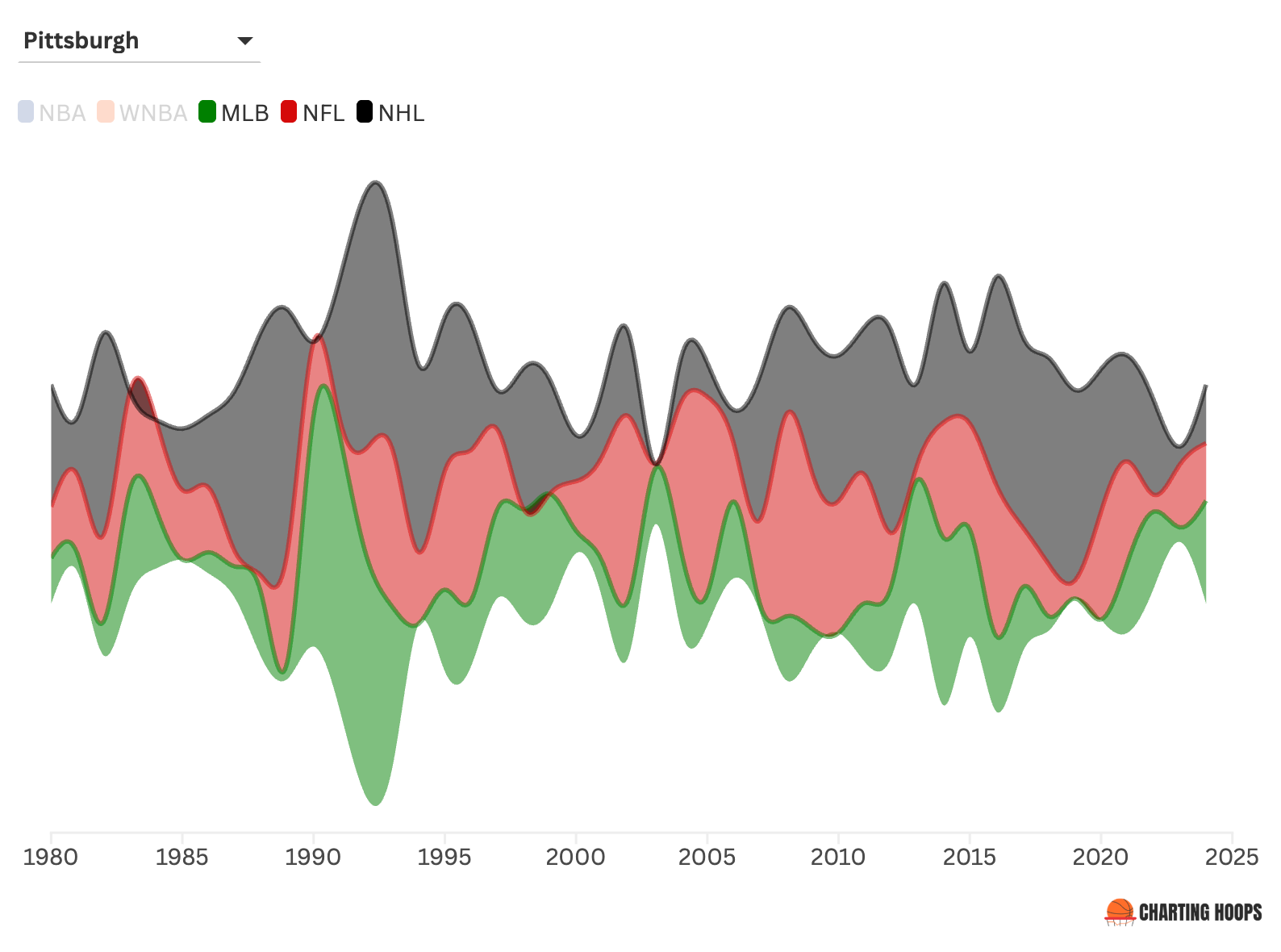
The Iron City hit peak happiness in 1992 with playoff appearances from all three teams (MLB Pirates, NHL Penguins, NFL Steelers) and a Penguins Stanley Cup, but the city fell off hard by 1994. The Steelers and Penguins made the playoffs again in 1996, behind Jerome Bettis and Mario Lemieux/Jaromír Jágr, while the Pirates hit expectations. They continued bouncing around, until a solid stretch from 2014 to 2016: Steelers made playoff runs, Pirates had the top ranked farm league system, and Penguins won the 2016 and 2017 Stanley Cups with MVP Sidney Crosby.
New Orleans has also been up and down:
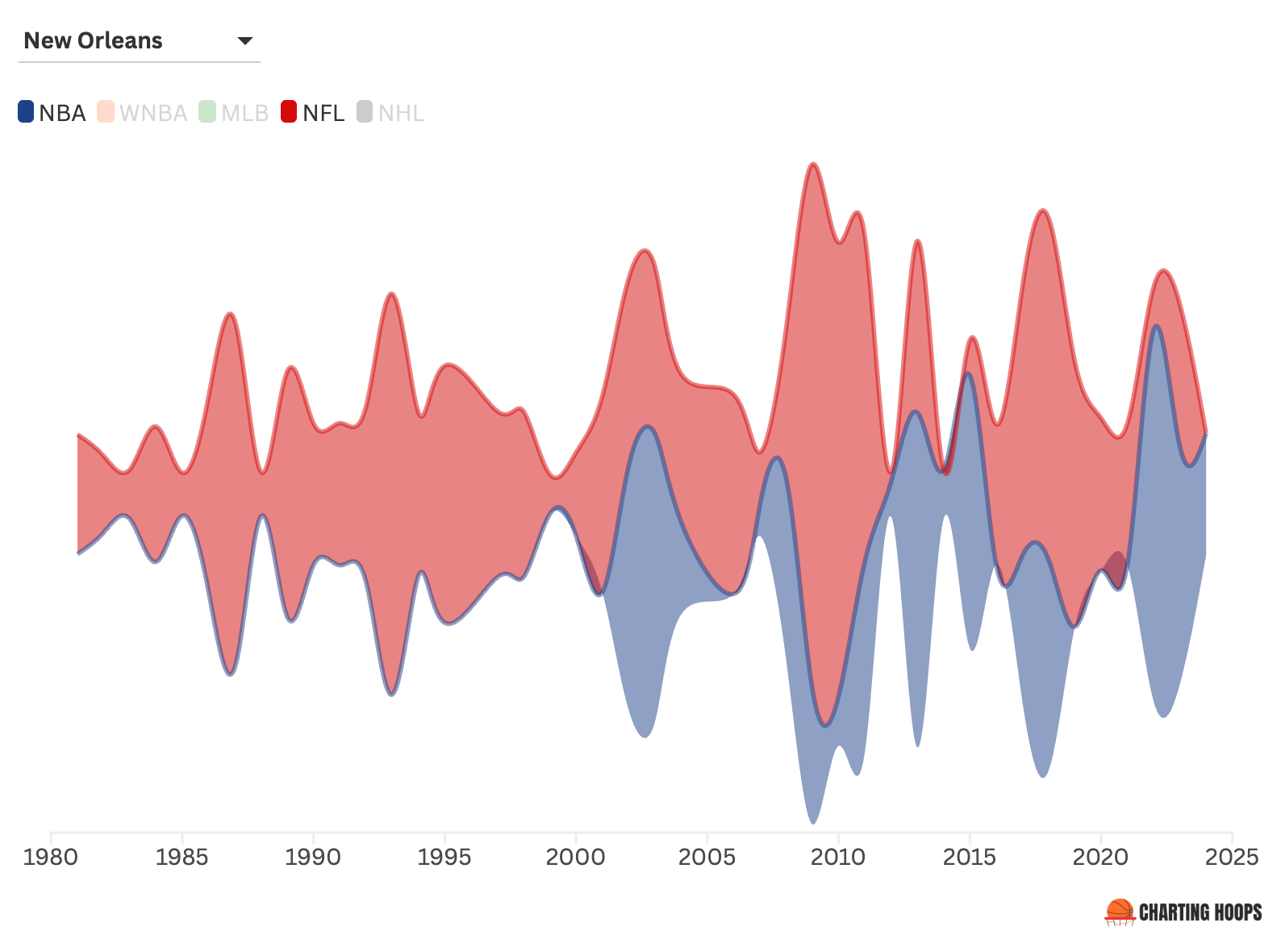
They started with a peak in 2003, when the Hornets made the playoffs in their first year in NOLA. The city had dipped way down by 2005, the year Hurricane Katrina rolled through, forcing millions to evacuate, including the Hornets who moved (almost permanently) to Oklahoma City while the Saints played their home games in San Antonio and Baton Rouge.
The city rose back up by 2009, when the Saints won the Super Bowl with QB Drew Brees finishing second in MVP voting. The Pelicans also made the playoffs.
But then all teams quickly regressed, all the way to negative happiness (aka sadness) by 2012 as both teams finished below .500. Then bad, then good, then bad, then …
Finally some optimism in 2017, as Alvin Kamara won NFL Offensive Rookie of the Year and the Saints made the playoffs. The upward trajectory continued in 2018, the first time since 2008 to 2009 with two straight upticks, as both teams made the playoffs, Drew Brees finished second in MVP again, and the Pelicans had the #1 pick in the 2019 draft (which they would use on Zion Williamson).
Perhaps expectedly, San Antonio is the most stable city.
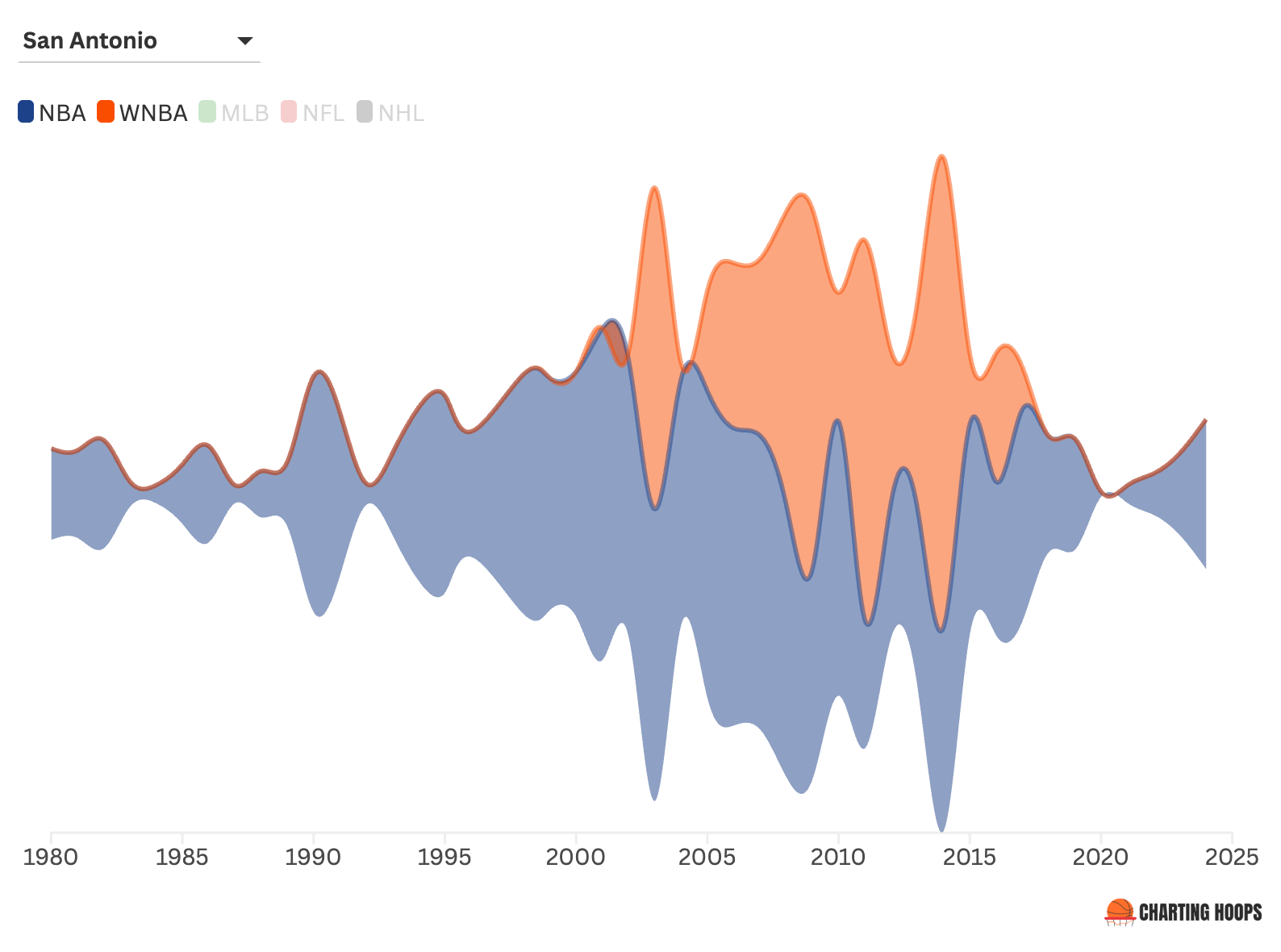
San Antonio had a sustained level of basketball success through the 2000s, with the Silver Stars arriving from Utah in 2003, the same year the Spurs won the NBA trophy. The Spurs would win two more titles in the next four years, cementing themselves as a dynasty.
The Spurs hit within 10% of their win expectations every season from 2000 to 2008, with The Big Fundamental, Tim Duncan perennially in the MVP conversation12 and David Robinson, Manu Ginóbili, and Tony Parker with a few top 10 finishes as well.
The Spurs continued to make the playoffs every year until 2020, while the Silver Stars made the playoffs every year from 2007 to 2012.
Things came crashing down in 2018 when the Silver Stars moved to Las Vegas (and got A’ja Wilson) and the Spurs missed the playoffs for the first time in two decades the following year. There’s been a rebound (and lots of blocks and dunks) thanks to the arrival of back-to-back Rookie of the Year winners Victor Wembanyama and Stephen Castle, which also drove increased attendance in the Frost Bank Center.
If you’ve made it to the end, thank you for reading. Truly, this Thanksgiving I’m so grateful for the community I’ve made in this basketball content creation world, and all the support from you. As a token of my appreciation, here’s a map showing the evolution of sports happiness (bigger circle = more happiness) across the US since Jimmy Carter was President.

Knicks 83, Heat 82, in classic 90s NBA fashion.
This measurement, while reliant on LOTS of data, is, in fact, not exact. We can argue all day over how many happiness units (utiles for the economists out there) should be doled out for different feats. I picked a course I feel is justifiable and accurately captures the general vibes in a city, but by no means am I claiming this is “the answer”. I am claiming it is a fun way to remember the good old days!
They are:
New York 1986: Mets & Giants
Los Angeles 1988: Lakers & Dodgers
San Francisco 1989: A’s & 49ers
Los Angeles 2001: Lakers & Sparks
Los Angeles 2002: Lakers, Sparks, & Angels
Boston 2004: Red Sox & Patriots
Detroit 2008: Shock & Red Wings
Boston 2018: Red Sox & Patriots
Washington DC 2019: Mystics & Nationals
Tampa 2020: Buccaneers & Lightning
Los Angeles 2020: Lakers & Dodgers
Las Vegas 2023: Aces & Golden Knights
I have limited this analysis to professional teams from the Big 5 US sports leagues: NBA, WNBA, MLB, NFL, NHL. Other pro leagues generally don’t have a long enough history to evaluate. If you’re a college fan, sorry.
See footnote 2.
This analysis does not include 2025 results (including the Florida Panthers Stanley Cup), except for Oklahoma City, given all its teams (i.e., just the Thunder) are done for the year.
Or feel free to jump straight to your city. You can see all the charts here!
Based on the year in which the NFL season started.
I promise it’s not just because I moved to Boston in 2017.
Outside of Dunkin’ Donuts and Ben Affleck movies.
Including Joe Carter, Roberto Alomar, Devon White, Jack Morris, Dave Winfield, Duane Ward, John Olerud, and Paul Molitor. Though no Blue Jay won MVP in this stretch.
Here are Tim Duncan’s MVP finishes, starting in 2000: 5th, 2nd, 1st, 1st , 2nd, 4th, 8th, 4th, 7th.
When I read Charting, I think Crypto