

A Bald Pace Lie
Mike Brown says he wants the Knicks to play faster. I don't buy it.

I’m back earlier than my usual Wednesday post this week to get some Finals thoughts in on Games 1 and 2 before Game 3 tips off tonight. Feel free to share this post with any Knicks fans in your life, even the bandwagoners!
After the first quarter of Game 2 of the NBA Finals, sideline reporter Lisa Salters asked Knicks Head Coach Mike Brown about the pace of the game. As is typical in these mostly unnecessary 20 second long interviews, Brown didn’t give much insight into his team’s strategy. “The pace has been pretty good.” Brown said. “We still gotta play faster.”
The Knicks got 25 possessions in that first quarter, which works out to a pace (possessions per 48 minutes) of exactly 100. Is that actually too slow for Brown, or did he just amenably agree with Salters so he could move on and get back to doing his more important job as coach?
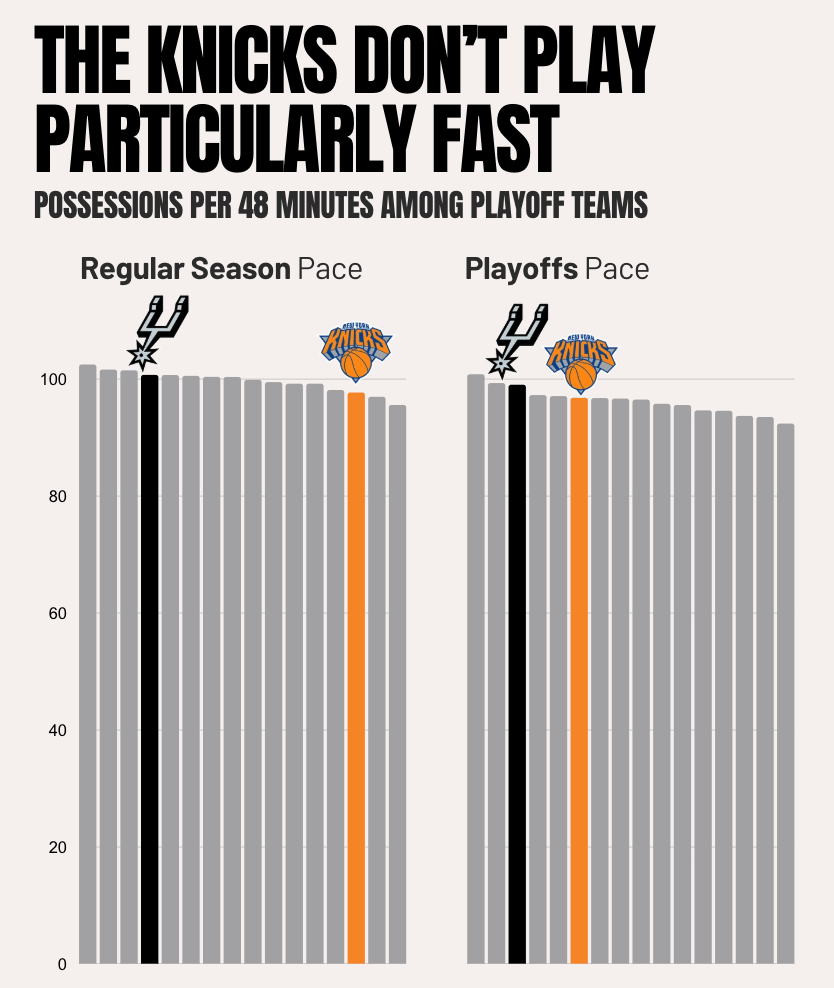
Consider that, in the Regular Season, the New York Knicks averaged 97 possessions per 48 minutes. That was one of the slowest paces in the NBA. They used 15.3 seconds of the 24-second shot clock on average, which placed them 27th out of 30 teams in pace. Their Finals opponents, the San Antonio Spurs, used just 14 seconds per possession, making them the fifth fastest offense in the league. So why would Lisa Salters assume the Knicks want to play faster than the Spurs in the first place, and why would Mike Brown so readily agree?
The Regular Season feels like ages ago for this Knicks team. They haven’t lost a game in 46 days, and in that month-and-a-half completely transformed from a good team into an all-time great one. So how much faster has Mike Brown had his team play on this historic run? Not at all. The Knicks are still averaging 97 possessions per game in the Playoffs, same as they did in the Regular Season.
Now, the game does slow down in the Playoffs, and the Knicks did move from a bottom decile Regular Season pace team to above average in the Playoffs. But, the Spurs have still been playing faster than the Knicks all Playoffs long, and both teams played above their averages in that Game 2 Quarter 1 of interest.
I disagree with Salters and Brown. The Knicks should want to play slow. When they look at the box score at the end of a quarter or a game, they should want to see fewer possessions, not more. Here’s why.
Luring Wemby
The majority of the Knicks’ offense - for better or worse - runs through Jalen Brunson’s shooting hand. He took 56 attempts from the field in Games 1 and 2 of the Finals, more than twice as many as anyone else on the Knicks has attempted.1 His inefficiency has been well noted (he made just 19 shots, or 34%,2 in those games), but that misses3 the point. For the Knicks, the shots going down is gravy; they just want Brunson to get them up at the right time.
Namely, the times when Victor Wembanyama is not in rebounding position. Josh Hart described this mindset himself after Game 1:
“The biggest thing, you want to get shots up. It doesn’t matter what shot you get up, just get it on the rim. With Wemby contesting it, now he’s out of the play and someone like (Mitchell Robinson) is down there by themselves.”
Wemby changes the geometry of basketball. Whereas an average person sees a court that is 94 feet long and 50 feet wide, to Wemby it feels like it’s just 60’ x 30’, less than half as big, given his enormous stride length and reach that allow him to cover more space than anyone in basketball history. It becomes extremely difficult to score in traditional ways against him, especially when your best player is over a foot shorter. So, the Knicks have had to get creative, finding new ways to get the Alien out of his orbit around the basket.
In Game 1, Brunson took 19 shots4 with Wemby on the floor. He missed 13 of them. But, before 10 of those 13 misses, Brunson had penetrated deep enough into the Spurs’ defense to draw Wemby in as help, or had Wemby on him to start with.
This style takes time. Brunson created almost all of these shots on his own,5 by beating his defender off the dribble to the basket. The Spurs’ have very good defensive Guards, so first Brunson has to get the isolation matchup he wants (usually trading Stephon Castle or Devin Vassell for Julian Champagnie or Carter Bryant). Wemby’s still not going to over-help right away, so Brunson has to execute a series of fancy dribbles and drives to lure Wemby over. Only then can he shoot. Nearly half of Brunson’s Game 1 shots came late in the shotclock.
The result is longer half-court possessions, which means fewer possessions, i.e., a slower pace.
Second Chances
The ultimate goal of pulling Wemby out to help on Brunson is second chance points. Namely, quickly securing the offensive rebound and going back-up or kicking out to a three-point shooter while Wemby is still out of the play.6
Steve Aschburner wrote about this on NBA.com after Game 1, coining “non-paint Wembanyama”. He noted that, largely thanks to their ability to lure Wemby out of the paint, “New York owned a 23-14 edge in second-chance points . . . nine points that accounted for nearly everything in the 10-point margin [of victory]. San Antonio won the rebounding battle overall (54-49), even on the offensive glass (14-10), but the Knicks got more mileage out of theirs.“ The Spurs’ interior defense is just so much worse without Victor Wembanyama, that it’s worth missing shots to get him out of the paint.
The Knicks have the personnel to run this anti-gravitational Wemby strategy. They have the fourth highest offensive rebounding rate in these Playoffs, and employ some of the best in the business at grabbing missed shots: Mitchell Robinson, Karl-Anthony Towns, and Josh Hart especially.
While the rest of us are watching Brunson dribble, Robinson, Towns, Hart, and the rest of the Knicks are actively getting themselves into offensive rebounding position, well before the ball goes up for the shot. Mitch preemptively seals off Wemby, Towns boxes out the Spurs’ smaller Forwards, Hart sneaks past Julian Champagnie on the perimeter, and every so often the ball bounces their way.
Of course, the ball does still have to bounce their way. The Spurs are the best defensive rebounding team in the NBA, so they’ve still sucked up a lot of these missed shots anyway. Wemby, being the alien that he is, recovered enough from helping on Brunson to pull down four of the 10 shots Brunson took while he was “out of position” himself.
Still, the Knicks secured two of the 10 Brunson misses for second chances, and overall in Game 1 got 10 points directly off second-chance points that came from Wembanyama contesting a shooter, per The Athletic’s counting. Again, the margin for the game was 10 points.
Offensive rebounds give teams another chance to score, but in the box score they don’t reset the possession, they extend it. More offensive rebounds means longer possessions, means fewer possessions, i.e., a slower pace.
Hack-a-Mitch
The counter to Mitchell Robinson’s offensive rebounding is simply fouling him off the court. Robinson is a career 51% free throw shooter, which is really bad, but oh it gets worse. In his Playoff career, a not small sample of 50 games, he’s only made 37% of his free attempts, the single worst mark in NBA history7 by a wide margin. These Playoffs he’s at 32%.8
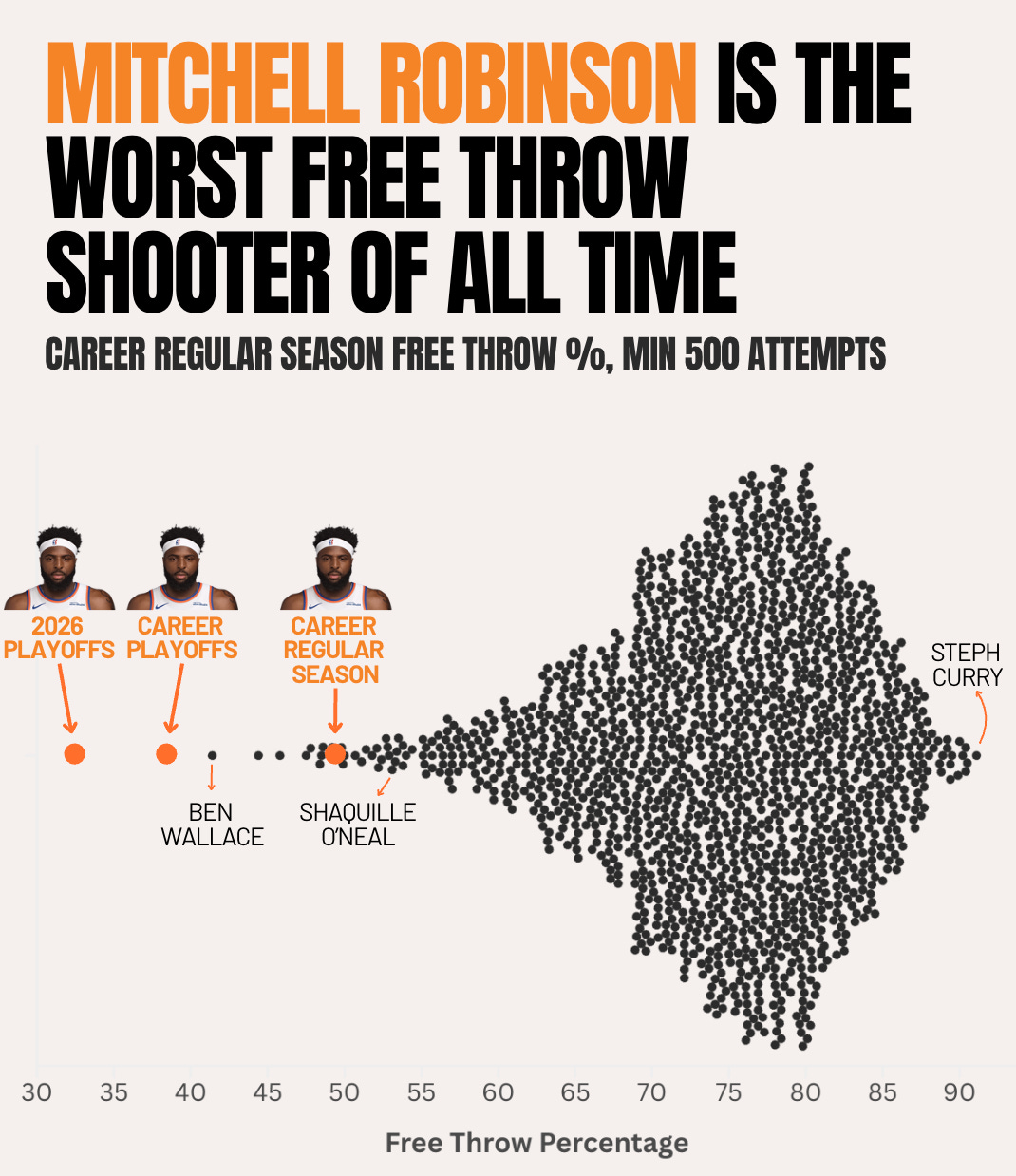
Teams figured out decades ago, famously with the Shaquille O’Neal “Hack-a-Shaq”, that fouling bad free throw shooters and sending them to the line is statistically a better approach than trying to play real defense against them. “Hack-a-Mitch” results in an expected 0.64 points for the Knicks,9 about half of the 1.2 points per possession the Knicks are averaging these Playoffs. You’ll take that all day as a Spurs fan.10
Of course, the Spurs don’t need to waste any time before hacking a Mitch. They’ll do it right away, which results in shorter possessions and more of them. Said the other way, less Hack-a-Mitch = more 1.2 points per possession plays for the Knicks’ offense = longer possessions = fewer possessions, i.e., a slower pace.
Fast Breaks
So, when Mike Brown reviews the box score at the end of the night and sees a slower pace, it probably means his team was able to lure Wemby out of his ideal defensive position, grab offensive rebounds, and avoid watching the worst free throw shooter of all time throw away possessions in straight line drives.
But it also might mean that the Knicks aren’t getting points off of fast breaks, where they have been the most efficient team in these Playoffs. Generally, Brown is ok with that: despite being elite at finishing in transition all season, New York has been in the middle of the pack in transition frequency both in the Regular Season and in the Playoffs. They’ll take fast break opportunities when they come, and score on them often, but it’s not this team’s identity.
Stopping fast breaks in their tracks is a key identity of the San Antonio Spurs; they have the third best transition defense in the league. Fast break opportunities sound great, until they look like this:
On the other side, the Spurs have shown they would love to get out and run. They are second in the NBA Playoffs in fast break points, only behind the Knicks, despite forcing the fifth fewest turnovers. That’s because the Spurs want to run, even if they don’t have the built-in advantage of live ball turnovers. In these so-called “fire breaks”, the Spurs will rapidly inbound the ball after their opponents make a shot, and throw it ahead, creating fast break chances out of thin air.
The Knicks want fewer of these fire breaks, meaning they want longer, fewer possessions, i.e., a slower pace.
The Knicks are a half decade older than the Spurs. They have the Playoff experience and they are cool under pressure in ways the Spurs’ simply haven’t been around long enough to become yet. The Knicks can take their time, execute their strategy, and play their game at their pace. Mike Brown can tell us that the pace should be faster, but don’t trust everything you hear on TV.
Karl-Anthony Towns is second with 27 field goal attempts.
The New York Mets would love a guy with a 34% success rate in their lineup.
Pun intended.
Excluding a “grenade” he had to chuck up at the end of the shot clock.
By my count, of Brunson’s 31 shots, only 5 came off of potential assists from his teammates: 4 were for three-pointers and 1 was on a fast break.
Relatively. With an 8’ wingspan he’s never really fully out of the play.
Minimum 100 attempts.
It’s a stretch, but feasible that he finishes with a higher offensive rebound rate (currently 20%) than free throw percentage (32%) during this Playoff run.
32% * 2 attempts = 0.64.
Well, for as long as you can, until your team gets in foul trouble or the final two minutes when the rules change.