


On March 4, 2013 Allie Quigley signed a contract with the Chicago Sky; it was hardly newsworthy at the time. Quigley was a journey-woman who had already been signed and waived by four teams1 in her young WNBA career. In fact, she had been close to giving up on the WNBA entirely and had started planning for a career overseas. She spent the prior summer working as a counselor at DePaul kids camps and watching Sky games from the stands. A year later, she would be playing in those games and ultimately the signing would alter the course of women’s basketball,2 and a few personal lives.
Quigley is from just outside of Chicago, and played her college ball at DePaul so she was certainly excited about the prospect of returning home to play in front of friends and family. She was also excited to get to play with the Sky’s Point Guard, Courtney Vandersloot.
For a shooter, getting on-target passes from one of the best young Point Guards in the league3 was a blessing in and of itself, but that’s not the only reason Quigley was excited to join teams with Vandersloot. The pair had met on the 10-hour flight from Slovakia, where they were both playing in the offseason, to Chicago and hit it off immediately. They agreed to keep their relationship platonic during the season, but shortly after the games wrapped the Sky backcourt announced they were dating.
That, of course, led to the creation of one of the best WNBA nicknames ever, VanderQuigs, and leads me into creating a new advanced stat for measuring teammate chemistry: VANDERQUIGS.
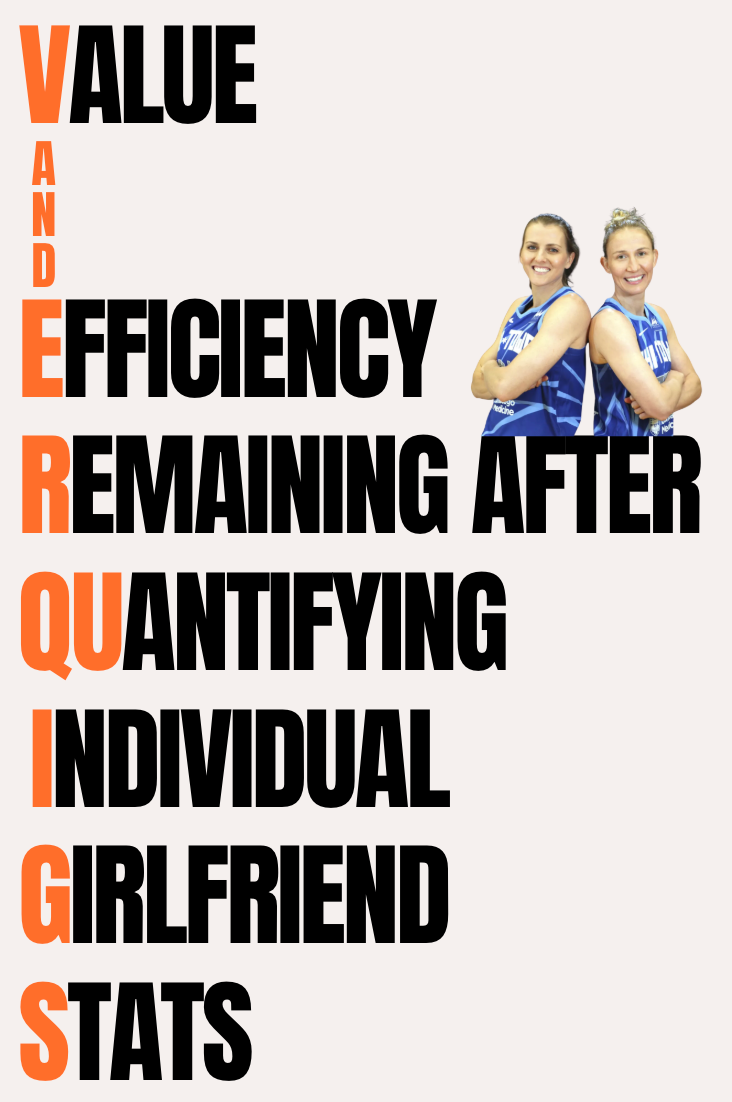
For ease of calculation,4 we’ll measure “value” with points, “efficiency” with effective field goal percentage (eFG%), and “remaining after” will be defined as the amount a given player’s stats increase when they play on the same team as their significant other.5
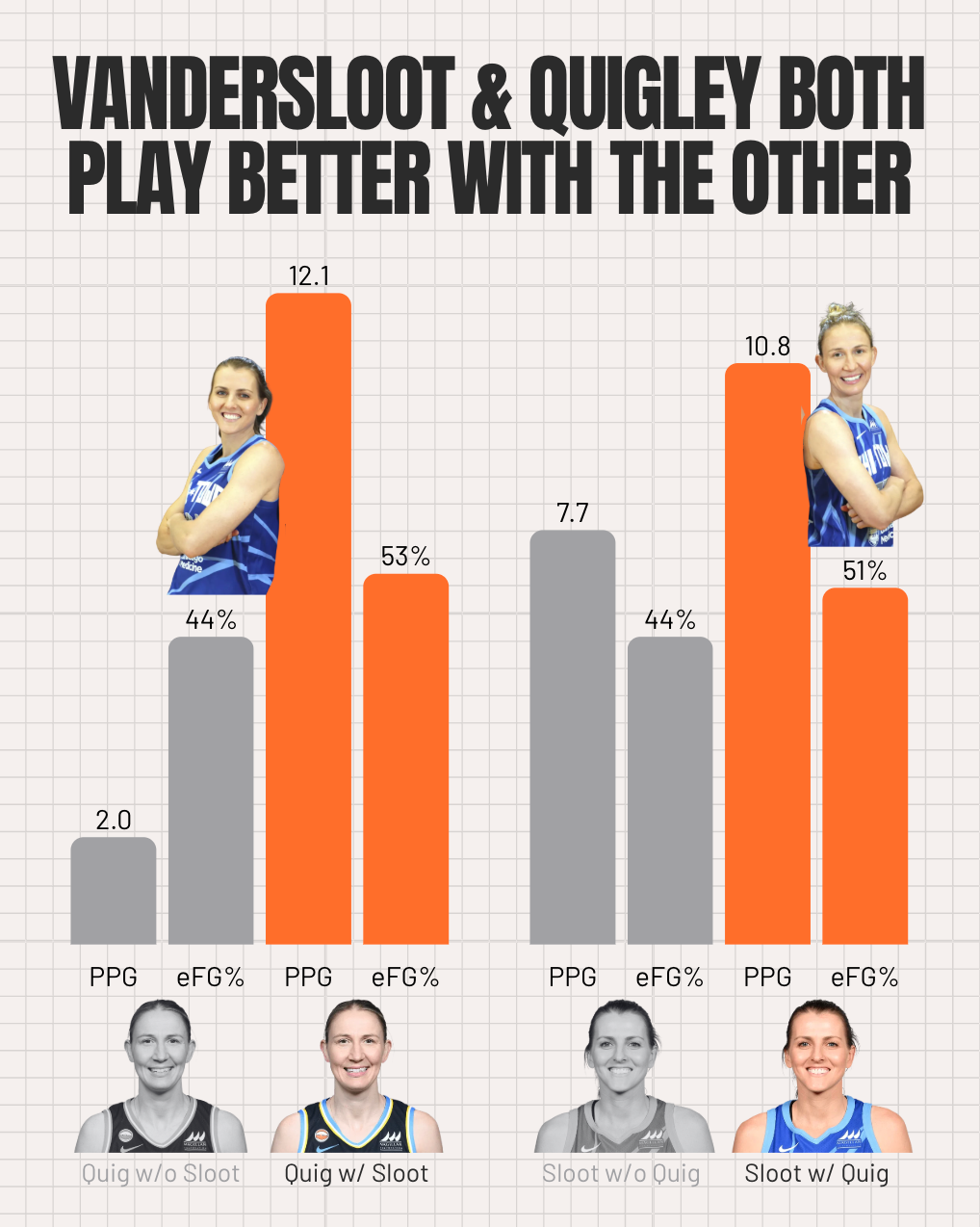
So what is the VanderQuigs’ VANDERQUIGS? Let’s start with Allie. As mentioned, before finding her home with the Sky she hadn’t had much of an impact in the WNBA. She had averaged just 2 points per game on 44% eFG% to date. After joining Sloot in Chicago those numbers ballooned to 12.1 points on 53% eFG% shooting, increases of 6.1x and 1.2x respectively or an average of 3.7x.
Vandersloot, meanwhile, had a stronger start in her first couple of years in the league, averaging 7.7 points per game with Allie’s same efficiency (44% eFG%). But her numbers also improved once Quigley moved in, up to an average of 10.8 points on 51% shooting in the decade the two played together in Chicago. Running the numbers6 that gives her a VANDERQUIGS of 1.3x. Both Vander and Quigs helped one another become their best selves (on and off the court), but Quigley got the bigger boost (on the court, at least).
That finding is reinforced by VANDERQUIGS +/-.7 According to databallr’s WOWY (With Or Without You8) metric, when Quigley and Sloot shared the court the duo posted a +4.1 net rating (meaning they outscored their opponents by 4.1 points per 100 possessions) over 4,826 minutes together.9 But when Quigley played without Sloot, the Sky posted a -6.6 net rating, a drop-off (or VANDERQUIGS +/-) of -10.7. Sloot’s net rating actually increased to +5.2 when Quigley rested, giving her a VANDERQUIGS +/- of +1.1.
Let’s look at another iconic WNBA couple, Penny Taylor and Diana Taurasi.10 T&T both joined the Phoenix Mercury in 2004, Taylor as the number one pick in the Cleveland Rockers dispersal draft11 and Taurasi as the number one pick in the college draft. They would ultimately play 10 seasons together in Phoenix, and boost each other every step of the way.
Taylor’s scoring (value and efficiency) both increased in Phoenix from her days in Cleveland, while Taurasi’s stats were higher with her wife on the team, relative to what they would drop off to once Taylor retired after the 2016 season.12 Both end up with VANDERQUIGS numbers of 1.2x.
Quigley and Taurasi both retired a few seasons ago, so today’s Point Guard - Shooting Guard portmanteau of note is, of course, Pazzi.13 The Wings used their back-to-back number one picks in the last two drafts on Paige Bueckers and Azzi Fudd, reuniting the UConn teammates in Dallas.
Paige was a no-brainer selection in 2025, but the decision to take Fudd was, and continues to be, heavily scrutinized. Not because Fudd didn’t have the talent or resumé to deserve the top billing (she did), but because the draft also happened to include one Olivia Miles, who was taken second by the Minnesota Lynx and has proceeded to have one of the best Rookie seasons in WNBA history.
Many have assumed that the built-in chemistry with Bueckers, their franchise star, factored into the Wings decision. They can debate whether it should have, but it’s been undeniable that the two are more effective together than they are apart.
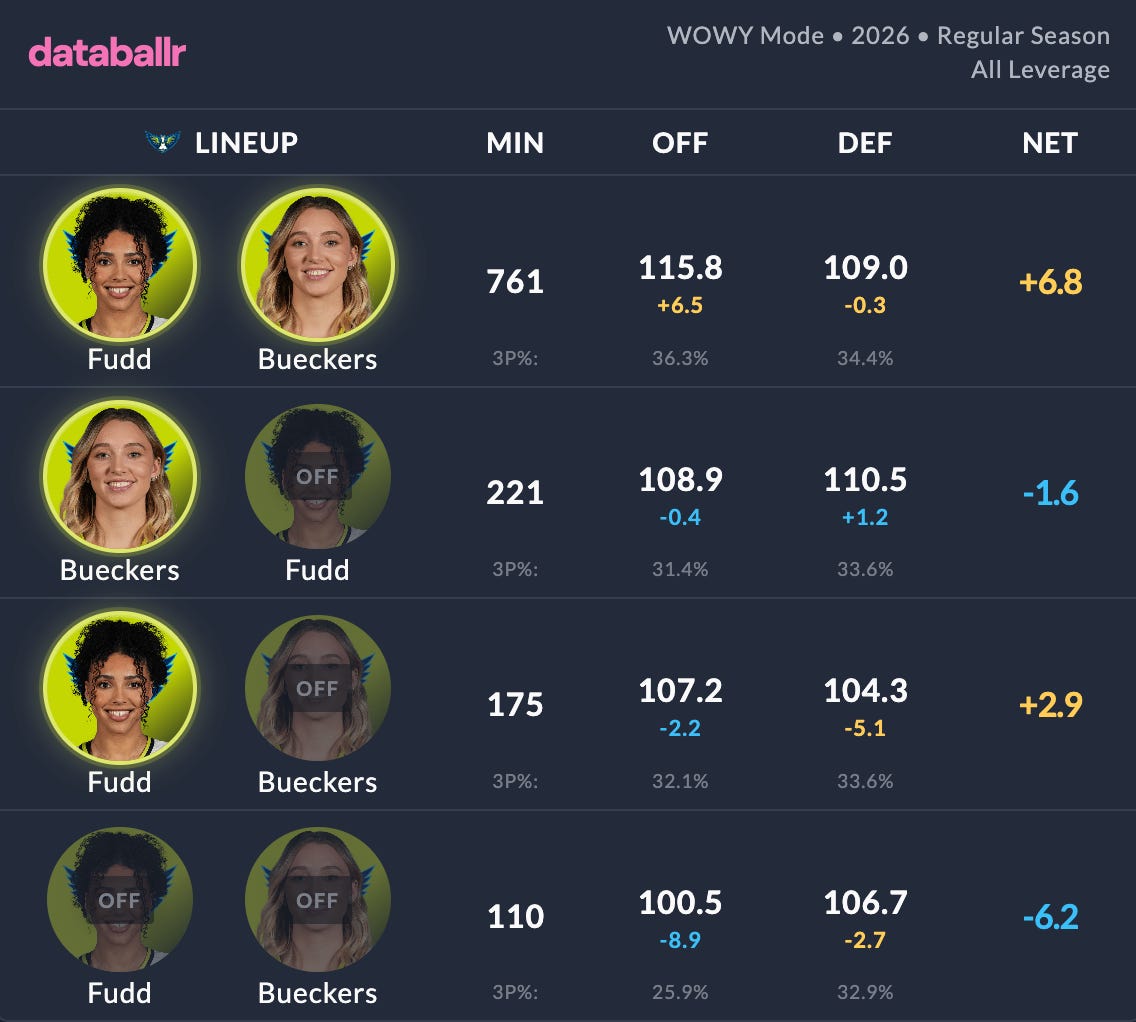
When Paige and Azzi are on the court together the Dallas Wings outscore their opponents by 6.8 points per possession,14 but when either sits that advantage drops significantly. Fudd without Bueckers is just +2.9 (VANDERQUIGS +/- of -3.9) and Bueckers without Fudd is actually outscored by 1.6 points per 100 possessions (VANDERQUIGS +/- of -8.4). They truly make each other better.
Allie and Courtney, Diana and Penny, and Paige and Azzi have all only played together in the WNBA, never against one another.
Well . . . technically Allie Quigley and Courtney Vandersloot did face off in the 2019 All-Star game, which gave us a glimpse into how competitive married professional athletes can be with one another.
“[Courtney] was talking a lot of mess the last week about how she was gonna lock me up, I wasn’t gonna score, so I just had to prove who’s boss in the house.”
So what happens when partners face off in real WNBA games? They come to play.
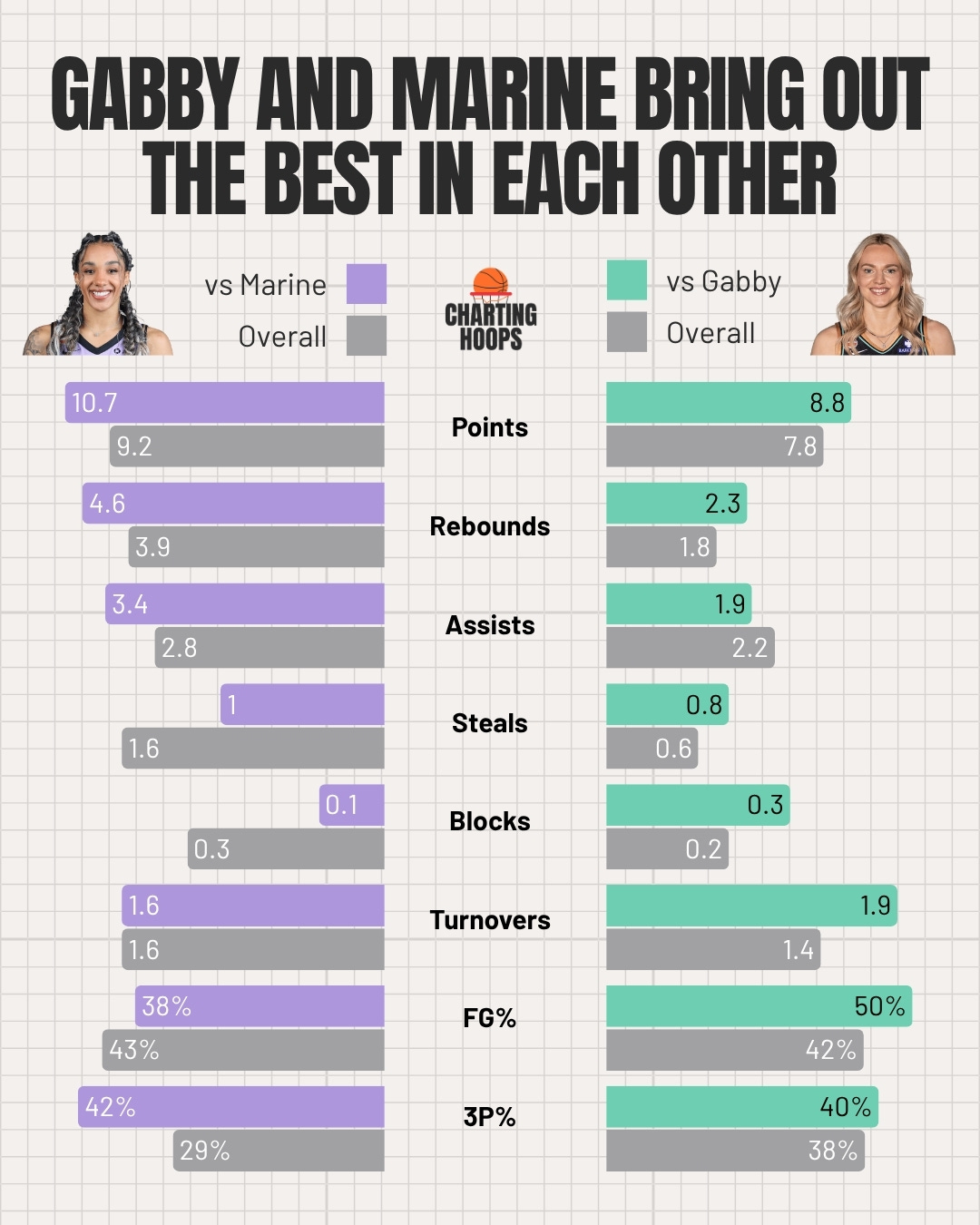
The French duo of Gabby Williams and Marine Johannes have played each other nine times in their careers. In the two matchups this season, Williams, the Defensive Player of the Year frontrunner, has locked down her Johannes.15 But across all of the matchups, both improve, scoring more points, securing more rebounds, and connecting on a higher percentage of their three pointers relative to their career averages when they play against each other.
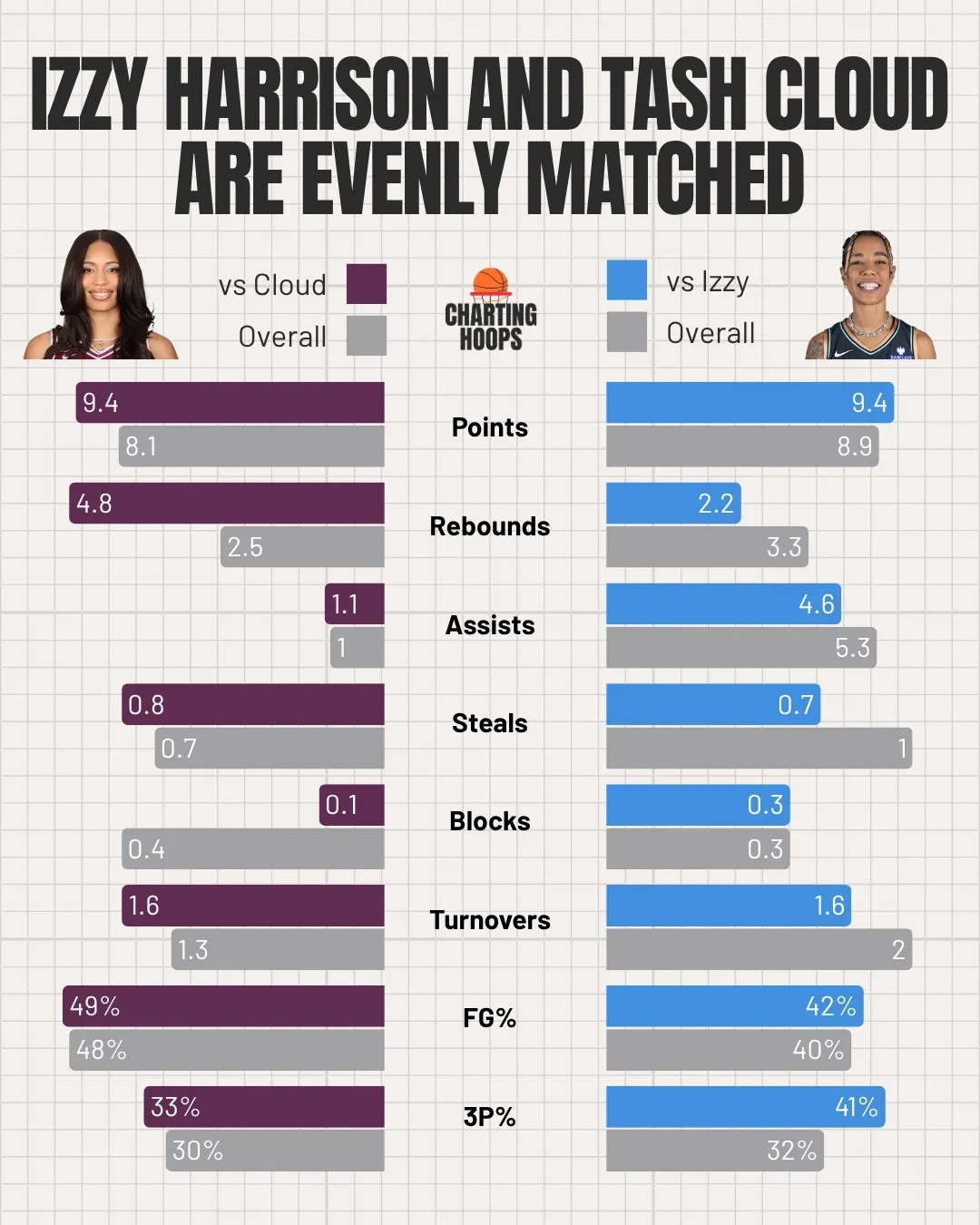
Izzy Harrison and Natasha Cloud are the same way in their 16 career matchups; they post very similar averages across stat categories, in their careers overall as well as in their head-to-head battles.
However, not every couple is so evenly matched. Stepping back from basketball, in most successful partnerships each member of the couple has their own strengths and their own weaknesses, and in that way they can balance each other out. Even among professional basketball players, it’s often the case that one of them is way better at basketball than the other.
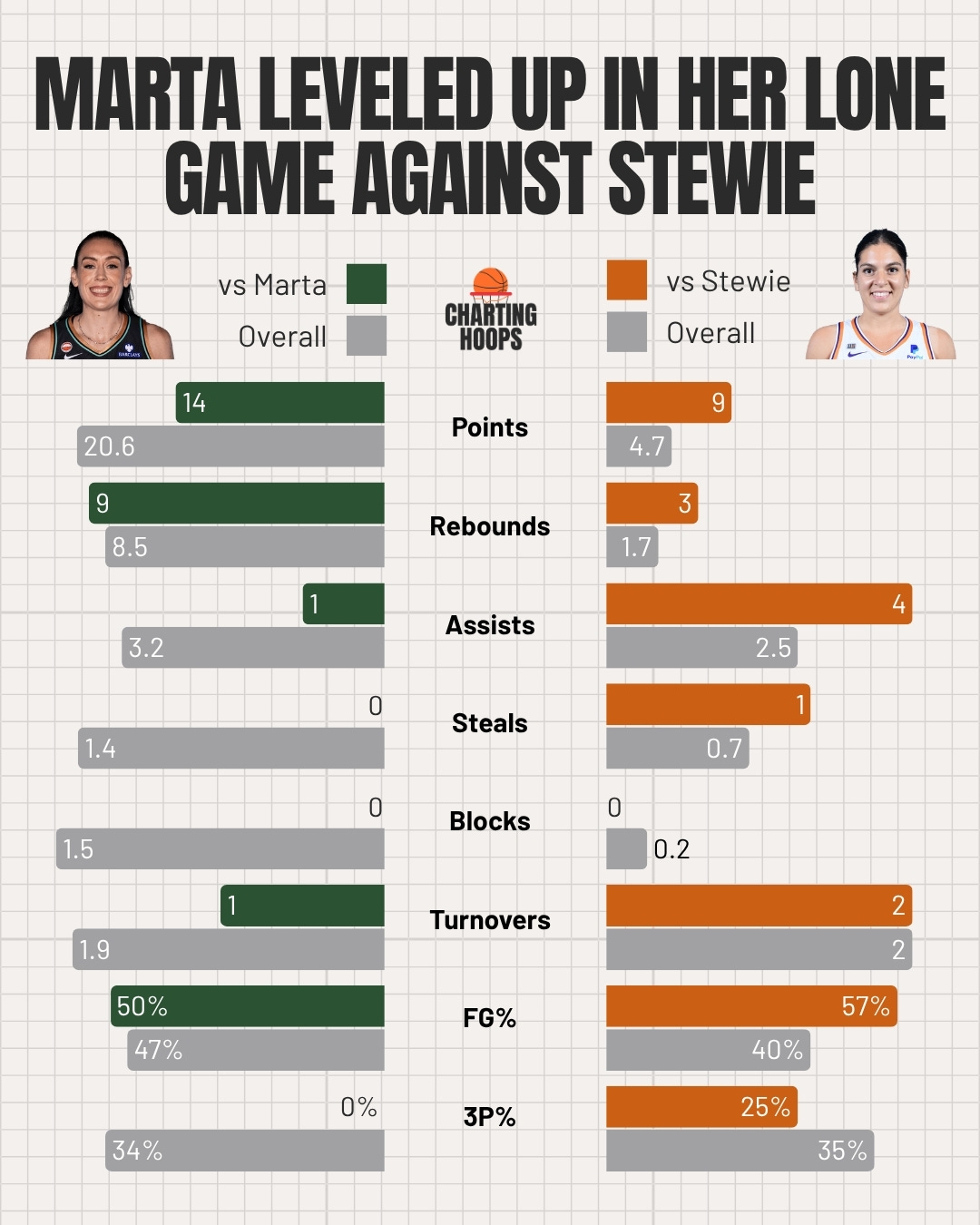
Marta Xargay Casademont was a solid role player for two seasons in Phoenix. Her wife is Breanna Stewart, a seven-time All-WNBA selection, three-time champion, and two-time league MVP. Stewie has averaged 21 points, 9 rebounds, 3 assists, and 3 stocks in her career; Marta averaged 5, 2, 3, and 1.
But Marta had one opportunity to play against her wife in a WNBA game, and she took full advantage. In mid-September 2016, Marta’s Mercury played Stewie’s Storm, and beat them by a whopping 24 points. Stewart mustered just 14 in 29 minutes while Xargay16 nearly doubled up on her career marks in points, rebounds, assists, and steals. By Basketball Reference’s Game Score, it was the sixth best game of her entire career.
Marta makes a strong case, but in the end I have to go back to the originals. Vanderloot and Quigley are my VANDERQUIGS All-Stars;17 how could it be any other way?
Storm, Mercury, Fever, Silver Stars (now Aces), and Storm again.
Quigley was a critical part of the Sky’s championship run in 2021.
One who will likely finish her career with the most assists of anyone in WNBA history.
Yes, this is going to be a real stat.
So above 1 means a player improves when on her partner’s team, below 1 means her stats go down.
((10.8/7.7) + (51%/44%))/2 = 1.3
Oh yeah, there’s more.
A little over 120 regulation WNBA games. That’s a lot of time.
I previously argued that Quigley was better than Taurasi. It’s a losing argument, I’m aware, but if you’d like to check it out anyway it’s here.
This is a good time to acknowledge this metric is flawed and doesn’t account for a player’s age, experience, or the rest of the team context. It’s just meant to be fun!
Don’t make me try to come up with a backronym including two Zs!
For context, only three teams - the Lynx, Valkyries, and Fever - are posting higher net ratings currently.
Johannes had zero points in the May 5 matchup, and just three on June 28.
Starting alongside both Penny Taylor and Diana Taurasi.
No, I’m not going to get into the NaLyssa Smith, DiJonai Carrington, Jackie Young drama.
I had a question for you, but then I reached your 17th footnote 😂😂😂 This was excellent
👏 🙌🏻 Bravo