

NBA MVP TMI
Breaking Down The Narratives That Impact MVP Voting

Before diving into the data behind MVP, I wanted to highlight two features I’ve been running the last few weeks:
NBA Battlegrounds: For each Playoff matchup from the Conference Semis on, I’ve created matchup “cheat sheets”, highlighting the parts of the game where one team has an advantage over their Playoff opponent. Here’s Thunder vs Spurs and here’s Knicks vs Cavs. Thanks to Owen Phillips for the format!
What Happened in the WNBA: Every morning I’m posting a minute-long summary of the prior day in the WNBA, going through the games played, winners, standings, top performers, and more. Check it out in Notes or on Instagram / TikTok / YouTube. Thanks to graphsketball for the format!
Shai Gilgeous-Alexander was voted the most valuable player in the National Basketball Association last weekend,1 the second straight year he’s won the award. He was once again the best player on the best team in the league, and may even be the best basketball player in the world2 this time around.3
The big narrative around Shai this season was his consistency. When Michael Pina wrote his MVP ballot article for the Ringer, he started the Shai section with the rhetorical question, “Has there ever been a more resounding combination of consistency, elegance, and art in a scorer?” He scored at least 20 points in every one of the 68 games he appeared in. Actually, he’s scored at least 20 points in every game since November 2024, famously breaking Wilt Chamberlain’s record of 126 such games.4
He’s been this way for a while.5 In March 2024, after SGA broke the franchise record for consecutive 30-point games, the team’s post-game interviewer (the guy the players cover with towels) set Shai up with a question about his consistency, and his response didn’t disappoint:
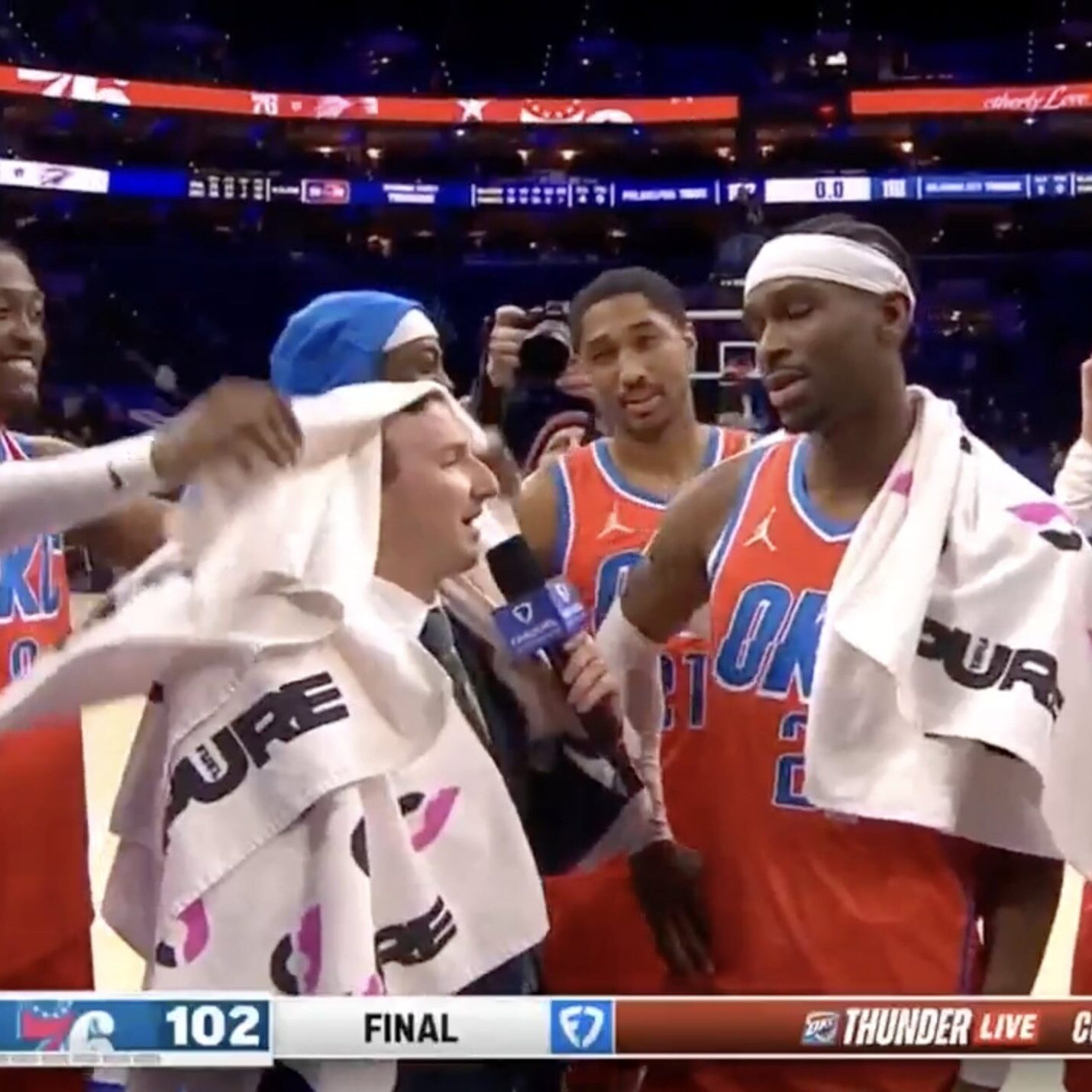
“My whole life is consistent. Everything I do. From what I eat, to when I sleep, to my recovery, to my loved ones. Everything’s consistent. It’s a routine for me at this point.”
There’s no doubt consistency is an incredibly valuable attribute for leaders in any field, especially one like the NBA with its repetitive, at times tedious, 82-game schedule. Shai’s teammates know exactly what to expect of their leader every game, and he calmly delivers every time, allowing them to get comfortable with and grow in their own roles.
But I wondered, when it comes to the Most Valuable Player award, do voters actually reward consistency? Not really.
MVPs Aren’t All So Consistent
I haven’t figured out a way to quantity elegance and art,6 but consistency I can do. I pulled the box scores from every game played by every MVP candidate (those receiving at least one vote) since 2000, calculated their Game Scores7 in every one, then used the inter-quartile range (middle 50%) throughout their MVP-worthy season as a consistency metric. The smaller the range, the more consistent.
Then, building off of Neil Paine’s exploration of voter fatigue from last season, I ran a logistic regression - the dependent variable being whether the player won MVP (1) or not (0) - to isolate the effect of a player’s consistency after controlling for performance and team factors. The result was not statistically significant,8 but if anything having a wider range of performances (i.e., being less consistent) made a player slightly more likely to win the MVP, not less.
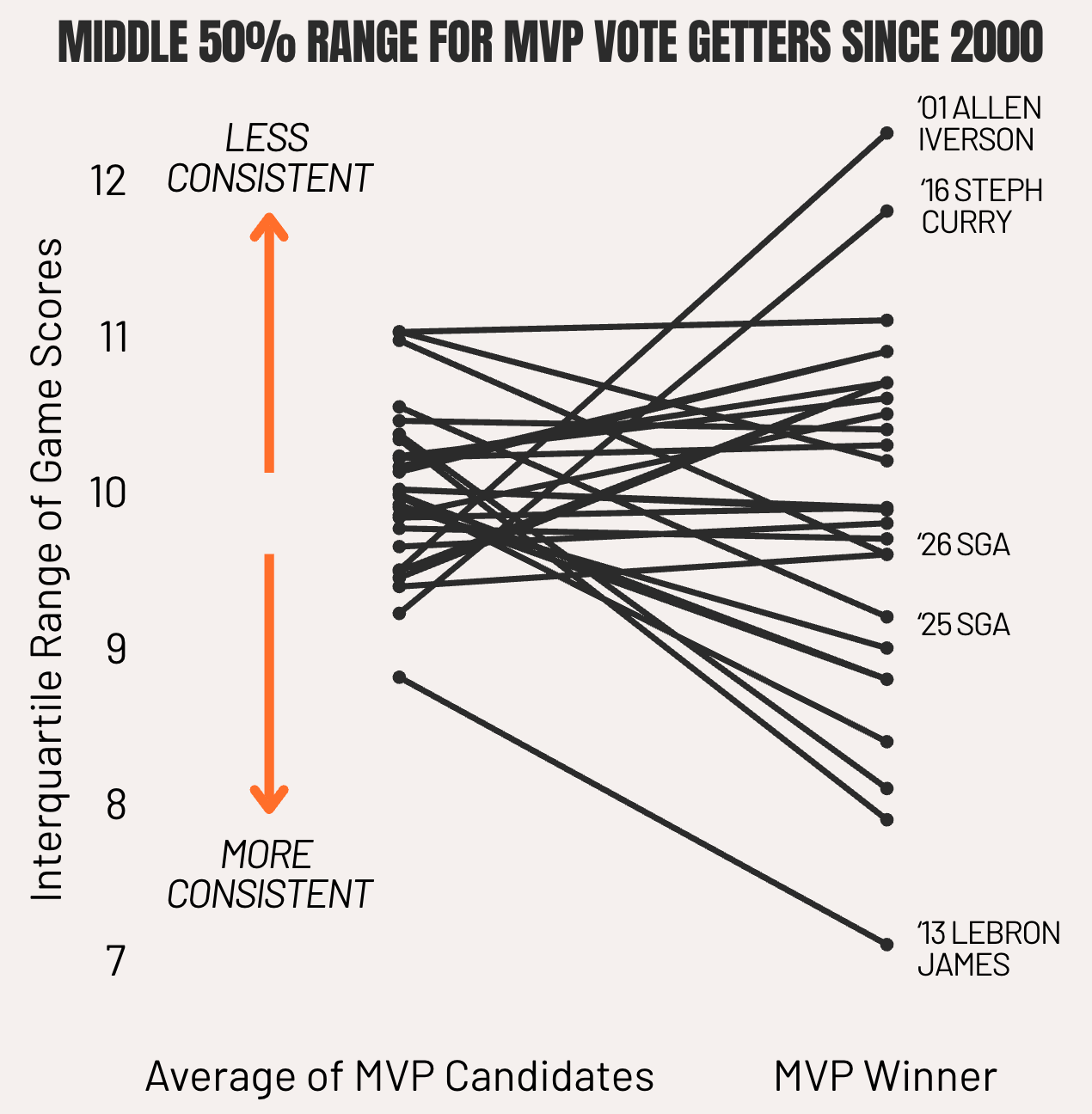
On one hand, with Shai as a prime example, you’d think the more consistent player would win more votes. But, too often fans and voters distill an entire season down to a handful of outstanding performances. In the eyes of many, Shai sealed his second-straight MVP the moment he hit this game winning shot over Nikola Jokić’s Nuggets. Jokić probably secured his place in second, ahead of Victor Wembanyama in the MVP race, when he hit this Sombor-shuffle over the Le Chesnay-left arm of Wemby.
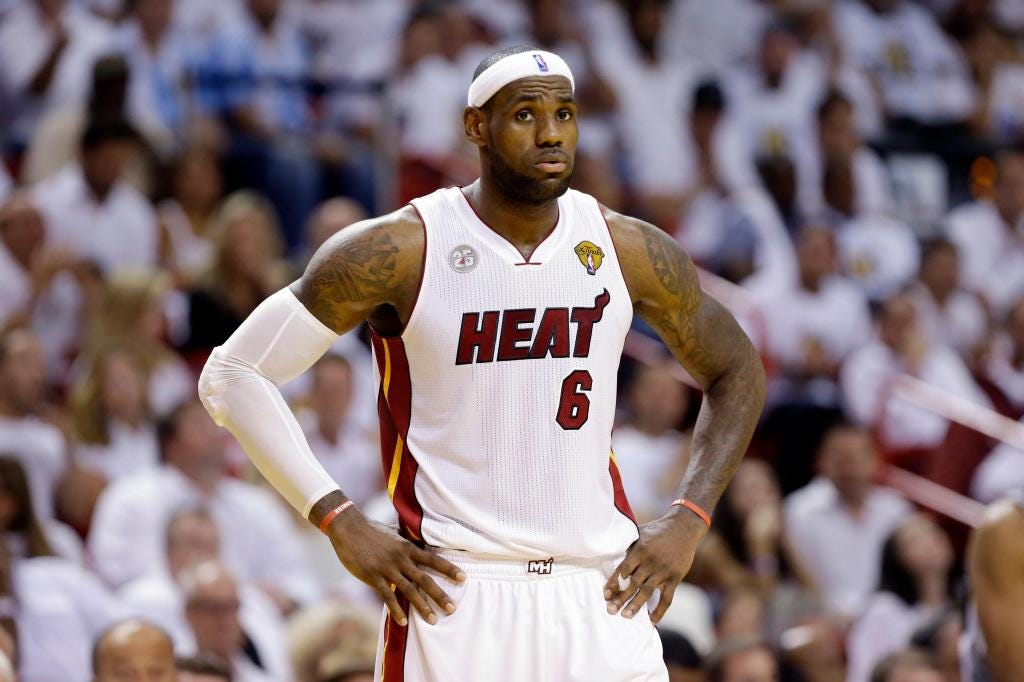
I’d like to take a minute to highlight 2013 LeBron James, because wow he was good. He played in 76 games that season, only taking six off toward the end of the year because his Miami Heat were up by 12 games in the Eastern standings. He played 38 minutes in those games, and averaged 28 points, 8 rebounds, and 7 assists. He made the most field goals in the league on insane efficiency (he got the 50/90 parts of 50/40/90) while also being one of the best defenders in the Association (he finished second in DPOY voting to Marc Gasol). Game Score is calibrated so that 10 is about average; LeBron’s average was 24.4 and he never dipped below 11. I think we forget how good peak LeBron was.
Usually, these “flashbulb” moments that sway voters happen down the stretch of the season, partially because the stakes are higher, but also just because the more recent games are easier to recall. So do players who over-perform later in the season do better in award voting? Maybe a little.
Most MVPs Finish the Season Strong
Since I already had all the box score data, I also calculated the change in average Game Score after the All Star break for every MVP since 2000. Looking at the winners, it does appear many finish the season better than they started it.
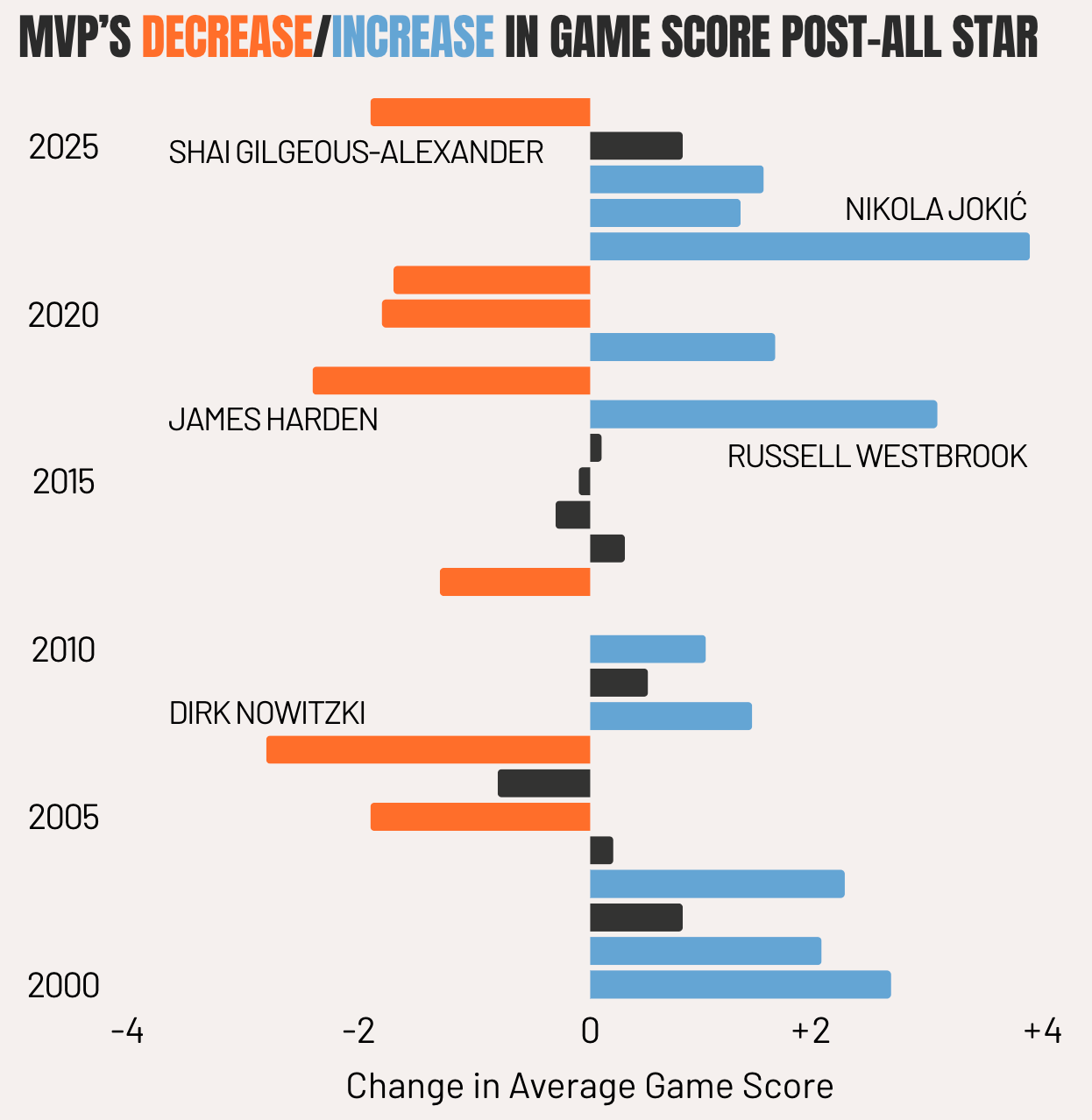
In this sense, SGA is somewhat of a historical outlier, with his average Game Score falling about 7% after the All Star break. Only Dirk Nowitzki in 2007 and James Harden in 2018 fell off more and still managed to win the Most Valuable Player Award.
If the pattern held, if MVP were just a recognition of post-All Star performance, Victor Wembanyama would have won in a runaway. He was the main reason the Spurs finished the season 24-4, best in the league over that stretch, as he improved his Game Score by +4 points on average.9 That would have bested Jokić’s +3.8 in 2022 for best second-half adjustment of the century for an MVP.
Of course, Wemby thinks the award should have been his anyway. Defense is half the game, he says, and he is far and away the best defender. Everybody agrees with the second half of that statement, but some would dispute the first half. Players do spend roughly half of their playing time on defense, but the best offensive players usually have more of an impact on the game than the best defensive players simply because the offensive team controls the action and the defense has to react to it.
MVPs Don’t Have to Defend
As a result, defense hasn’t factored heavily in MVP voting over the last quarter century. If it had, Ben Wallace would be in the GOAT conversation.
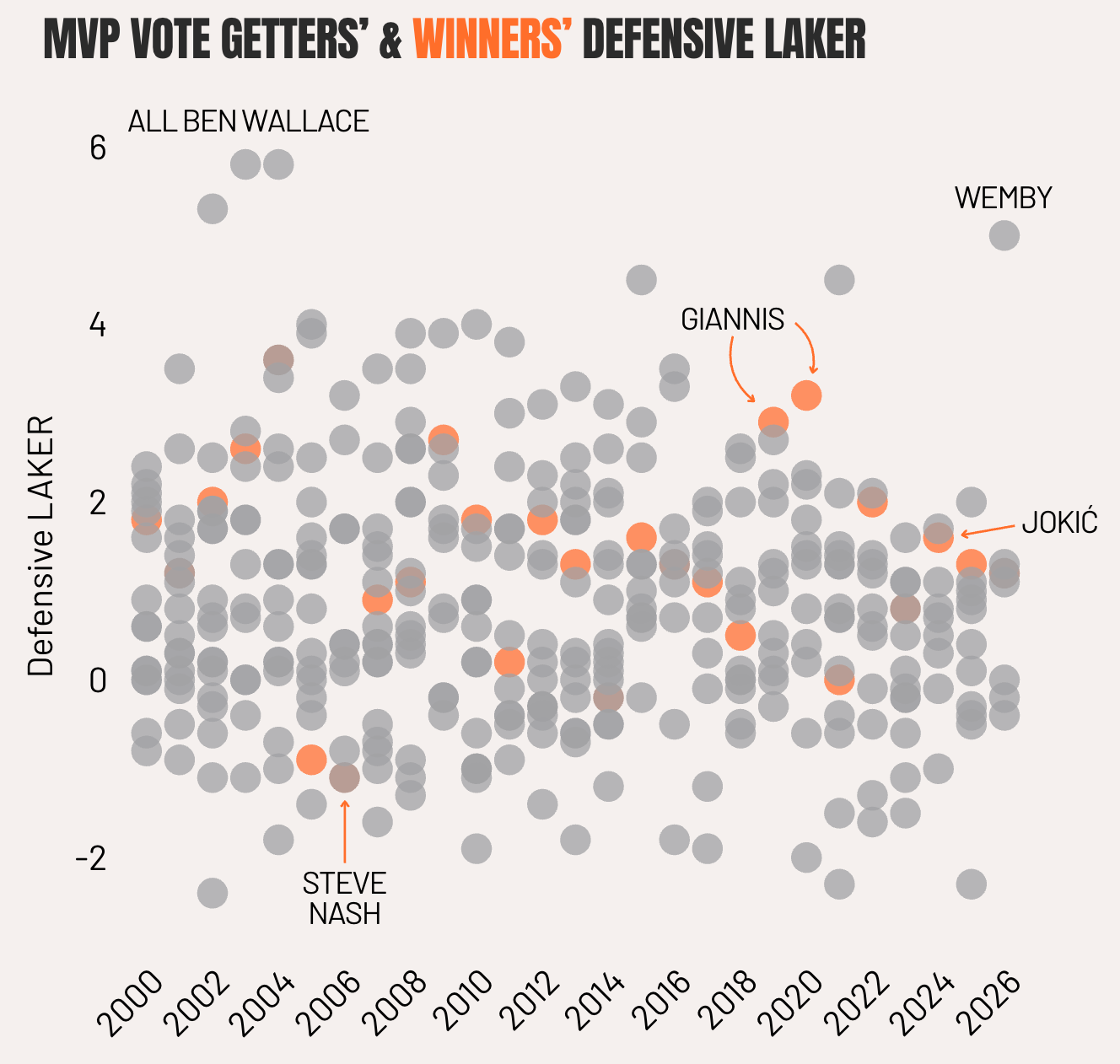
Only one player this century10 has won MVP while posting the best defensive metrics in the league, Giannis Antetokounmpo, back-to-back in 2019 and 2020. That’s the same number (1) who won MVP while being the worst defender among all candidates. In 2006, Steve Nash posted the lowest defensive LAKER among 11 MVP vote getters, and he won the award over LeBron James anyway.11
For the Jokić-defense naysayers, I feel obligated to point out that the Nuggets big man actually had the second highest defensive impact among candidates the last year he won MVP, in 2024, only a hair below Shai’s defensive LAKER rating.
Nikola’s defense has slipped a bit the last two seasons, so his cases against Shai have rested mostly on absurd offensive output. Last season Jokić finished top-three in points, rebounds, and assists per game (first time that’s ever been done), while this season he dropped down to *just* eighth in scoring but finished first in both rebounds and assists (first time that’s ever been done too).
Voters don’t really care about leading the league in those stats though. Somewhat surprisingly, since 1980 only two players have won MVP while leading the league in assists (Steve Nash and Magic Johnson) and two others won while leading the league in rebounds (Kevin Garnett and Moses Malone).
Scoring The Most is the Most Valuable
Leading the league in scoring, however, is valuable. Since 2000, eight MVPs (30%) averaged the most points per game the year they won the award. That list includes Shai last season, Joel Embiid in 2023, all three of the former OKC Big-3 (James Harden, Russell Westbrook, and Kevin Durant) in the years they won, as well as Steph Curry, Allen Iverson, and Shaquille O’Neal. That list does not include Luka Dončić.
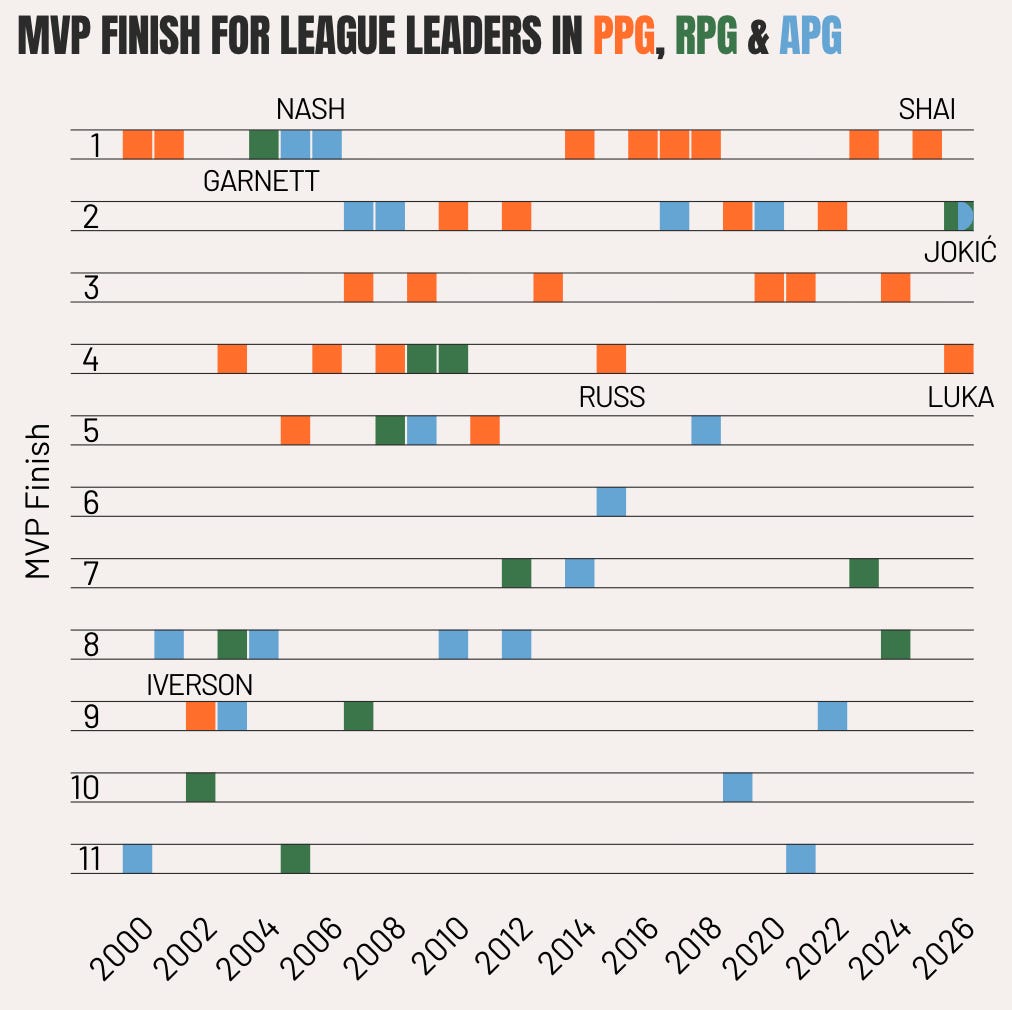
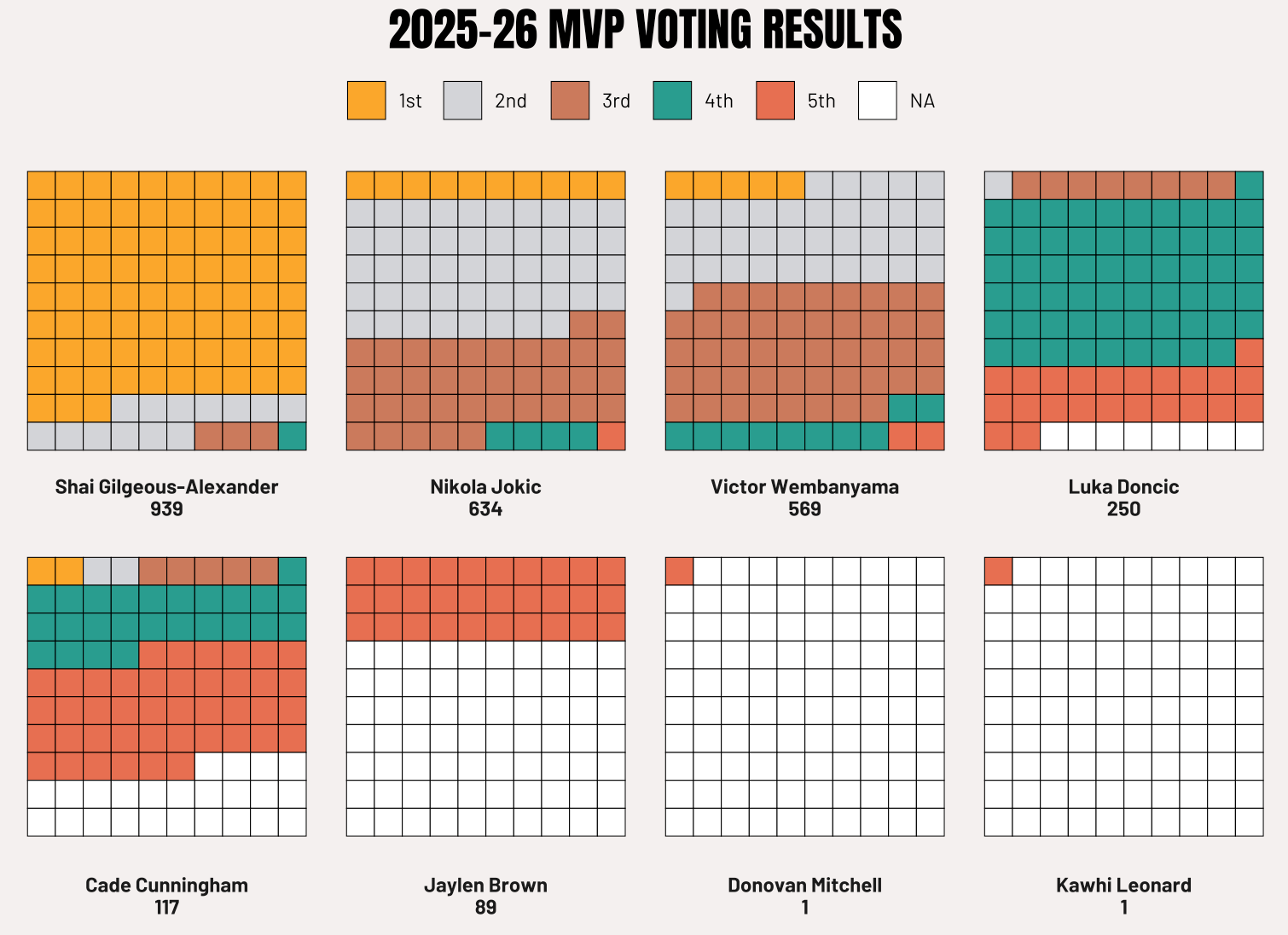
Despite leading the league in scoring this season, Luka didn’t get a single first place vote for MVP. Now, he still finished fourth overall, garnering a few second and third, and most of the fourth place votes. That’s better than Allen Iverson who finished ninth in the voting in 2002, or Tracy McGrady who, in 2004, led the league in scoring and didn’t get a single ballot for MVP.
So what does matter in MVP voting? Like Neil Paine found last year at this time, winning and the narrative. Shai had everything going for him this season:
The Thunder started 24-1 and finished with the best record in the NBA
The Thunder have the best defense in the NBA, and Shai is a key piece of it
Shai got his team to the #1 seed despite missing his best teammate for most of the season with a hamstring injury
He broke a Wilt Chamberlain record along the way, and
He thrived in the biggest games and biggest moments
Jokić had some of those things, Wemby had others. Luka, Cade Cunningham, Jaylen Brown, Donovan Mitchell, and Kawhi Leonard had a few as well. But 83 of 100 voters agreed that Shai had the most valuable season. And so it is.
Later this week I’ll be pontificating on some other NBA awards. No, not Sixth Man of the Year, or Most Improved Player, or even Best Teammate. Awards - some serious, some funny - that don’t actually exist. Subscribe below to receive that, and all my new posts.
Or, if you like abbreviations, NBA MVP: SGA
Wemby’s not of this world, apparently.
Unlike last year when he was named most valuable but everyone still thought Nikola Jokić was better.
He’s now at 140 Regular Season games.
That’s kind of how consistency works.
Yet. I’m working on it, Michael Pina.
I’ll give you details for Game Score, but first promise you’ll keep reading despite me using “logistic regression”, “inter-quartile range”, and now this formula in one sentence: Game Score; the formula is PTS + 0.4 * FG - 0.7 * FGA - 0.4*(FTA - FT) + 0.7 * ORB + 0.3 * DRB + STL + 0.7 * AST + 0.7 * BLK - 0.4 * PF - TOV
p-value well above 0.05.
And that doesn’t include his ridiculous 40+ point 20+ rebound showing two nights ago.
Which notably excludes Michael Jordan, who won both MVP and DPOY in 1988.
LeBron also had nearly double the WAR as Steve Nash. Those were the days before advanced stats.
Super interesting post Chris! It got me rethinking a post on consistency i had been working on for a while, but never came together in a way I was happy with.