A Random, Interesting Q&A with Josiah Cohen
Rise of the Valkyries, Fandom, 2K, and more

Lots of incredible things came out of the WNBA’s expansion to the Bay Area last season, but one of my favorites was getting to know and follow the new team through Josiah Cohen’s Substack, Rise of the Valkyries.
He posted thoughtful reflections after almost every game, with lots of clips breaking down plays, as well as broader, season-long themes and trends, all with very clever post names (an underrated part of writing on the Internet) that made me smile. It is, to my mind, the most interesting coverage of the Valkyries out there, and made it that much more enjoyable to follow my hometown team from thousands of miles away.
I connected with Josiah over email, to ask him about the inaugural season, his background in 2k leagues, and what’s next. He’s a humble guy, but his stuff is great and I hope you enjoy getting to know him as much as I did!
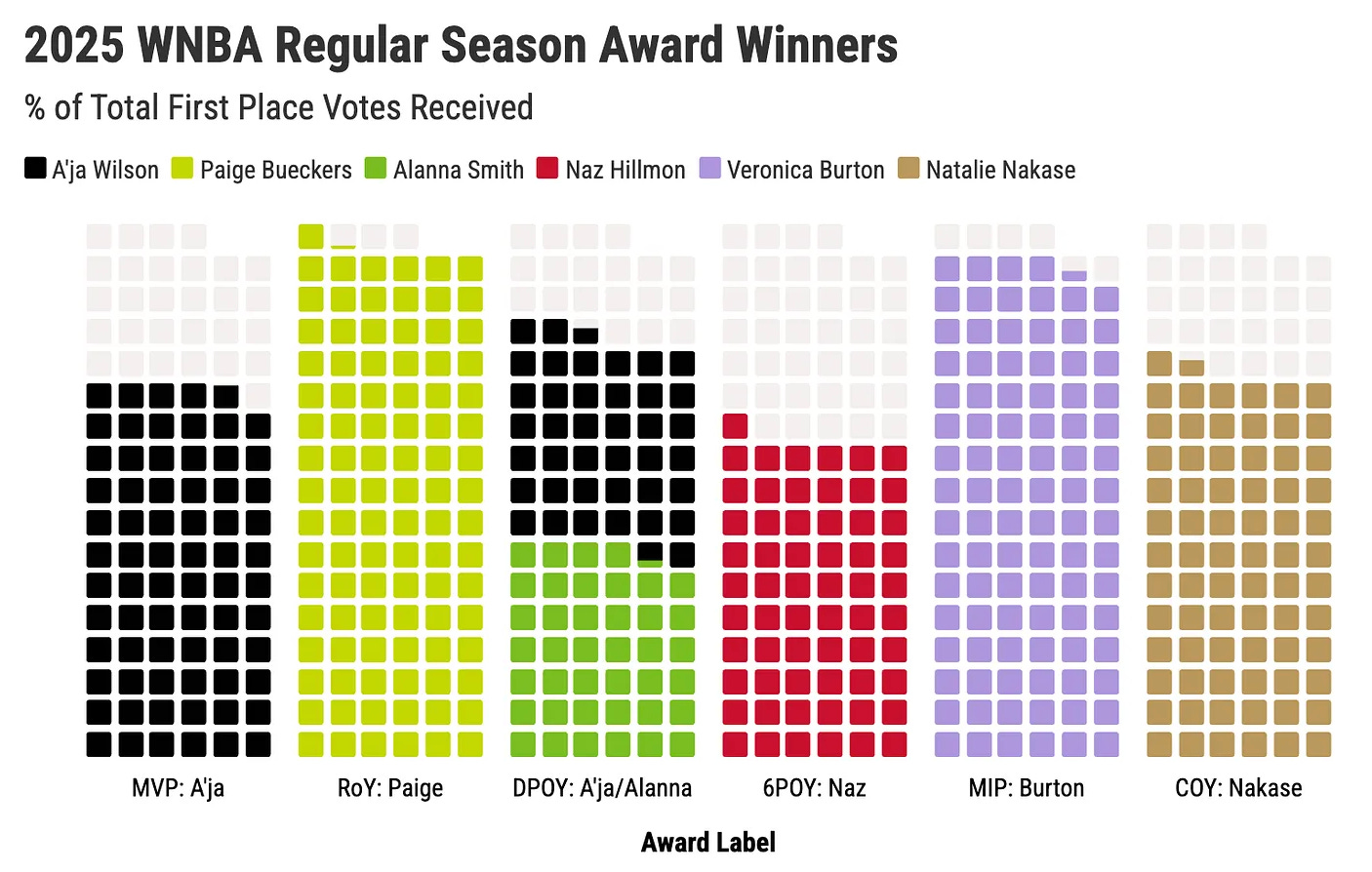
CHRIS: The Valkyries obviously had a historically great inaugural season, which must have made covering them a whole lot more interesting and fun than you were probably expecting. There are a lot of reasons for that, but to focus on one person, what do you think Coach of the Year Natalie Nakase did so well?
Josiah Cohen: Absolutely, and I’m grateful for it, although the coverage expectations certainly would have been lower had they been worse!
As for CotY Nakase, among many things, I’d say her ability to instill an identity and integrity in the team. Coaches have the ability to set the tone, and Nakase didn’t lower the expectations just because the Valks were an expansion team. We’re going to shoot threes and we’re going to play defense, not necessarily in that order, and we’re going to do that game in and game out no matter who’s in the lineup that night. That was pretty much the guiding principle from day one, and it held up all the way to game 46. It’s easy to see consistency ebb and flow throughout the course of the season, but the Valkyries had less of that because their North Star was so strongly defined.
Thinking forward to next April, fill in the blank: I’m most excited to see _____ in Ballhalla this season?
I’m most excited to see what the next step is. That A’ja-to-the-Bay reunion talk sure quieted down when the Aces won the title, naturally, but the Valkyries have plenty of room to grow into their championship-in-five-years expectation. I don’t know if that’s a big-ticket free agent arrival, a transcendent arrival of Jocytė (international player draft year + 1 can really hit), or just consistent three-point shooting. I think I’m most interested to see if the fever stays hot.
Throughout the season you came back to a few themes again and again, including lineups and shot selection. Why’d you like focusing on those? If you had to guess now, what do you think the key stats or trends will be for the Valks in year two?
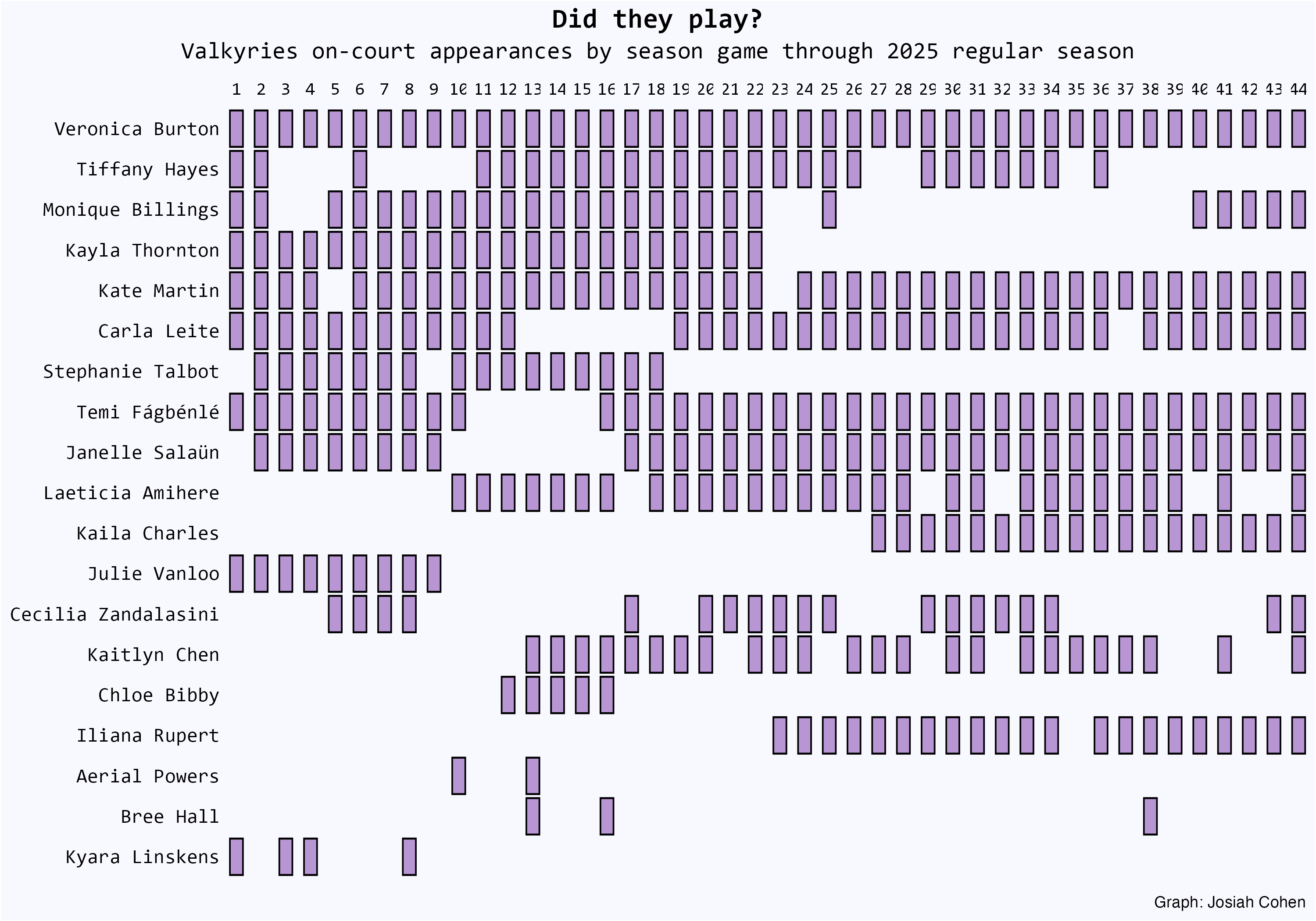
I tried to approach my coverage with more of a coaching lens than is traditional, and those two things - lineups and shot selection - are two aspects of the game over which the staff manages to have some sway. Injuries aside, the staff controls who plays, and the offensive philosophy they instill dictates the shot selection. Three-point variance is a pretty significant factor in basketball nowadays, and that’s going to trickle into the WNBA more and more, and the Valkyries are leading that trend. That efficiency will be the biggest thing.
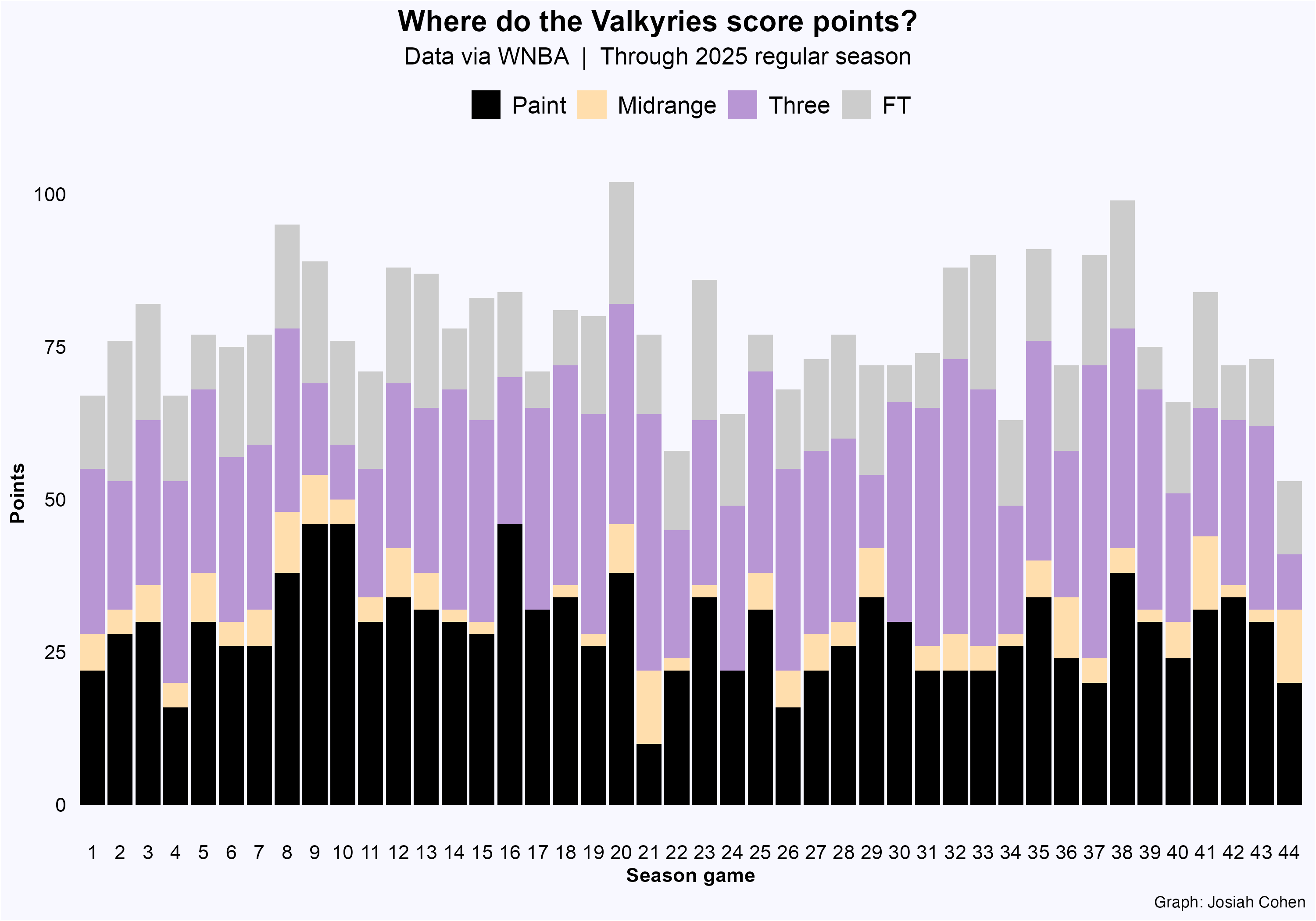
I’d also look at some of the assist numbers. Golden State ranked second-last in the league last year in assists per 100, but that’s in part a function of their poor shooting and slow pace. They were fifth in assist rate, though, and I know from personal experience that Golden State as an org is very invested in passing and some of the underlying concepts that I think translate quite well to the WNBA. If the Valks can push the top three in assist rate while getting even more efficient, that’s a recipe for offensive success.
What’s something that’s true about women’s basketball that others don’t agree with you about?
In real life, unfortunately, it’s that women’s basketball is worth watching. On the internet, it’d probably involve the value of bigs.
Brandin Podziemski definitely thinks women’s basketball is worth watching. Thoughts on him as a fan?
Pro, in both senses of the word! But shouldn’t totally take away the spotlight of fandom from some of the Bay Area’s longer-tenured and, uh, more representative women’s basketball fans.
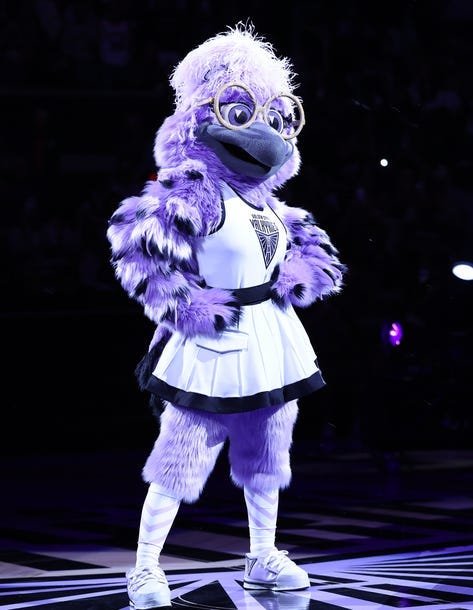
Thoughts on Vi?
I’ve never been a big mascot guy, but she seems cool. I’m interested to see her shooting form develop over time.
Before starting Rise of the Valkyries you were a coach and general manager for NBA 2k teams. What’s an interesting skill or discipline you learned doing that you wouldn’t have gotten elsewhere?
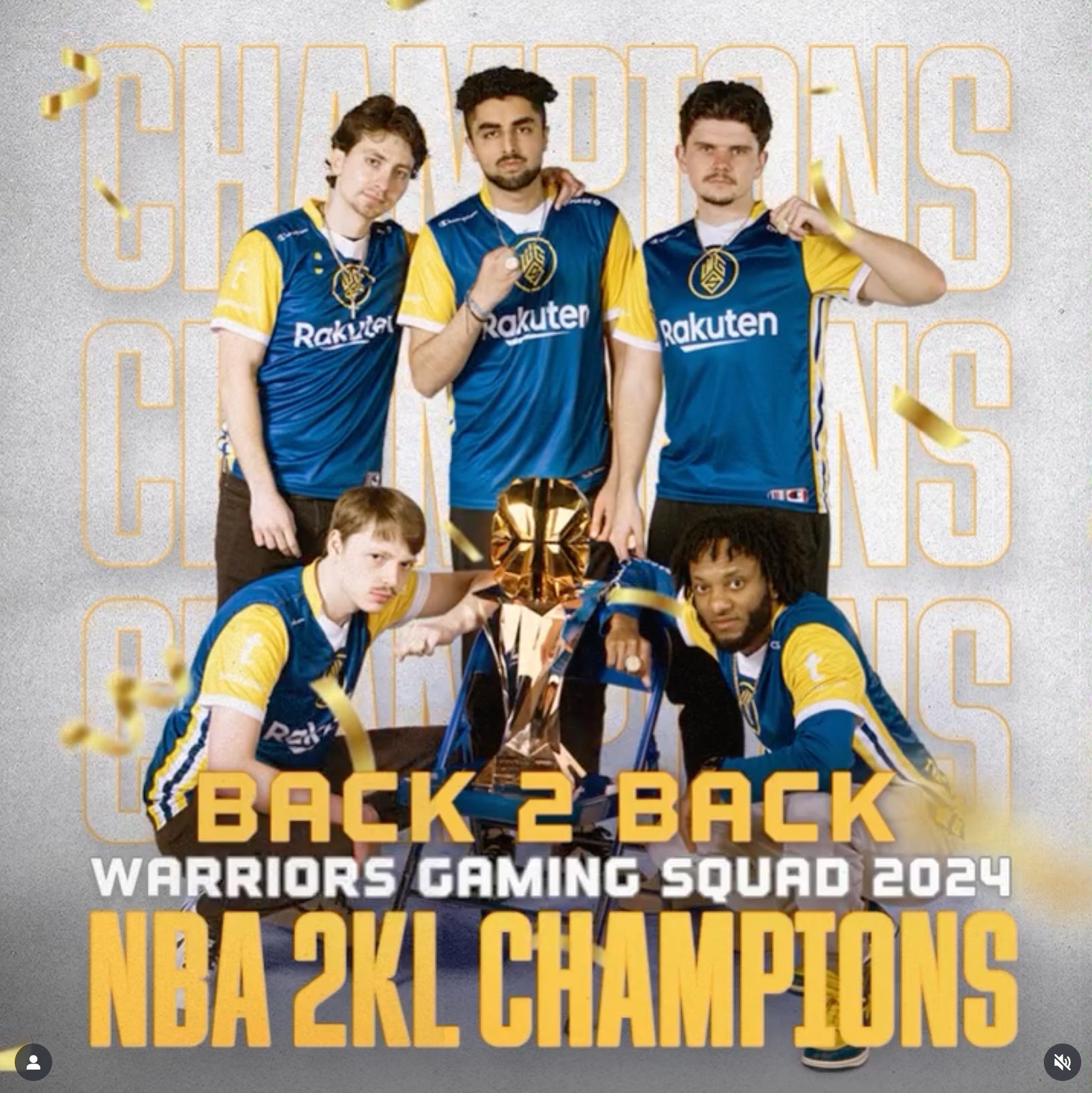
This is very true (and very niche). I was the assistant GM and coach for the Golden State Warriors’ NBA 2K League team, Warriors Gaming Squad (2023 & 2024 champions! Then the league folded). It was an unbelievable opportunity to work in a basketball startup, essentially, and have exposure to Warriors personnel and still have a lot of responsibility for a team. I taught myself to code (somewhat) as part of that role, and I wouldn’t have done that otherwise, or gotten a chance to learn Synergy, or . . . I could go on.
What’s the GM day-to-day look like for e-gaming? What do you look for in players? How much is “scouts vs stats” (i.e., watching film vs looking at numbers)? What stats do you look at?
In-season, it’s helping to coach practice, which consists of scrimmages against inter-conference opponents, and scouting for upcoming opponents. Offseason, it’s watching a lot of Twitch streams and doing other draft prep. For player evaluation, there’s a big debate over “stick” skill (i.e., talent) vs. intangibles. You need a lot of both to be successful, since the margins for error at the highest level of 2K are so thin.
The 2K League was hilariously light on stats - most teams couldn’t tell you their own points per game numbers, for example, and the league had so much other stuff going on that stats weren’t high on their list of operational objectives. That gave us a bit of a competitive edge, since we had 2K-specific tracking, game API extraction (boxout data, for example), and a belief in statistical thinking that permeated the player consciousness (I tried, at least). The difficulty is that the game itself changes every year, and players can change their in-game selves every game, so predictive modeling is much trickier. But that’s a whole conversation - really a whole series of articles - for another time.
Why is the US so good at 2K? 47-0 across two years with two consecutive eFIBA gold medals is wild.
There’s a lot of good international 2K out there. With the USA Basketball E-National Team, though, we had exclusively professional 2K players and staff with more on-stage and big-game experience. It’s not dissimilar to the USA Basketball 5x5 Women’s National team, actually. We’ll see if we can stay on track with them and get three in a row in this next cycle.
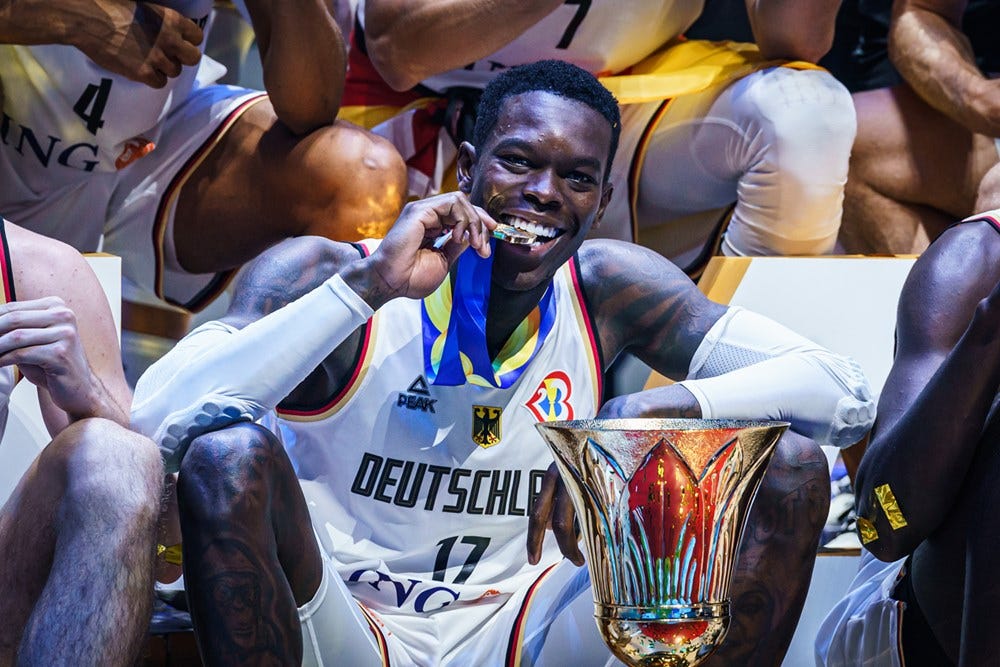
Is there a Dennis Schröder of eFIBA?
Tremendous question. Sort of. There are a lot of great international players, as I said, who unfortunately didn’t get 2K League exposure (many teams had a block against drafting international players, especially international guards, for several reasons of varied merit), but to specify a Dennis Schröder - great internationally, fine in the league - is tricky.
There are two answers I came up with. A point guard who went by the gamertag Killeyy was fairly mediocre in the league but took his Puerto Rico team into some tight games with the USA. Internationally, the French team has been the second-best in Europe, generally, after Turkey, and their point guard - BreakerTheBeast, who was almost a 2K League draft pick in 2024 - took them to the eFIBA Finals in 2023 with an upset of Turkey. International success, but no North American League success.
I spent way too much time thinking about this.
Who do you like playing as most in 2K?
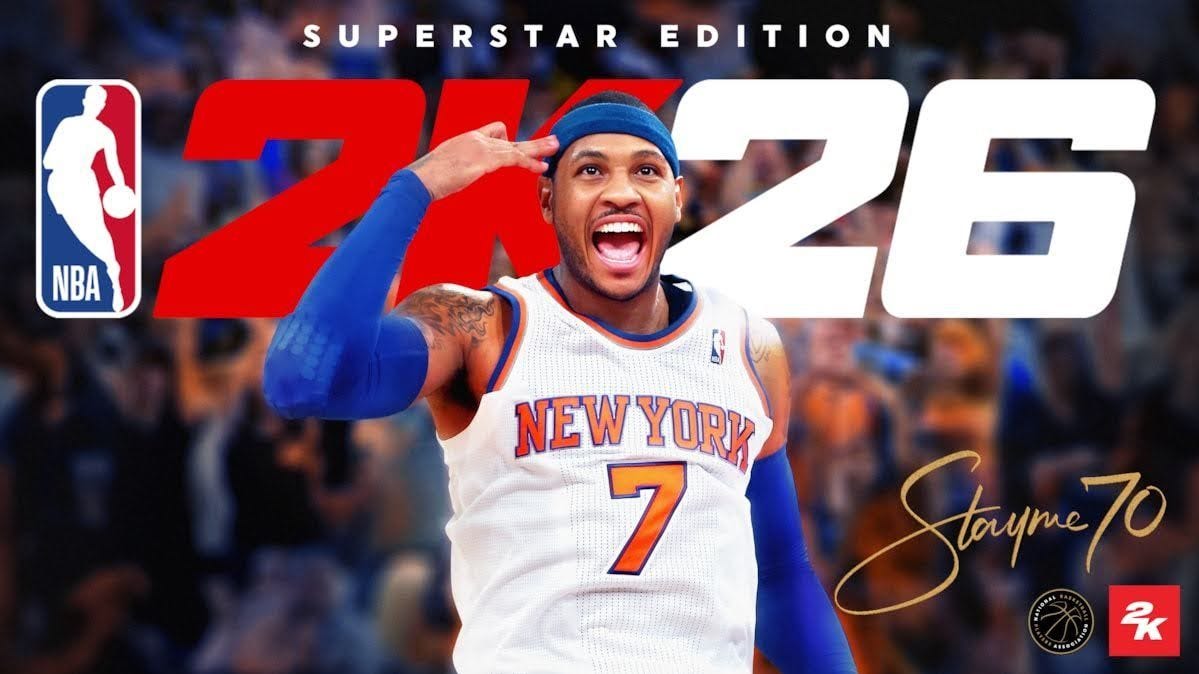
I haven’t really played much more than the Pro-Am (i.e. MyPlayer) mode in a long time, but I like using the Cavaliers, if I play online, and I once played a whole season with the late Melo-era Knicks. But I usually play as a Power Forward (backend defender) or Center in MyPlayer modes.
I think a lot of people that work in data visualization got started because there was a particular person that made them go, “Wow I want to do that”. Is that true for you? If so, who were those people?
I honestly don’t think so, in part because I never considered myself as working in dataviz. Obviously, I take a lot of inspiration from Owen Phillips at The F5 [Editor’s Note: I do too, including this question]. Anthony Reinhard in the NFL space is another person whose work I’ve always admired. For me, it was post-graduation “hey, I kinda like this,” and graphs were just an intuitive way to approach data and test out some coding. I’ve been lucky enough to get a lot of advice along the way, technical or philosophical, and I wish I got to make more graphs in my day-to-day life.
What’s your plan for the offseason? Anything coming up you want to plug?
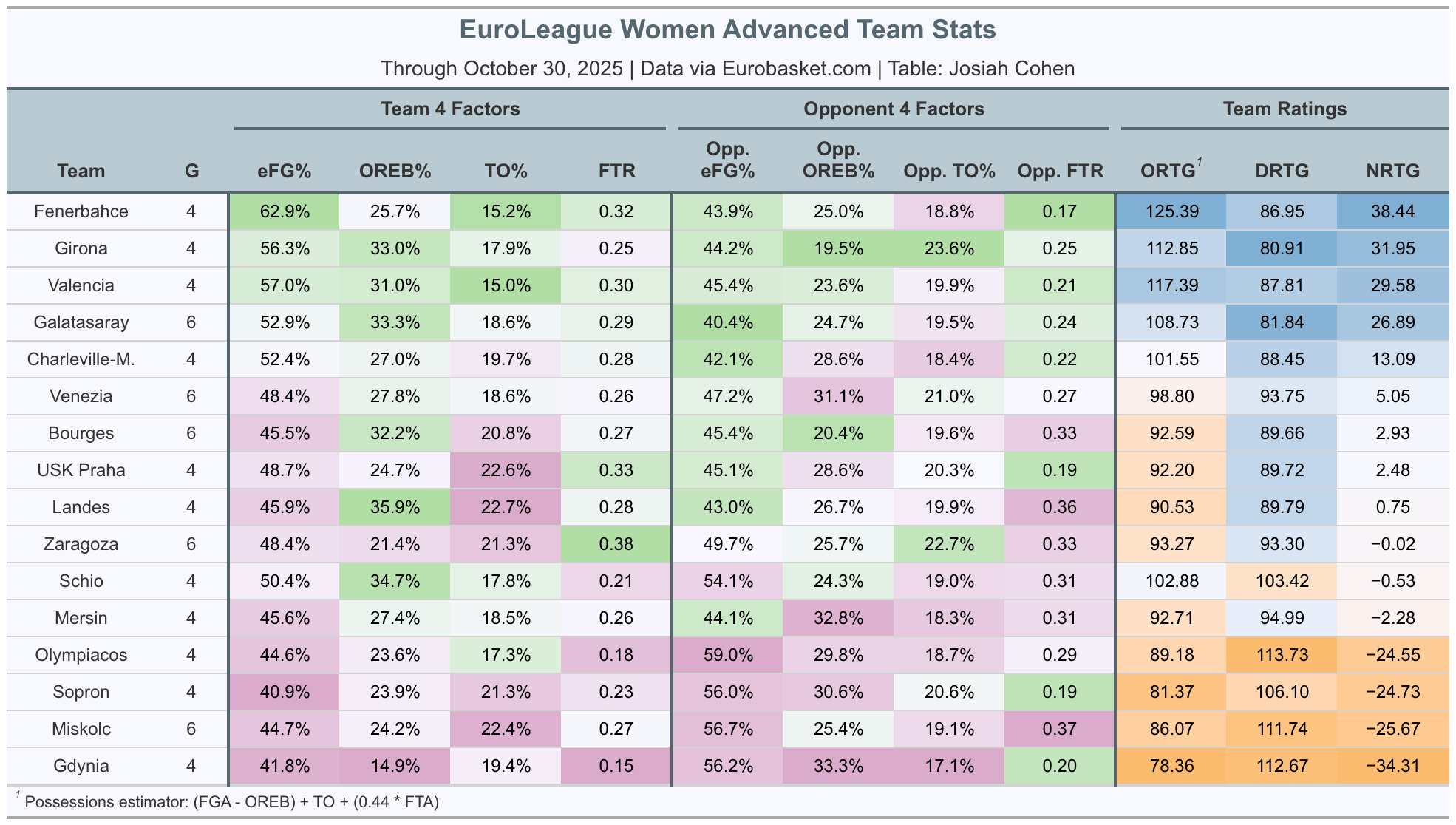
A ton of basketball watching. EuroLeague and other European competitions, WNBL, NCAA . . . the list goes on. It’ll be interesting to find the balance between offseason Valkyries coverage and more prospect watching. I need not plug anything, because I don’t know if my stuff will be any good, but I’ll just say there’s never a bad time to watch women’s and men’s basketball.
I know you’re a big F5 fan, so I’ll ask you his go to question, What’s one thing you can’t live without during the WNBA season?
A great question from a great source (RIP). While pbpstats, Basketball-Reference, and HerHoopStats are all bookmarked for me, I can get most of my stats myself. So I’ll actually say WNBA League Pass, which is attractively priced and simply a great repository for watching games back, which is integral to any film-watching process. They also do an excellent job turning around a concise version of games (full game, just without commercial breaks) pretty soon after they end, which is impressive work. Very worth the subscription, and I probably spent more time in League Pass during the season than anywhere else.